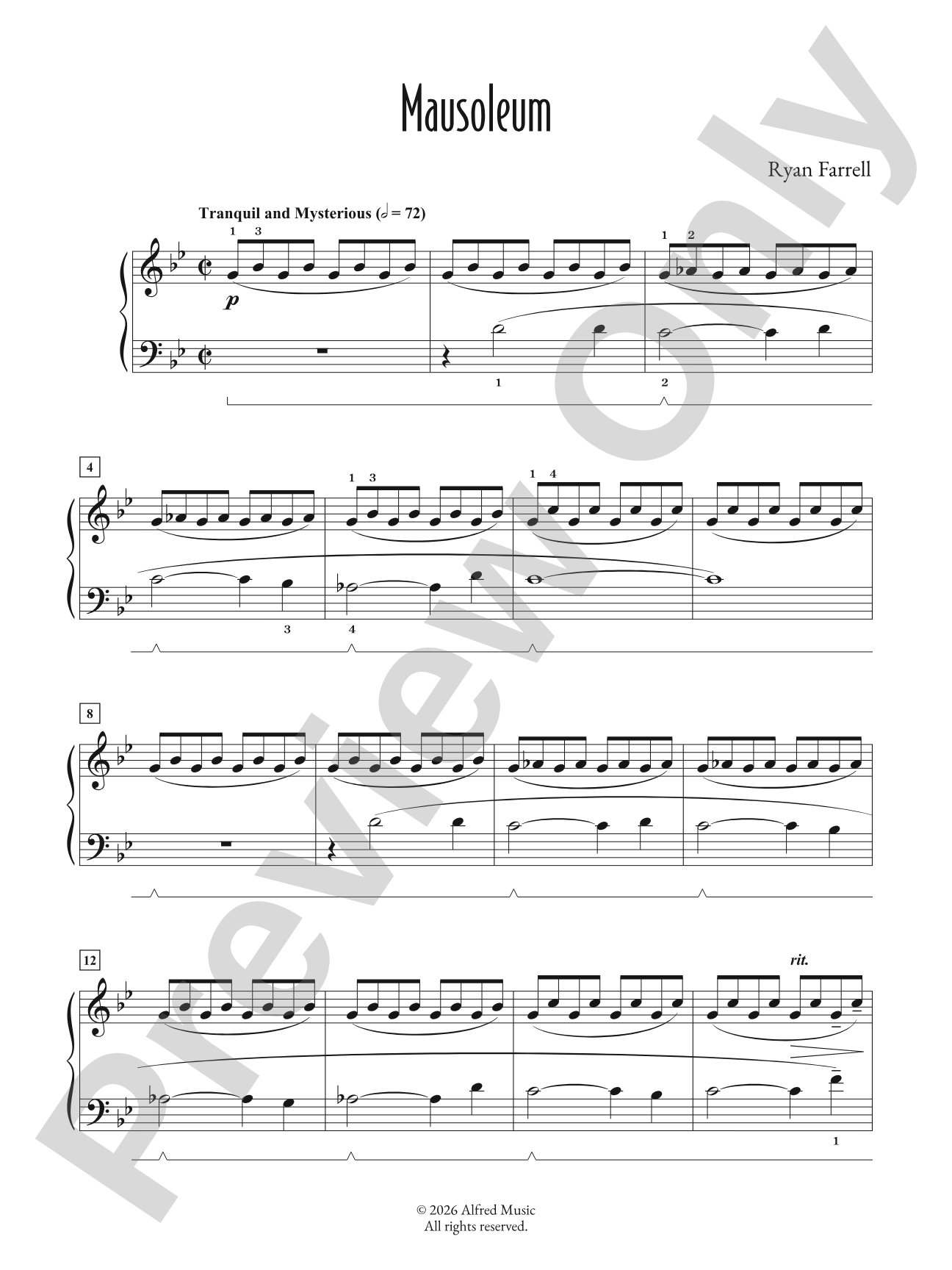
This eerie minimalist piece creates a haunting atmosphere as the left-hand melody wanders in unexpected rhythms. A repeating two-note pattern in the right hand provides steady motion and an unsettling sense of momentum.
Discover MakeMusic Cloud: thousands of interactive titles your students can play along with today.
Ryan Farrell is a Cleveland-based composer and pianist who earned both bachelor's and master's degrees in music composition from Cleveland State University. Beyond the concert hall, he is widely recognized as the bassist and visual architect of Mushroomhead, the experimental heavy metal band that has toured internationally for decades. His dual life in classical composition and avant-garde rock informs a compositional voice that bridges accessible minimalism with textural sophistication.
Farrell has taught music in the Cleveland area for more than twenty years, channeling his experience as both performer and educator into works that challenge intermediate players. He is also an accomplished visual artist working in charcoal, acrylic, and oil. For more information, visit www.ryanfarrellartist.com.
Why we love this
Farrell's minimalist aesthetic avoids the trap of being understated or easy. The asymmetrical left-hand melodic phrases demand listening and precision, while the hypnotic right-hand ostinato creates a psychological tension that students actually feel. It's a piece that rewards both technical control and interpretive choice, making it equally compelling in a student recital or a contemporary music program.
What to expect
Mausoleum envelops the performer and listener in a cool, deliberate quiet. The left hand wanders like someone moving through an unfamiliar space, while the right hand's insistent pulse suggests time passing inexorably. Together they create an unsettling beauty that lingers long after the final note.
Who it's for
Intermediate pianists seeking repertoire that develops interpretive maturity without excessive technical demand. This piece suits students ready to think about color, pacing, and the psychology of minimalism rather than just fingering patterns.
How to get the most out of it
Shape the left-hand melody as a single arc across irregular phrase lengths rather than treating each gesture as isolated. This counteracts the natural temptation to reset between rhythmic disruptions.
Let the right-hand two-note pattern maintain unwavering steadiness. Any wavering in tempo or dynamics here destabilizes the entire piece's foundation.
Experiment with dynamic contrast between hands. The left-hand story can emerge distinctly if the right hand doesn't fight for attention.
Explore silence or breath-like pauses before re-entering the left-hand melody. The eerie quality deepens when listeners feel genuine uncertainty about what comes next.
How to use it
Program this alongside other contemporary solo works to frame a recital around texture and atmosphere rather than virtuosity. It works particularly well as a prelude to a more dramatic piece, or as a standalone moment that gives an audience permission to sit with discomfort and curiosity.
Skills your students will build
Playing polyrhythmic textures with clear hand independence
Maintaining ostinato patterns with rhythmic precision and tonal consistency
Shaping asymmetrical melodic phrases without traditional barline anchors
Creating harmonic color through minimal material
Controlling dynamics and articulation to build and sustain tension
You May Also Like
Scan to Complete Your Purchase
Use your phone's camera to scan the code below
You'll log in on your phone and the order will be added to your account