Mattinata Sheet Music Preview

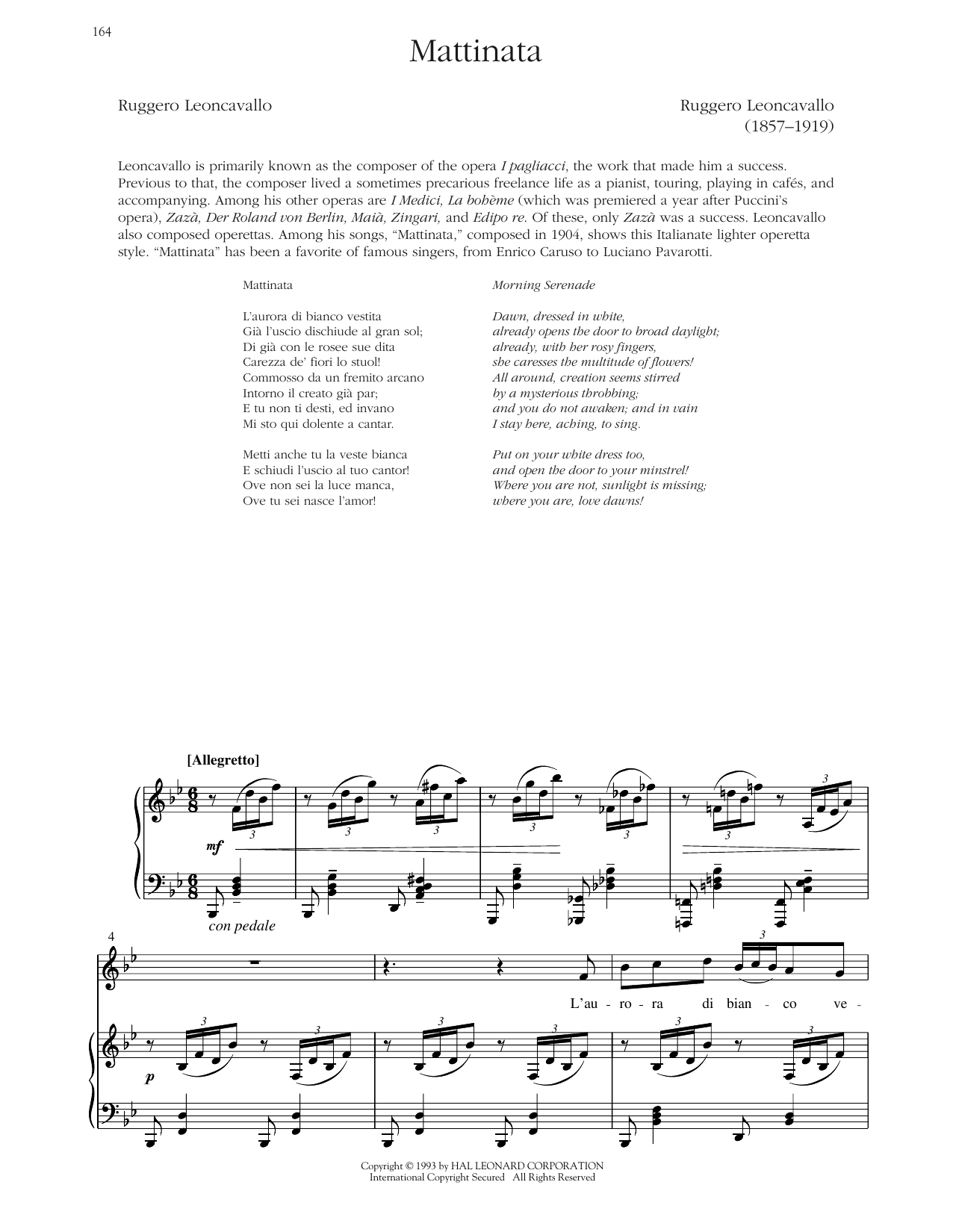
Mattinata: Piano Vocal

By Ruggero Leoncavallo / Edited by Richard Walters

Item: 35-DS01821529

Digital Download
$5.99
Description

Mattinata: Piano Vocal isn't in MakeMusic Cloud just yet...but it could be. Let us know you'd like to see it, and you'll help shape what comes next. In the meantime, start a free trial and dive into thousands of interactive titles your students can play along with today.

Sample Audio
No sample audio found.
Sample Video
Additional Details
Publisher: Hal Leonard
Page Count: 4
SKU: 35-DS01821529

More about this title

About the Composer: Ruggero Leoncavallo

Ruggero Leoncavallo (1857-1919) stands as one of Italy's most prolific opera composers, though his output extended well beyond the stage. While his operas, particularly "La bohème" and "Pagliacci," secured his place in the repertoire, Leoncavallo was equally invested in composing art songs and vocal works for drawing rooms and concert halls. He understood the intimate power of a well-crafted melody paired with piano accompaniment.

Matinata exemplifies his gift for creating melodies that lodge themselves in memory. Written early in his career, the song showcases his talent for balancing Italian lyricism with accessible charm. For music students and singers, Leoncavallo's vocal writing offers a masterclass in how to shape a phrase without requiring extensive dramatic baggage.

Why we love this

This song delivers immediate musical gratification without overselling itself. The melody is genuinely beautiful, the accompaniment provides natural support without demanding a virtuosic pianist, and the four-page length makes it realistic for solo recitals, auditions, or informal performances. It sits squarely in the "actually singable" category for mature students with solid technique but limited operatic experience.

What to expect

Mattinata arrives like morning light: warm, unhurried, and capable of shifting from intimate reflection to gentle brightness. The melody breathes with the ease of natural speech set to music, and the accompanying piano maintains a conversational presence without commanding attention. You're inviting listeners into a moment rather than demanding they witness a spectacle.

Who it's for

This song suits mature singers (high school through adult) with solid breath support, reliable intonation, and comfort in the Italian lyric tradition. It works equally well for singers preparing for college auditions, community recitals, or vocal study as a piece that demands musicality without requiring dramatic interpretation.

How to get the most out of it

  • Treat the opening phrase as an announcement rather than a climax. The beauty unfolds gradually, so resist the impulse to pour everything into the first few bars.
  • Work with your pianist on the rhythmic flexibility inherent in the accompaniment. This style of song often benefits from slight elasticity that feels conversational rather than metered.
  • Shape the text as you would speak it, even as the melody rises and falls. Leoncavallo's phrases follow Italian word stress and breath patterns, not arbitrary compositional whims.
  • Check the dynamic markings carefully, particularly in passages marked piano or pianissimo. The song's intimacy depends on your ability to carry a lyrical line at softer volumes.

How to use it

Pair this with other Italian art songs or operatic excerpts for a focused recital set. Its moderate length and accessible character make it ideal filler between weightier repertoire, or lead it as a gentle opening number for a student vocal recital. It also serves remarkably well as a teaching piece for students first encountering formal art song structure.

Skills your students will build

  • Sustaining lyrical lines across longer phrases without excessive vibrato
  • Responding to Italian text stress and vowel shapes within a melodic framework
  • Collaborating with a pianist to balance vocal line with accompaniment
  • Navigating dynamic contrast in a single-stanza form
  • Maintaining musical shape through repetitive harmonic structures

You May Also Like