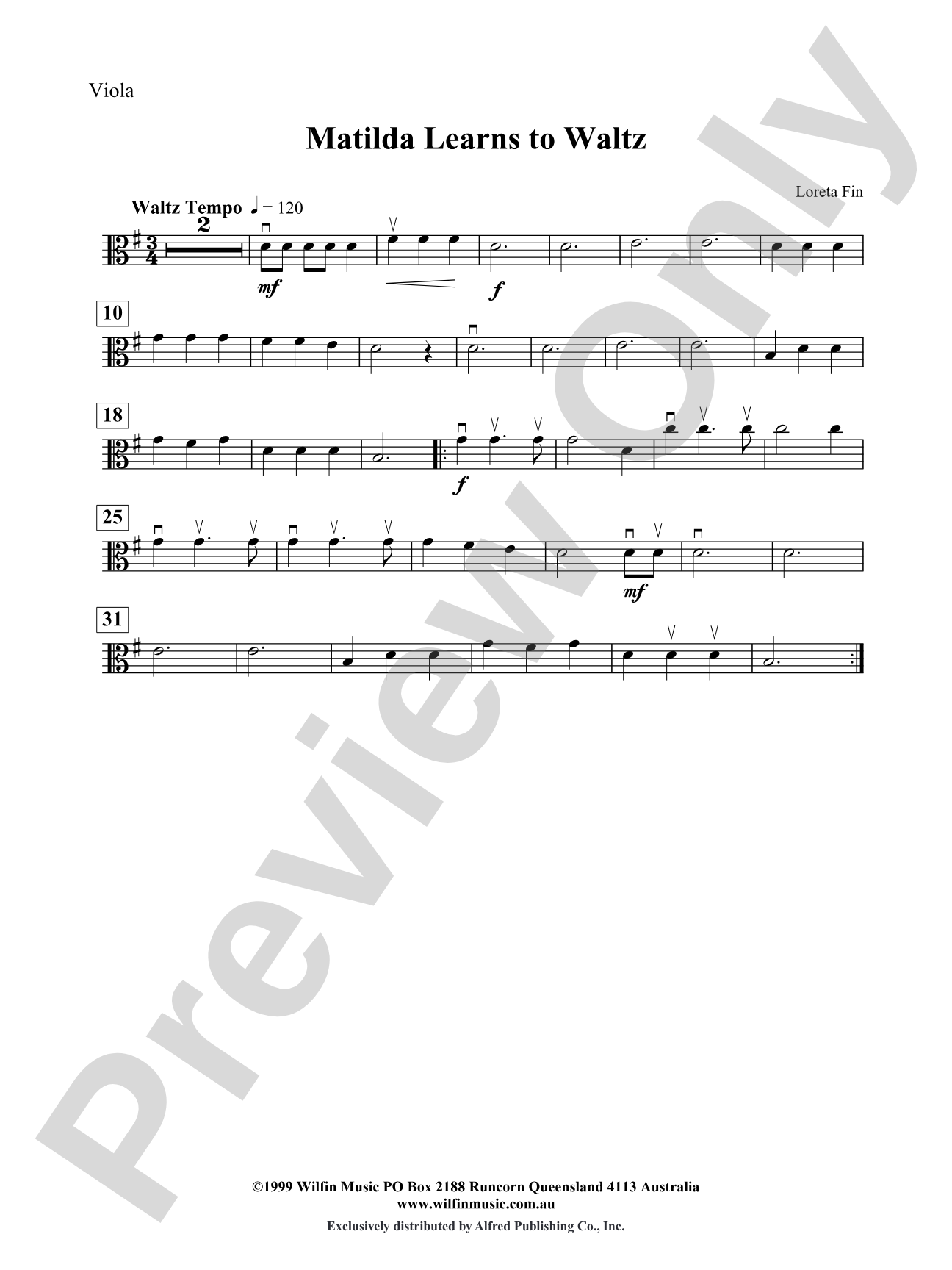
Matilda Learns to Waltz: Viola Sheet Music Preview

Matilda Learns to Waltz: Viola

Arr. Loreta Fin

Grade: 1-1.5

Item: 76-PC-0000002_VA1

Digital Download
$5.99
Description
Great piece that is fun, easy and short. Clever adaptation to a waltz of the famous Australian tune, "Waltzing Matilda".

Matilda Learns to Waltz: Viola isn't in MakeMusic Cloud just yet...but it could be. Let us know you'd like to see it, and you'll help shape what comes next. In the meantime, start a free trial and dive into thousands of interactive titles your students can play along with today.

Sample Audio
No sample audio found.
Sample Video
Additional Details
Series: Wilfin String Orchestra: Young String Ensemble Series
Publisher: Wilfin Music
Page Count: 66
SKU: 76-PC-0000002_VA1

More about this title

About the Arranger: Loreta Fin

Loreta Fin

Loreta Fin AM is an accomplished violist, educator, and composer based in Australia with deep roots in string pedagogy. She studied at the Sydney Conservatorium of Music, served as Principal Viola player with the Queensland Pops Orchestra for over 25 years, and has directed the strings program at Somerville House School in Brisbane since 1993. Her work as an adjudicator, presenter at national music conferences, and examiner with the Australian Music Examinations Board reflects her standing in the string teaching community.

Fin has composed more than 100 works for string orchestra, published globally by Alfred Music, and founded a Beginner String Ensemble Series that makes early-level repertoire accessible to young players. Her contributions to string education earned her the National Award for Services to Music and String Teaching in Australia, and she was nominated for the ARIA "Best Teacher" award. Since 2015, she has regularly conducted state and national honours ensembles programs, bringing her vision of musical excellence to developing musicians across Australia and internationally.

Why we love this

Fin has written this arrangement with a string director's eye for what young players need: a recognizable tune that captures their interest, straightforward rhythms that build confidence, and a waltz structure that introduces 3/4 meter without overwhelming the ensemble. The clever adaptation of "Waltzing Matilda" honors the source material while making it entirely new, giving students a fresh reason to engage with a familiar Australian icon.

What to expect

Dancing and lighthearted, this waltz moves with an easy, buoyant lilt that invites players into the joy of ensemble music. The familiar tune grounds the experience in something students may already know, while the new waltz arrangement makes it feel like a discovery they're making together.

Who it's for

This piece suits beginning string orchestras in grades 1 through early 1.5 who are discovering ensemble playing and the pleasure of recognizable melodies. Conductors working with mixed-ability groups will find the accessible writing lets younger or less experienced players contribute meaningfully while still challenging advancing musicians to shape phrasing and balance.

How to get the most out of it

  • Establish a steady, lilting waltz pulse from the downbeat. Young orchestras often rush the second beat; conduct with a clear three-count to anchor the ensemble rhythm.
  • Balance the melodic line across all parts. The tune may migrate between sections, so rehearse with full awareness of who holds it at each moment so no voice disappears.
  • Use the straightforward key and limited range to focus on tone quality rather than technical scrambling. Encourage sustained, singing lines even on the simplest passages.
  • Let the length of the piece work in your favor. Its brevity means players stay engaged and focused throughout; use that momentum to build musicianship before longer works demand it.

How to use it

Program this early in a concert to establish audience warmth and engagement, or use it as the final piece of a spring concert to leave the hall smiling. It pairs well alongside other accessible young ensemble repertoire, and its short duration makes it ideal for pops concerts, community performances, or school assemblies where you want immediate musical impact without lengthy rehearsal investment.

Skills your students will build

  • Reading and performing in 3/4 meter
  • Sustaining smooth, singing lines across bow changes
  • Balance and blend in an ensemble texture
  • Listening to the melodic line across different sections
  • Confidence in public performance through familiar, approachable material

You May Also Like