
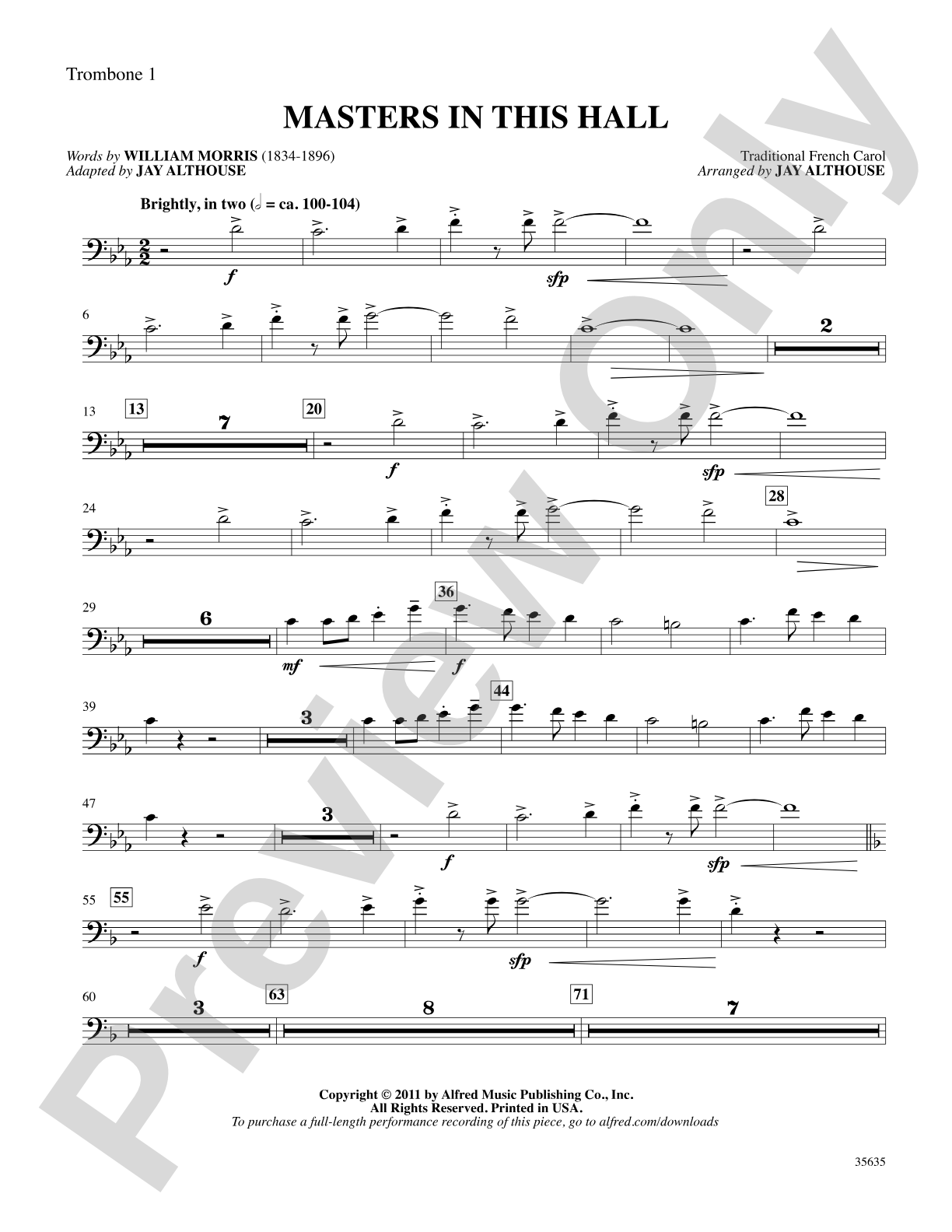

Masters in This Hall: 1st Trombone: Choral SoundPax
Traditional French Carol, words by William Morris / arr. Jay Althouse
Item: 00-PC-0014962_TN1
$4.00
Pickup currently not available
Description
Fresh-sounding harmonies and a rich accompaniment drive this powerful arrangement to a majestic and dramatic finish. Sure to be a holiday concert highlight.


Don't just read it, hear it, play along with it, and watch your students grow with it. In MakeMusic Cloud, Masters in This Hall: 1st Trombone: Choral SoundPax comes alive with professional accompaniment, adjustable tempo, and built-in practice tools that turn solo practice into real progress.
Open in the Player
Jump straight in and assign it today.
Start Your Free Trial
Open this title and explore the full library in minutes.
Sample Audio
1
Audio File
--:--
0:00
0:00
Sample Video
No sample videos found.
Additional Details
Series:
Alfred Choral Designs
Publisher:
Alfred Music
Page Count:
28
SKU:
00-PC-0014962_TN1
Instrumentation:
SoundPax
More about this title
About the Arranger: Jay Althouse

Jay Althouse holds degrees in Music Education and Music from Indiana University of Pennsylvania, where he was honored with the Distinguished Alumni award. His career spans both publishing and composition; he spent eight years as a rights and licenses administrator at a major educational music publisher and served on the Executive Board of the Music Publishers Association of America. As a composer, he has over 800 choral works in print and is a writer member of ASCAP, a regular recipient of the ASCAP Special Award for his contributions to standard music.
Beyond his compositional output, Althouse has shaped music education through co-authored instructional resources including The Complete Choral Warm-up Book and Accent on Composers, as well as classroom materials like Ready to Read Music and Sixty Music Quizzes. He has collaborated with his wife, Sally K. Albrecht, on children's musicals and vocal collections. His arrangement and compilation work includes Folk Songs for Solo Singers and I Hear America Singing, the latter performed by the San Francisco Girls and Boys Choirs at President Barack Obama's inauguration in 2009. Based in North Carolina, he serves on the National Advisory Board of the Folk Art Society of America.
Why we love this
Althouse crafts arrangements that respect the source material while infusing it with contemporary harmonic sophistication and dramatic arc. The rich accompaniment here carries the piece forward with momentum, allowing your singers to focus on the emotional sweep rather than fighting against thin support. This is the kind of arrangement that lands solidly in concert and feels rewarding to rehearse.
What to expect
The fresh harmonies create unexpected brightness within a traditional carol framework, giving the piece a contemporary lift without abandoning its roots. As it moves toward the majestic, dramatic conclusion, the weight of the full arrangement becomes unmistakable. This is music that feels both welcoming and ambitious.
Who it's for
Choirs at intermediate to advanced levels who want a Christmas arrangement with harmonic substance and polished presentation. This works for school choirs, community ensembles, and church groups aiming for a concert that feels sophisticated rather than simplistic. Holiday audiences expect warmth and familiarity; this version delivers both without compromise.
How to get the most out of it
- Balance the accompaniment carefully during rehearsals so singers hear the harmonic movement without being overwhelmed; this foundation will steady intonation across the ensemble.
- Shape the arc toward the dramatic finish by gradually building intensity through the middle section; mark dynamics in rehearsal to ensure the climax doesn't arrive prematurely.
- Blend treble voices distinctly in the opening measures to establish the fresh sound, then add lower voices progressively so the harmonic layers register clearly.
- Use the recorded accompaniment early and often; it locks the ensemble into the piece's rhythmic and harmonic profile before you refine expression and nuance.
How to use it
Program this as a centerpiece in your holiday concert second half, where it can anchor the emotional arc between lighter seasonal fare and a closing processional. The dramatic finish makes it an excellent penultimate piece before a final selection. Consider pairing it with unaccompanied sacred work earlier in the program to highlight the arrangement's orchestral richness by contrast.
Skills your students will build
- Singing sustained lines over moving harmonic accompaniment
- Blending multiple voice parts while maintaining individual line clarity
- Responding to dynamic shape and dramatic pacing over a longer formal structure
- Following instrumental accompaniment cues and building ensemble cohesion with recorded support