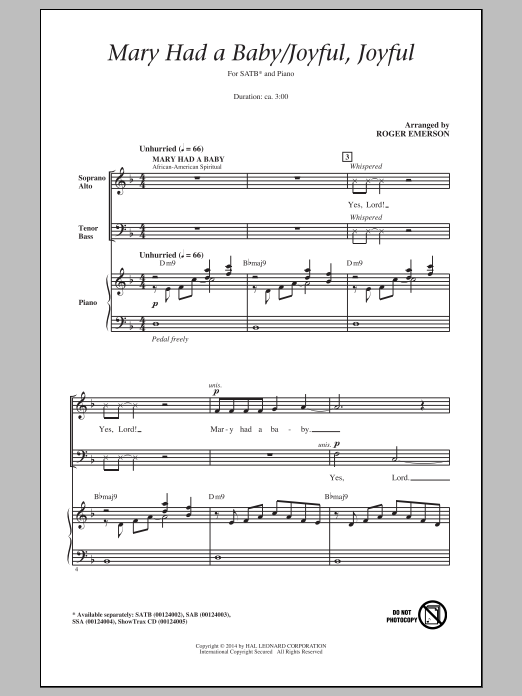
Mary Had A Baby / Joyful, Joyful Sheet Music Preview

Mary Had A Baby / Joyful, Joyful: SATB Choral Octavo

By Ludwig Van Beethoven / As performed by Edward Hodges / Arranged by Roger Emerson

Item: 35-DS00288731

Digital Download
$2.99
Description

Mary Had A Baby / Joyful, Joyful: SATB Choral Octavo isn't in MakeMusic Cloud just yet...but it could be. Let us know you'd like to see it, and you'll help shape what comes next. In the meantime, start a free trial and dive into thousands of interactive titles your students can play along with today.

Sample Audio
No sample audio found.
Sample Video
Additional Details
Publisher: Hal Leonard
Page Count: 8
SKU: 35-DS00288731

More about this title

About the Composer: Ludwig Van Beethoven

Ludwig van Beethoven (1770–1827) transformed Western music through his revolutionary approach to form, harmony, and orchestration. His nine symphonies, thirty-two piano sonatas, and sacred choral works established him as a towering figure whose influence shaped every composer who followed. Beethoven's ability to express profound emotional and spiritual depths made his music enduringly relevant to choirs seeking repertoire that moves both singer and listener.

Why we love this

Roger Emerson's arrangement fuses two distinct musical traditions into a cohesive whole, pairing the spiritual depth of "Joyful, Joyful" (derived from Beethoven's Ninth Symphony) with the folk warmth of "Mary Had A Baby." The result feels neither forced nor derivative; instead, it creates a festive Christmas offering that works equally well for choirs with limited rehearsal time or those seeking a meaningful alternative to standard holiday fare.

What to expect

The music radiates quiet reverence before building toward exuberance. Singing these eight pages feels like discovering something sacred within something celebratory; the blend of spiritual melody and festive energy creates warmth without sentimentality.

Who it's for

This arrangement suits intermediate to advanced high school choirs, college ensembles, and community choirs preparing holiday programs. It works especially well for directors seeking a piece that bridges classical sophistication with accessible joy, appealing to audiences familiar with both Beethoven and traditional Christmas repertoire.

How to get the most out of it

  • Balance the familiar Beethoven melody in the soprano line with supporting harmonies from the lower voices; the arrangement gains its character when listeners recognize the tune but hear it enriched by the fuller voicing.
  • Shape phrase endings with gentle releases rather than hard stops, allowing the spiritual character of both melodies to breathe across the eight pages.
  • Blend the transition between the two melodic ideas; mark a subtle tempo adjustment if needed to honor the shift from the reflective opening to the joyful climax.

How to use it

Position this as a bridge between your classical and popular holiday selections, perhaps pairing it with a cappella arrangements or instrumental works from the same season. Its moderate length makes it ideal for a concert's opening or closing moment, where it can establish both elegance and genuine holiday spirit.

Skills your students will build

  • Balancing familiar melodies with secondary harmonic lines
  • Sustaining legato phrasing across longer phrases
  • Managing dynamic shape and phrase architecture in four-part writing
  • Blending two distinct musical traditions into a unified whole

You May Also Like