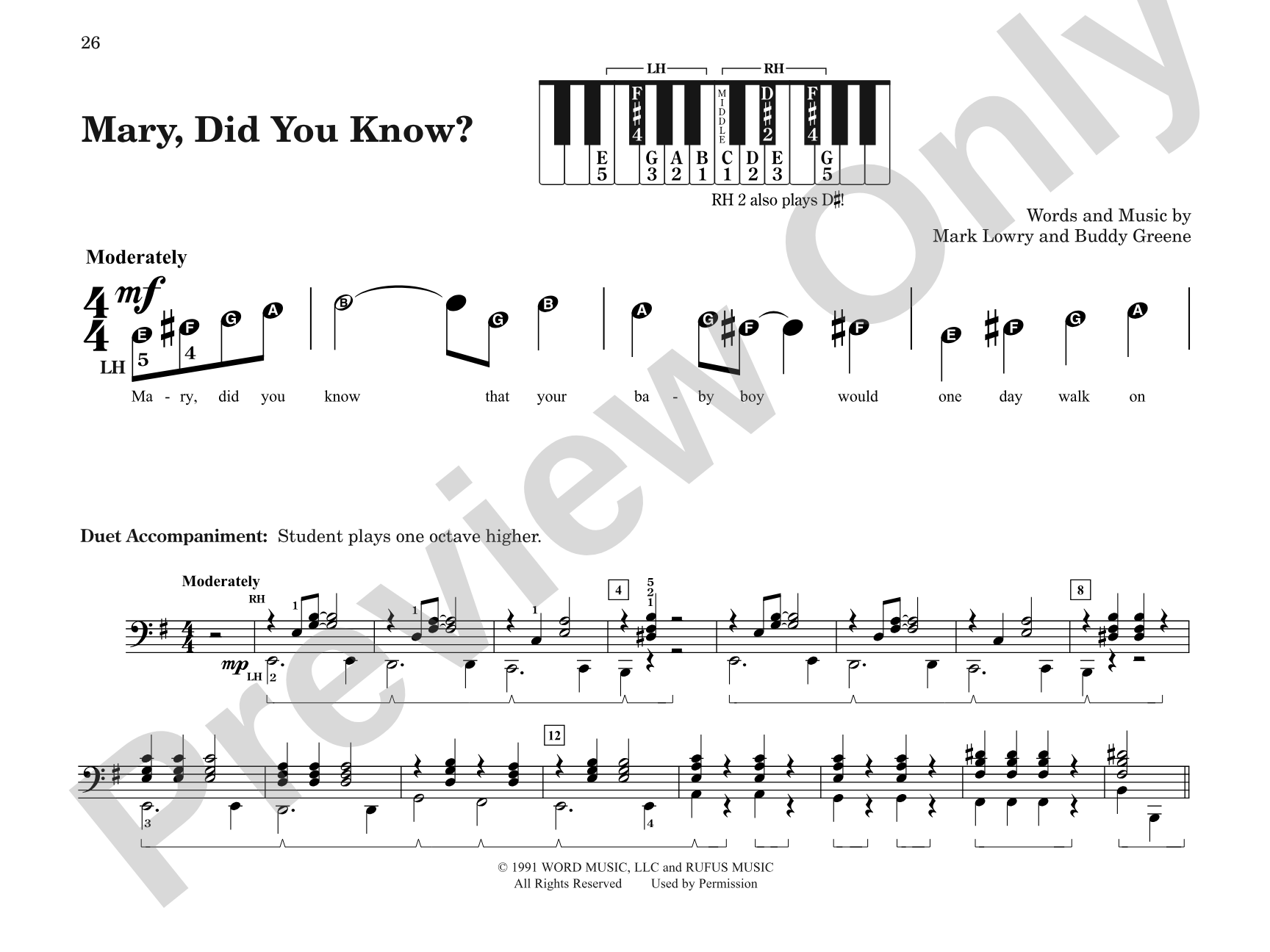
Mary, Did You Know? - Piano Solo with Lyrics (with Optional Duet Accompaniments) Sheet Music Preview

Mary, Did You Know? - Piano Solo with Lyrics (with Optional Duet Accompaniments): Piano Solo with Lyrics

Twelve Favorite Praise Songs for the Beginning Pianist

Arr. Gayle Kowalchyk and E. L. Lancaster

Level: Pre-reading

Item: 00-PS-0017266

Digital Download
$7.99

One moment…

Description
My First Praise Songs is designed for those students who have had only a few weeks of study, and consequently have limited skills in note-reading. Some of these pre-reading solos are in the Middle C Position with the melody divided between the hands. Students may be unfamiliar with the rhythmic notation of some of the pieces. However, they will usually play the music correctly by memory, or if not, the rhythms can be quickly learned by rote. All of the pieces include a duet accompaniment part for parents or the teacher. Titles: Because He Lives * Here I Am to Worship (Light of the World) * How Great Is Our God * In My Life, Lord, Be Glorified * Lord, I Lift Your Name on High * Mary, Did You Know? * Praise the Name of Jesus * Shout to the Lord * Shout to the North * We Fall Down * Worthy Is the Lamb * You Are My All in All. A Federation Festivals 2024-2028 selection.

Mary, Did You Know? - Piano Solo with Lyrics (with Optional Duet Accompaniments): Piano Solo with Lyrics isn't in MakeMusic Cloud just yet...but it could be. Let us know you'd like to see it, and you'll help shape what comes next. In the meantime, start a free trial and dive into thousands of interactive titles your students can play along with today.

Sample Audio
No sample audio found.
Sample Video
Additional Details
Series: My First...
Publisher: Alfred Music
Page Count: 32
SKU: 00-PS-0017266

More about this title

About the Composer: Mark Lowry

Mark Lowry is a prolific composer and lyricist whose work spans contemporary Christian music, gospel, and popular song. His compositions have reached millions through church services, radio broadcasts, and recordings; "Mary, Did You Know?" stands among his most recognized works, performed by artists across multiple genres and recorded hundreds of times since its 1991 composition.

Why we love this

This arrangement opens contemporary Christian repertoire to beginners in their first weeks of study without sacrificing the emotional weight of the original melodies. The duet accompaniment transforms solo practice into a shared musical experience, making early lessons feel less isolating and giving students immediate access to music that matters in their faith communities.

What to expect

These arrangements carry the warmth and accessibility of songs sung in worship settings, yet they're freshly imagined for solo piano. Each piece invites thoughtful, unhurried playing; the presence of duet accompaniment transforms what could feel like a bare beginning-level solo into something that feels complete and full.

Who it's for

This collection suits piano students in their first month or two of study who benefit from familiar, emotionally resonant melodies and minimal note-reading demands. It also works well for students returning to piano after time away, or those preparing for faith-based recitals and ensemble performance opportunities.

How to get the most out of it

  • Play through the duet accompaniment yourself first, or recruit a parent or colleague to play it. Hearing the full harmonic picture helps students understand how their melody fits within the song's structure, even if they're reading only the melodic line.
  • When rhythmic notation feels unfamiliar, sing or speak the rhythm aloud before playing. Students often absorb the timing through their voice before their fingers trust it on the keyboard.
  • Let memory work for you. If a student stumbles over notation, pause and play it through from memory two or three times. Return to reading after confidence returns.
  • Keep the tempo conversational. These melodies are lyrical and song-like; rushing them flattens their character. A slower, singing pace invites students to listen to themselves.

How to use it

Program pieces from this collection in church recitals, faith-based school concerts, or family showcase events where contemporary Christian music is expected and celebrated. These titles also work well as performance assignments for students preparing for youth group or youth choir participation, giving them instrumental fluency with songs they may encounter vocally.

Skills your students will build

  • Reading melody in treble clef within a limited range
  • Playing with the melody divided between both hands
  • Building rhythm accuracy through rote and repetition
  • Sustaining legato phrasing and singing tone on piano
  • Ensemble listening and rhythmic coordination with accompaniment

You May Also Like