
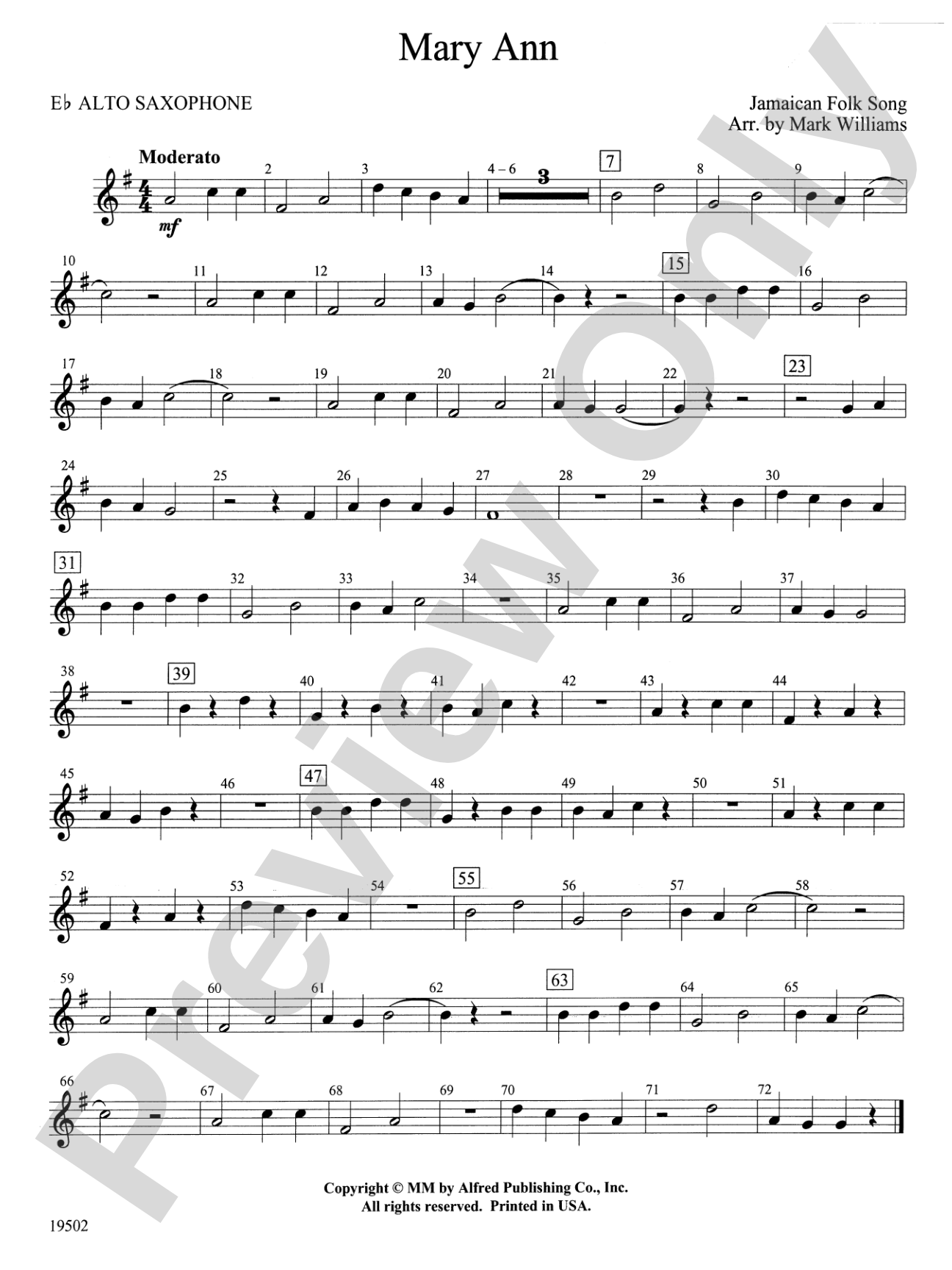

Mary Ann: E-flat Alto Saxophone
Arr. Mark Williams
Grade: 1 (Very Easy)
Item: 00-PC-0000320_AX1
$3.00
Pickup currently not available
Description
This happy Jamaican folk song simply sparkles in this very easy arrangement by Mark Williams. Using only six notes, with eighth notes limited to the percussion part, this is an excellent selection for your beginning band's first concert. The melody is passed through every section, enabling all students to participate in the fun. Correlated with Accent on Achievement, Book 1, page 10, this arrangement will be a favorite of students and audiences alike.


Don't just read it, hear it, play along with it, and watch your students grow with it. In MakeMusic Cloud, Mary Ann: E-flat Alto Saxophone comes alive with professional accompaniment, adjustable tempo, and built-in practice tools that turn solo practice into real progress.
Open in the Player
Jump straight in and assign it today.
Start Your Free Trial
Open this title and explore the full library in minutes.
Sample Audio
1
Audio File
--:--
0:00
0:00
Sample Video
No sample videos found.
Additional Details
Series:
Accent on Achievement
Publisher:
Alfred Music
Page Count:
128
SKU:
00-PC-0000320_AX1
More about this title
About the Arranger: Mark Williams

Mark Williams shaped generations of young musicians through his prolific output for school bands and orchestras. A specialist in elementary band education who taught in Washington state for many years, he co-authored the Accent on Achievement Band Method and composed or arranged over 200 works performed in schools across North America and beyond. His credentials included a Bachelor of Arts in Education and Master of Education from Eastern Washington University, along with professional experience as a woodwind performer and arranger for the 560th Air Force Band.
Williams earned recognition from the Western International Band Clinic's Gralia Competition and multiple ASCAP Special Awards for his contributions to band, orchestra, and choral literature. As a clinician and guest conductor, he worked directly with students and teachers in 34 states, 5 Canadian provinces, and Australia. Beyond composing and arranging, he remained an active bassoon performer and served as Conductor and Artistic Director for the Spokane British Brass Band, bringing his philosophy of accessible, engaging music to life on the podium.
Why we love this
Beginning band directors know the challenge of finding music that genuinely excites first-year players while staying within their technical reach. This arrangement achieves that balance perfectly by limiting the palette to six notes and keeping rhythmic demands simple, yet the constant melodic exchange between sections gives every student real ownership of the music. The Jamaican folk melody carries enough character and warmth that audiences hear a complete musical experience, not a training exercise.
What to expect
Bright and unhurried, with the warmth of a familiar folk song that listeners recognize and enjoy. The piece moves freely between sections in a natural conversation, creating a sense of shared joy rather than formal precision.
Who it's for
Beginning concert bands working toward their first public performance need repertoire that builds confidence without overwhelming technical demands. This arrangement fits that moment perfectly, offering every player a chance to participate fully in a recognizable, joyful melody.
How to get the most out of it
- Emphasize steady eighth-note pulse in the percussion parts, as they carry the rhythmic responsibility while the band focuses on melody and simple accompaniment.
- Plan your melodic passes so each section gets a moment to shine; use this as an opportunity to celebrate individual section growth during rehearsal.
- Keep the tempo moderate and dance-like to honor the folk song's character without rushing; let the melody breathe.
- Balance is your friend here; resist the urge to let early sections play too loudly when passing the tune, so later sections sound equally confident when their turn comes.
How to use it
Program this early in your first concert season when students are still building fundamentals. It pairs well with other Grade 1 selections that emphasize different styles, giving your opening half personality and variety while keeping technical challenge consistent across the set.
Skills your students will build
- Reading notation at Grade 1 difficulty (limited pitch range and note values)
- Playing sustained melodic lines with consistent tone
- Listening and responding to melodic passes between sections
- Maintaining steady eighth-note accompaniment rhythms in percussion
- Understanding folk music traditions and arranging approaches
- Building confidence in ensemble performance contexts