
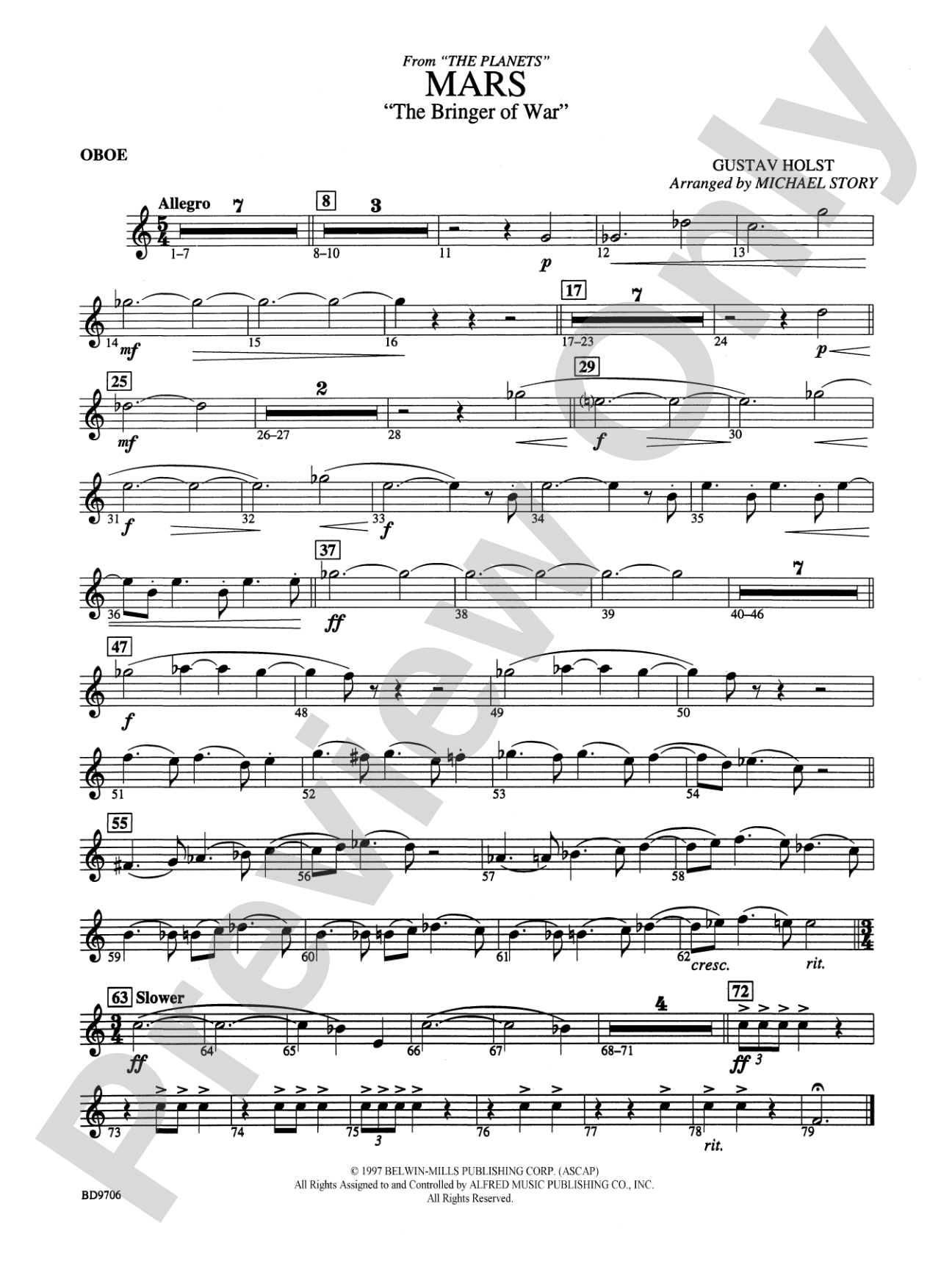

Mars ("The Bringer of War," from The Planets): Oboe
By Gustav Holst / arr. Michael Story
Grade: 3 (Medium Easy)
Item: 00-PC-0015592_O1
$3.00
Pickup currently not available
Description
In all of music literature, there is little that is more breathtaking in its raw musical power than this movement from Gustav Holst's The Planets. A thundering war theme introduces the work in a dramatic 5/4 meter with hugely successful harmonic and rhythmic counterpoint. Mars is guaranteed to bring your audience to its feet, resounding with applause! (3:16)


Don't just read it, hear it, play along with it, and watch your students grow with it. In MakeMusic Cloud, Mars ("The Bringer of War," from The Planets): Oboe comes alive with professional accompaniment, adjustable tempo, and built-in practice tools that turn solo practice into real progress.
Open in the Player
Jump straight in and assign it today.
Start Your Free Trial
Open this title and explore the full library in minutes.
Sample Audio
1
Audio File
--:--
0:00
0:00
Sample Video
No sample videos found.
Additional Details
Series:
Belwin Concert Band
Publisher:
Alfred Music
Page Count:
158
SKU:
00-PC-0015592_O1
More about this title
About the Composer: Gustav Holst
Gustav Holst (1874-1934) was an English composer whose orchestral suite The Planets stands as one of the most performed and recognizable works in classical music. Though trained in the Romantic tradition, Holst's harmonic language and structural innovations pushed beyond its conventions, and his willingness to experiment with unusual meters and tonal colors made him a modernist voice in early twentieth-century composition. His influence on music education was profound; he championed community music-making and wrote extensively for amateur and student ensembles, believing that access to great music should not be limited by skill level.
The Planets remains Holst's signature work and a cornerstone of the concert band and orchestra repertoire. Its seven movements each personify an astrological character through bold orchestration, memorable themes, and harmonic daring. Mars, the opening movement, exemplifies his gift for blending structural clarity with visceral emotional impact.
Why we love this
Michael Story's arrangement makes one of the most iconic pieces in all of music accessible to Grade 3 bands without sacrificing the raw kinetic energy that makes Mars unforgettable. The odd meter and counterpoint challenge young musicians in ways that feel purposeful rather than arbitrary, and the payoff of a performance that genuinely moves an audience is worth every rehearsal hour.
What to expect
Mars hits with unstoppable force. A pulsing, ominous rhythm in 5/4 carries a relentless war theme that feels both ancient and modern, building through layers of harmony and counterpoint until the whole ensemble seems to march forward as one. The piece bristles with rhythmic energy and harmonic tension that never lets the listener rest.
Who it's for
This arrangement is designed for Grade 3 concert bands ready to tackle a major masterwork without needing to simplify the musical content. It works for confident middle school ensembles and high school groups looking for a showpiece that combines historical significance with immediate audience impact.
How to get the most out of it
- Establish the 5/4 meter clearly in early rehearsals by conducting the divided beat (2+3 or 3+2, depending on your preference) and having the ensemble tap the pulse before playing. This meter will feel natural only after consistent exposure.
- Balance the war theme between sections so that no single instrument or choir drowns out the harmonic and rhythmic detail. The power comes from the density of voices, not from one part playing louder.
- Shape the dynamic arch of longer phrases rather than treating each measure in isolation. The piece's drama is cumulative, so resist the urge to peak too early.
- Lock the rhythm section (timpani, bass drum, low brass, and basses) so tightly that they feel like a single entity. This foundation lets the upper voices and countermelodies sit clearly on top.
How to use it
Program Mars as a concert opener or centerpiece. It establishes authority immediately and sets a high bar for musicianship and ensemble cohesion that the rest of your program can build from. It also pairs well thematically with other twentieth-century works or with classical repertoire that experiments with meter and harmony.
Skills your students will build
- Reading and maintaining 5/4 meter in a sustained ensemble context
- Executing rhythmic counterpoint between independent instrumental lines
- Building and shaping dynamic intensity over longer musical phrases
- Balancing harmonic layers so that multiple melodic ideas remain audible simultaneously
- Responding to a conductor's leadership of complex metric structures