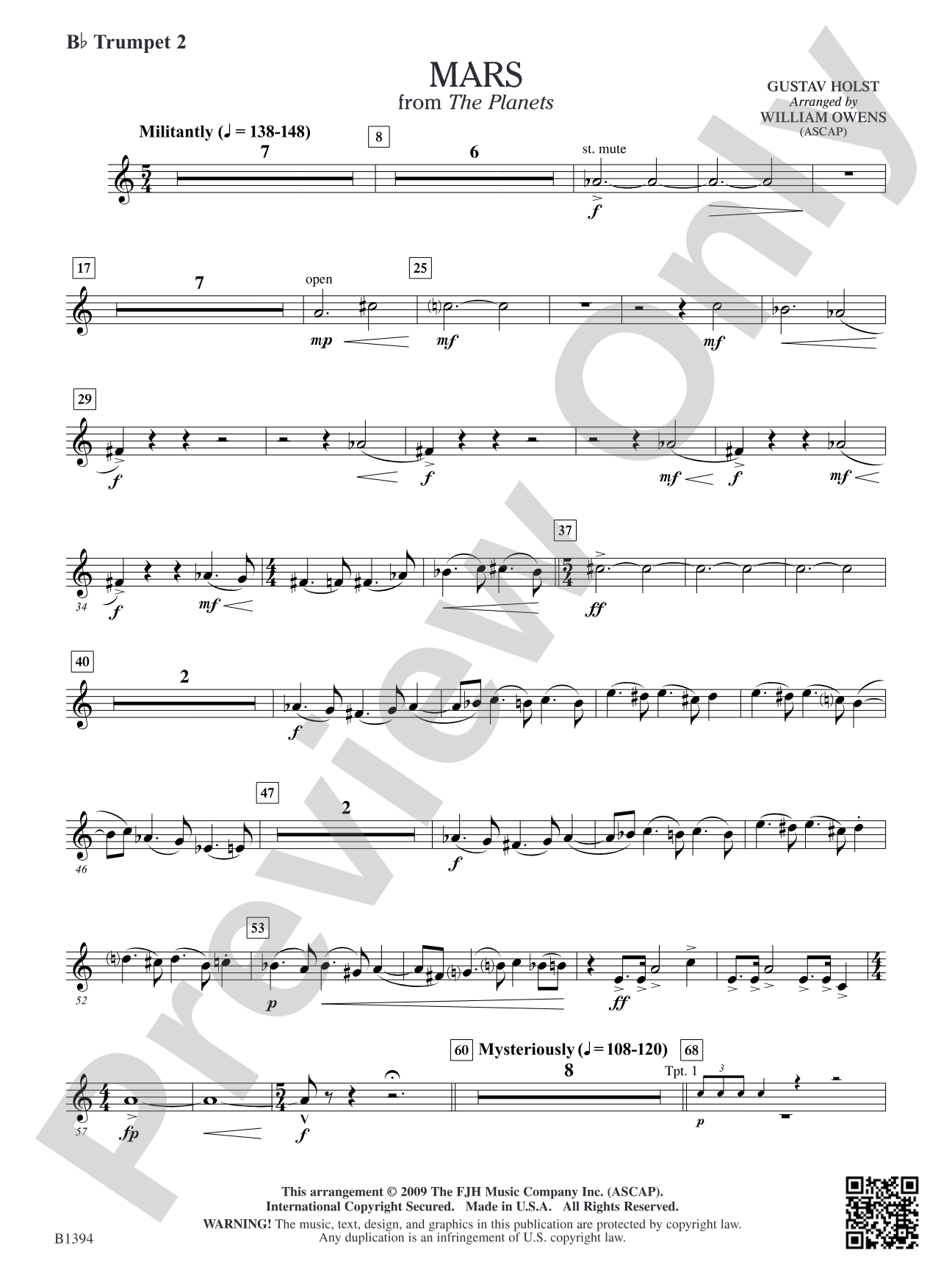
Mars from The Planets: B-flat Trumpet 2 Sheet Music Preview

Mars from The Planets: B-flat Trumpet 2

By Gustav Holst / arr. William Owens

Grade: 4

Item: 98-PC-DB1394_T2

Digital Download
$7.00
Description
This exceptional arrangement captures all the raw power and intensity of the first movement of The Planets by Gustav Holst. Shortened to be more accessible to younger groups this version uses clever orchestrating techniques to retain all the fire of the original. At times, you will think you are listening to the original version. Simply outstanding!

Mars from The Planets: B-flat Trumpet 2 isn't in MakeMusic Cloud just yet...but it could be. Let us know you'd like to see it, and you'll help shape what comes next. In the meantime, start a free trial and dive into thousands of interactive titles your students can play along with today.

Sample Audio
0:00
0:00
Sample Video
Additional Details
Series: FJH Symphonic Band
Publisher: The FJH Music Company, Inc.
SKU: 98-PC-DB1394_T2

More about this title

About the Composer: Gustav Holst

Gustav Holst (1874, 1934) was an English composer whose orchestral suite The Planets stands as one of the most performed and beloved works of the 20th century. Though he composed extensively across genres, operas, choral works, chamber music, it is The Planets that secured his legacy in music education and the concert hall. Holst's genius for orchestral color and his ability to distill complex harmonic language into visceral, immediate music made his work especially valuable for teaching composers and conductors about orchestration.

Beyond The Planets, Holst was a dedicated music educator who understood the needs of school ensembles and amateur musicians. His arrangements and original compositions for band and orchestra reflect that commitment to accessibility without compromise. He believed that music of substance belonged in the hands of young players, and his output demonstrates that conviction throughout.

Why we love this

William Owens has threaded a needle here that rarely gets threaded this cleanly: the arranger preserves the unmistakable identity of Holst's Mars while reimagining the orchestration to sit comfortably within the technical grasp of a Grade 4 band. The shortened form keeps the dramatic arc intact without losing the piece's aggressive, propulsive character. Your students will feel like they're playing the real thing, not a simplified version.

What to expect

Relentless forward momentum. The piece charges ahead with the swagger of military drums and the heft of full harmony, invoking everything the original Mars conveys: aggression tempered by architectural precision, power without chaos. There's a bruising quality to the sound that comes from harmonic density rather than technical pyrotechnics.

Who it's for

This is for directors working with Grade 4 bands who want to program something genuinely substantial without drowning in technical demands. Younger high school groups, strong middle school ensembles, and community bands will all find this version rewarding to prepare and thrilling to perform.

How to get the most out of it

  • Establish the opening unison march figure with clarity and weight before layering in harmonic support; rhythmic precision matters more than volume here.
  • Balance the sustained chords against any exposed melodic lines so inner voices don't disappear, Holst's orchestrations depend on hearing multiple layers at once.
  • Lean into the dynamic contrasts between sections; the shifts from piano to forte drive the narrative forward and keep the energy alive throughout.
  • Let the timpani and bass line anchor the pulse, especially during the driving sections where younger players can drift if the foundation wavers.

How to use it

Open a concert with this and you own the room immediately. It works equally well as a standalone dramatic statement or as part of a multi-movement thematic program. Consider pairing it with contrasting repertoire, something lyrical or introspective, to highlight its intensity by contrast.

Skills your students will build

  • Reading and executing rhythmic figures in compound meters without losing pulse stability
  • Maintaining accurate pitch and intonation under sustained harmonic pressure
  • Balancing dynamic contrast within a single section (bringing out inner melodic lines)
  • Responding to large-scale structural shifts (transitions between tempo and character)
  • Ensemble cohesion in fast, unison passages where individual mistakes register immediately

You May Also Like