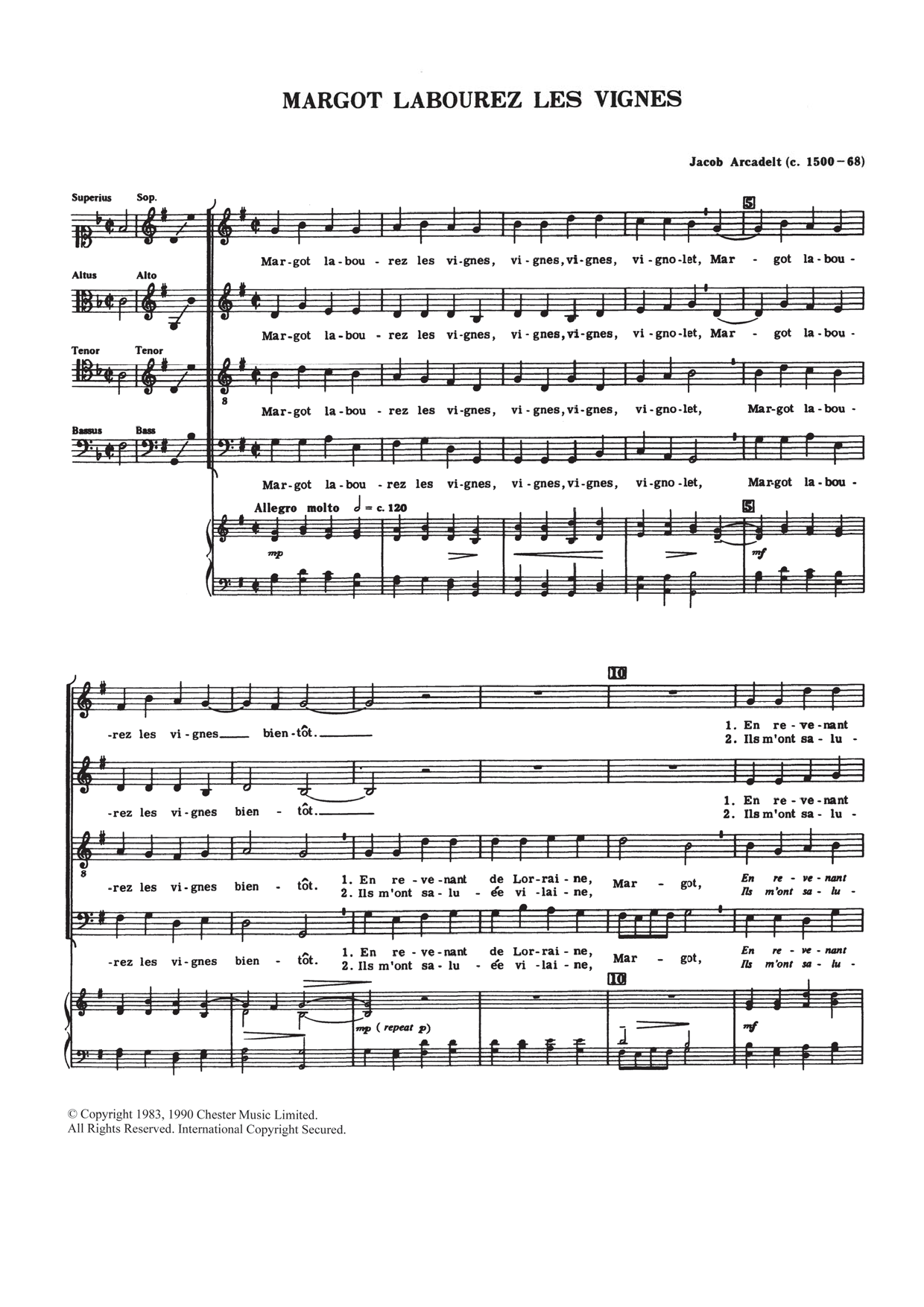
Margot Labourez Les Vignes Sheet Music Preview

Margot Labourez Les Vignes: Choral Octavo

As performed by Jacob Arcadelt / Arranged by Anthony Petti

Item: 35-DS00333617

Digital Download
$2.99
Description

Margot Labourez Les Vignes: Choral Octavo isn't in MakeMusic Cloud just yet...but it could be. Let us know you'd like to see it, and you'll help shape what comes next. In the meantime, start a free trial and dive into thousands of interactive titles your students can play along with today.

Sample Audio
No sample audio found.
Sample Video
Additional Details
Publisher: Hal Leonard
Page Count: 2
SKU: 35-DS00333617

More about this title

About the Artist: Jacob Arcadelt

Jacob Arcadelt (c. 1507–1568) was a Franco-Flemish composer whose madrigals and chansons defined the secular vocal music of the Renaissance. He spent much of his career in Italy, where he absorbed the lyrical sensibilities of Italian poetry while retaining the polyphonic sophistication of northern European training. His output became a model for how composers could balance textual clarity with intricate voice leading.

Arcadelt's music remains central to Renaissance choral pedagogy because it demonstrates how constraint breeds elegance. Working within the madrigal and chanson genres, he created works that challenge singers to navigate flowing lines while maintaining textual intelligibility, all without requiring virtuosic display.

Why we love this

Arcadelt's chansons sit at the sweet spot between accessibility and artistry. The counterpoint here is transparent enough that young singers can track their own line, yet sophisticated enough that directors hear real compositional thinking. This is the kind of piece that reminds students why Renaissance polyphony still matters.

What to expect

Gentle and conversational, like overhearing an elegant debate between friends. The voice lines move with lyrical grace, interweaving without urgency, and the harmonies unfold with the inevitability of natural speech set to music.

Who it's for

Choirs with intermediate sight-reading skills and some experience with Renaissance repertoire will find this an ideal step forward. It works especially well for mixed ensembles that need literature connecting the sacred and secular traditions.

How to get the most out of it

  • Let the text breathe naturally rather than metrically. Renaissance phrasing often transcends bar lines, so encourage singers to follow the vowel sounds and punctuation.
  • Balance the voices so that no single line dominates. In Arcadelt, every voice matters, and the blend should shift as material passes between parts.
  • Attend to the French language with care. Proper vowel placement clarifies the counterpoint and brings out the emotional content of the poetry.

How to use it

Pair this with other Renaissance chansons to create a focused thematic concert segment, or use it as a contrasting moment between weightier works. Its intimate scale makes it ideal for smaller concert formats or as a palate-cleanser in longer programs.

Skills your students will build

  • Renaissance polyphonic voice leading and independence
  • French language pronunciation and diction in singing
  • Phrase shaping across irregular melodic contours
  • Balancing multiple simultaneous melodic lines

You May Also Like