
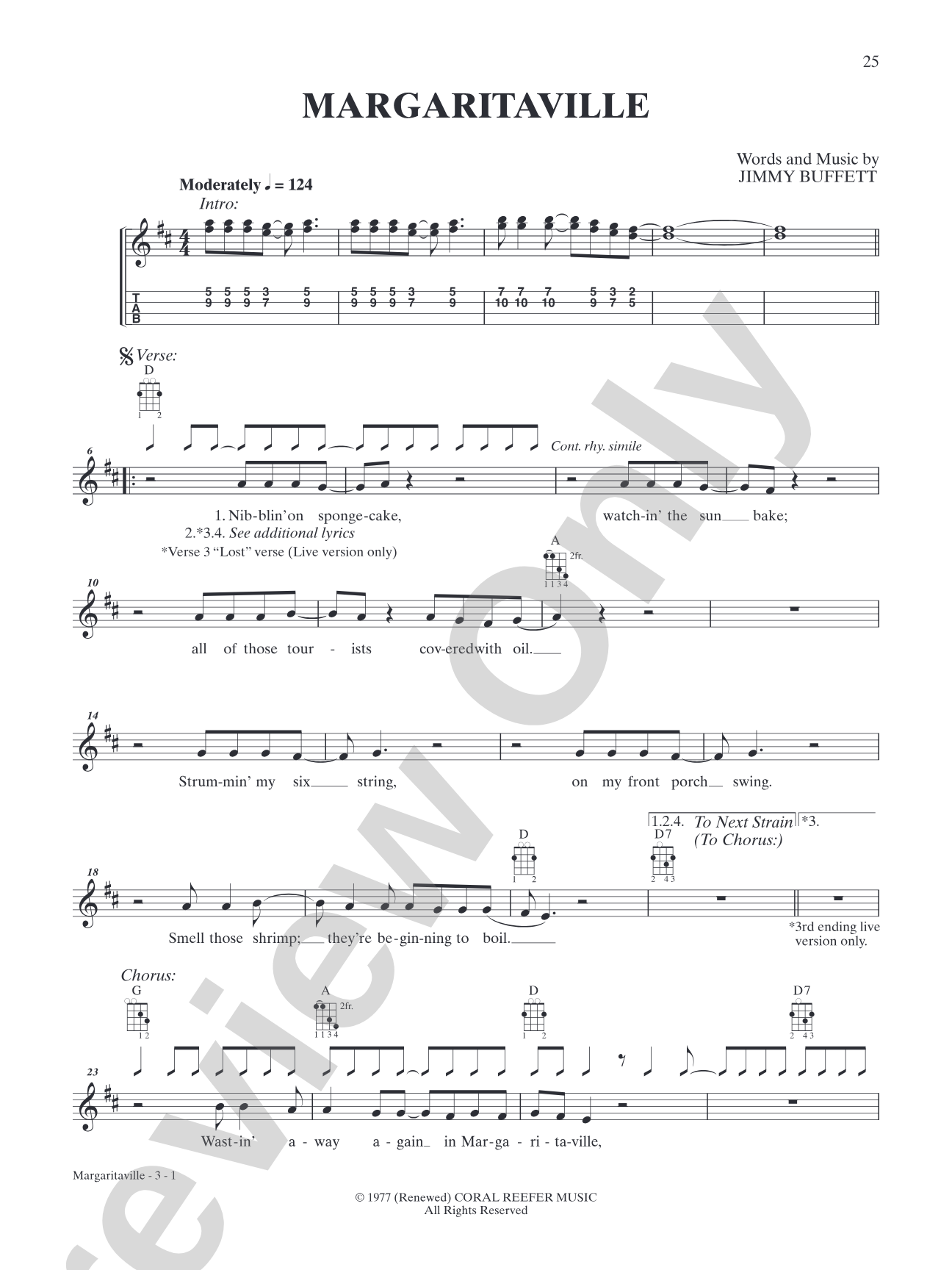

Margaritaville: Mandolin TAB
12 Great Songs -- Just a Few Chords
Item: 00-PS-0011764
$4.99
Pickup currently not available
Related Items
Take Me Home, Country Roads: Mandolin TAB |
$4.99
|
View | |
As Tears Go By: Mandolin TAB |
$4.99
|
View | |
Gloria: Mandolin TAB |
$4.99
|
View | |
Good Riddance (Time of Your Life): Mandolin TAB |
$4.99
|
View | |
Moondance: Mandolin TAB |
$4.99
|
View | |
Big Yellow Taxi: Mandolin TAB |
$4.99
|
View | |
Peaceful Easy Feeling: Mandolin TAB |
$4.99
|
View | |
Horse With No Name: Mandolin TAB |
$4.99
|
View |
Description
Easy Rock Mandolin is designed for your total enjoyment. Each featured song is inherently simple, with just a few chords. All the tunes are arranged for mandolin from the actual guitar parts, simplified just enough to keep them fun and musically satisfying. Titles: As Tears Go By (The Rolling Stones) * Big Yellow Taxi (Joni Mitchell) * Casey Jones (Grateful Dead) * Gimme Some Lovin' (The Spencer Davis Group) * Gloria (Them) * Good Riddance (Time of Your Life) (Green Day) * A Horse with No Name (America) * Margaritaville (Jimmy Buffett) * Moondance (Van Morrison) * Peaceful Easy Feeling (Eagles) * Take It Easy (Eagles) * Take Me Home, Country Roads (John Denver).


Margaritaville: Mandolin TAB isn't in MakeMusic Cloud just yet...but it could be. Let us know you'd like to see it, and you'll help shape what comes next. In the meantime, start a free trial and dive into thousands of interactive titles your students can play along with today.
Request This Title
Tell us you want it.
Start Your Free Trial
Explore everything that's ready to play right now.
Sample Audio
No sample audio found.
Sample Video
No sample videos found.
Additional Details
Series:
Just for Fun
Publisher:
Alfred Music
Page Count:
52
SKU:
00-PS-0011764
More about this title
About the Composer: Jimmy Buffett
Jimmy Buffett's songwriting career spans more than five decades, anchored by his ability to craft infectious melodies that blend rock, country, folk, and Caribbean influences into accessible, radio-friendly arrangements. Though widely known for his live performances and cultural persona, Buffett's compositional foundation rests on straightforward harmonic progressions and memorable hooks that translate readily to multiple instruments, making his work a natural fit for music education contexts.
Why we love this
This collection pairs well-known rock and classic rock standards with genuine mandolin arranging rather than note-for-note guitar transcriptions. The simplified voicings preserve the melodic and harmonic character of each tune while keeping finger patterns manageable, so mandolin students actually enjoy playing recognizable songs from day one without getting bogged down in unnecessary technical demands.
What to expect
Accessible and immediately rewarding. The melodic lines sit comfortably on the mandolin's fingerboard, the chord changes move logically, and every tune carries genuine musicality despite its simplicity. Players experience the satisfaction of sounding like they're playing real songs within weeks of beginning mandolin.
Who it's for
Mandolin players in their first 1-2 years of study who want to move beyond exercises and play complete, recognizable songs. This collection also works well for guitarists picking up mandolin, since the arrangements derive from the original guitar parts and include familiar harmonic frameworks.
How to get the most out of it
- Balance the mandolin's natural brightness by listening carefully to the recorded versions and noticing where the melody sits in the mix; this prevents overplaying and keeps the arrangement grounded.
- Work through the tab slowly enough to hear the melodic shape before worrying about tempo; these songs succeed on clean phrasing and confident delivery, not speed.
- Pay attention to rhythmic articulation in the original recordings, particularly the strumming patterns; the transcriptions capture essential groove elements that make each tune instantly recognizable.
How to use it
Integrate these pieces into a beginning mandolin ensemble or use them as supplementary repertoire in a world music or fretted instruments class. The variety of tempos and styles makes the collection useful for building performance confidence throughout a semester or academic year, and the familiar titles engage both performers and audiences at informal concerts.
Skills your students will build
- Reading mandolin TAB and correlating it to fretboard positions
- Playing rhythmic patterns and recognizable melody lines on fretted instruments
- Understanding how successful songs use simple harmonic progressions across multiple genres
- Developing articulation and phrasing that matches recorded reference performances
- Building repertoire quickly and maintaining motivation through familiar material