Margaret's Cradle Song (Margarethens Wiegenlied) Sheet Music Preview

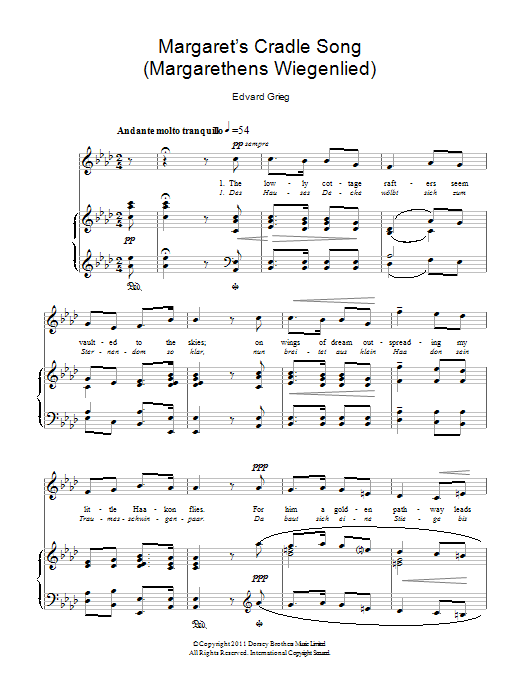
Margaret's Cradle Song (Margarethens Wiegenlied): Piano Vocal

As performed by Edvard Grieg

Item: 35-DS00205513

Digital Download
$5.99
Description

Margaret's Cradle Song (Margarethens Wiegenlied): Piano Vocal isn't in MakeMusic Cloud just yet...but it could be. Let us know you'd like to see it, and you'll help shape what comes next. In the meantime, start a free trial and dive into thousands of interactive titles your students can play along with today.

Sample Audio
No sample audio found.
Sample Video
Additional Details
Publisher: Hal Leonard
Page Count: 2
SKU: 35-DS00205513

More about this title

About the Artist: Edvard Grieg

Edvard Grieg (1843-1907) stands as Norway's most celebrated composer, bringing Scandinavian folk idioms and harmonic innovation into concert music. His gift for melody and atmospheric color shaped the Romantic era, and his works remain central to piano and vocal repertoires worldwide.

Greig's output spans symphonic works, concertos, chamber music, and hundreds of songs. His vocal writing consistently demonstrates how to serve the text while maintaining musical substance. Teachers and singers return to his songs because they balance accessibility with genuine artistry.

Why we love this

This intimate lullaby gives singers a chance to inhabit a complete emotional arc within two pages. Grieg's harmonic language feels fresh even now, and the straightforward vocal line ensures the poetry and melody remain the focal point rather than technical display.

What to expect

Tender and slightly wistful, with the gentle rocking quality you'd expect from its title. Grieg wraps the melody in soft harmonic colors that suggest both comfort and a quiet melancholy, as if the singer is remembering rather than simply narrating.

Who it's for

Intermediate to advanced singers preparing recital repertoire or looking for concert art songs with Scandinavian flavor. Voice teachers seeking material that develops legit singing and interpretive maturity.

How to get the most out of it

  • Shape the opening phrase with gentle rubato; let the cradle-song character breathe rather than sit in strict time
  • Listen closely to what the piano is doing in the interludes; the accompaniment often carries the emotional narrative between vocal phrases
  • Find the warmth in your middle range and avoid pushing for volume; intimacy serves this piece far better than projection

How to use it

Pair this with other Grieg songs to create a curated set, or feature it as a standalone encore that shifts the concert atmosphere into intimate reflection. Its brevity makes it ideal when you need a quiet moment between more extroverted pieces.

Skills your students will build

  • Sustaining legit tone in the middle and lower register
  • Coordinate rubato between voice and piano accompaniment
  • Text projection and phrasing in German
  • Responding to harmonic color and using dynamics musically rather than mechanically

You May Also Like