
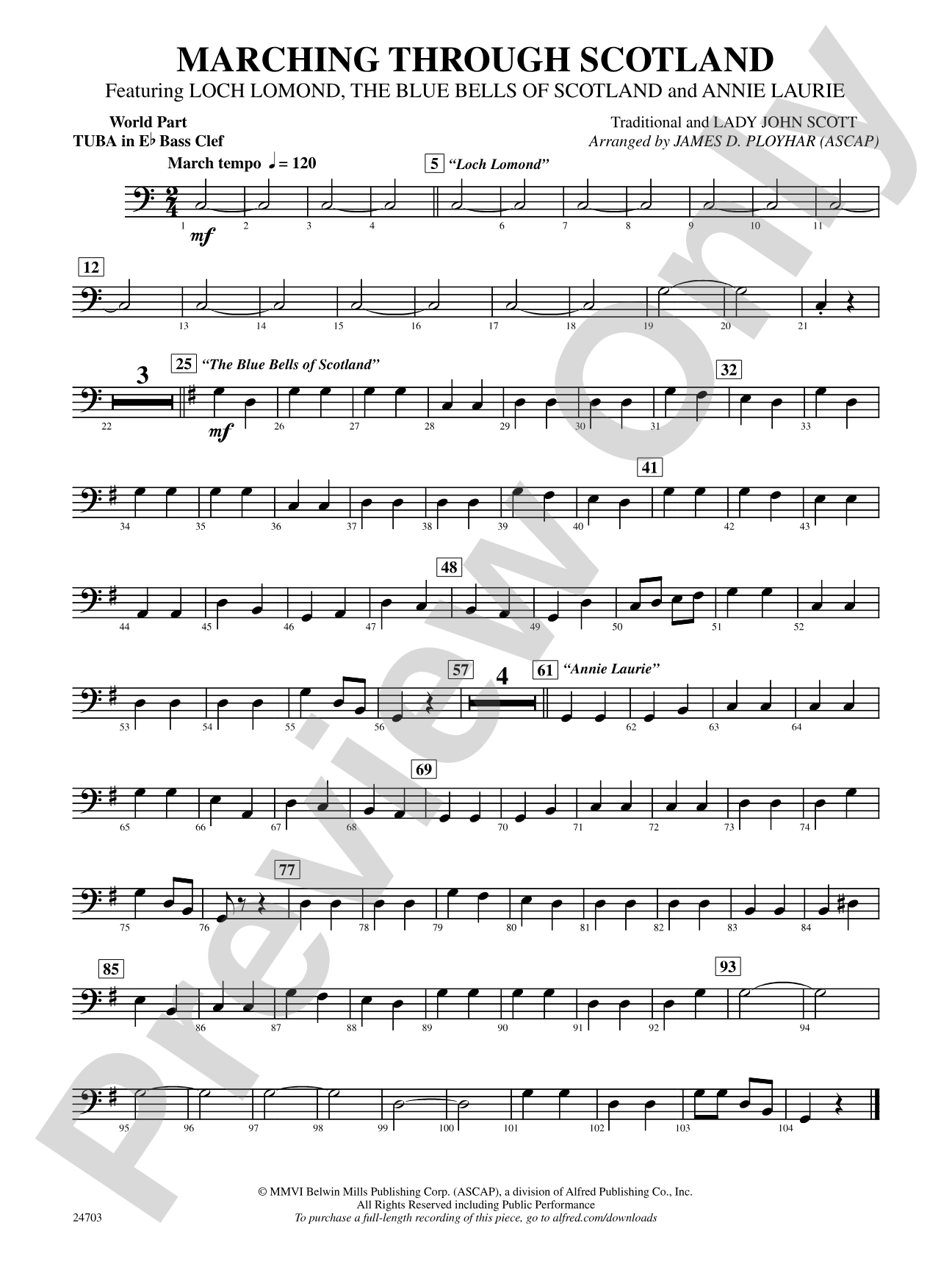

Marching Through Scotland: (wp) E-flat Tuba B.C.
Featuring: Loch Lomond / The Blue Bells of Scotland / Annie Laurie
Arr. James D. Ployhar
Grade: 1 (Very Easy)
Item: 00-PC-0000861_wpTBEBC
$3.00
Pickup currently not available
Description
Featuring "Loch Lomond," "The Blue Bells of Scotland" and "Annie Laurie," this James Ployhar arrangement of these charismatic Scottish melodies will be perfect on your next concert. Warmly scored, the lush themes flow freely. The inclusion of these familiar, yet often forgotten themes is a superb way to re-introduce traditional Scottish music into your program.


Don't just read it, hear it, play along with it, and watch your students grow with it. In MakeMusic Cloud, Marching Through Scotland: (wp) E-flat Tuba B.C. comes alive with professional accompaniment, adjustable tempo, and built-in practice tools that turn solo practice into real progress.
Open in the Player
Jump straight in and assign it today.
Start Your Free Trial
Open this title and explore the full library in minutes.
Sample Audio
1
Audio File
--:--
0:00
0:00
Sample Video
No sample videos found.
Additional Details
Series:
Belwin Beginning Band
Publisher:
Alfred Music
Page Count:
142
SKU:
00-PC-0000861_wpTBEBC
More about this title
About the Arranger: James D. Ployhar

James D. Ployhar has established himself as a prolific and respected voice in music education, with more than 800 published compositions to his name. His work includes the Contemporary Band Course, now published by Alfred Music and adopted internationally, including translations in French and Norwegian that are widely used throughout Scandinavia. Ployhar studied composition at California State University-Long Beach under Morris Hutchings Ruger and benefited from orchestration training with Knud Havalde of the Danish Royal Philharmonic Orchestra.
Beyond composition, Ployhar spent over 19 years in public school teaching and has maintained an active career as a clinician and conductor at colleges and universities across the United States, Canada, and Europe. His contributions to band music have been recognized with the National Band Association Citation of Excellence and the Distinguished Alumnus Award from Valley City State University. He holds degrees from Valley City State University (BS) and Northern Colorado University (MA).
Why we love this
Ployhar brings genuine warmth and accessibility to three beloved Scottish melodies without sacrificing musical substance. The lush orchestration opens these familiar tunes to beginning bands while maintaining the lyrical character that makes them enduring, and the Grade 1 scoring means your ensemble can handle the arrangement from day one. Programming Scottish repertoire at the concert level is uncommon, which makes this a thoughtful way to celebrate cultural traditions alongside your more standard selections.
What to expect
Nostalgic and graceful, these three Scottish melodies unfold with unhurried elegance. The warmth comes from Ployhar's lush voicing and the natural lyrical quality of the themes themselves, creating a concert moment that feels reflective rather than showy.
Who it's for
Beginning and developing concert bands working at Grade 1 level who want accessible, genuinely musical repertoire that introduces cultural traditions. Directors seeking a piece that programs well alongside standard concert fare and doesn't require an advanced ensemble to sound polished and professional.
How to get the most out of it
- Let the melodies breathe through sustained phrases; resist rushing even though the grade level permits quick tempos. Ployhar's scoring relies on the warmth of the voicing, so clarity of line matters more than speed.
- Balance the parts carefully so that thematic material in upper woodwinds and brass doesn't overwhelm the harmonic foundation. Lighter instrumentation works better here than heavy doubling.
- Use the familiar nature of these tunes to your advantage during rehearsal by asking students to sing through passages before playing them. The melodies are accessible reference points for intonation and phrasing.
How to use it
Position this arrangement in the second half of a concert to shift energy and mood, or open a program with it to establish a thoughtful tone. Its cultural specificity makes it a natural fit alongside other folk or multicultural selections, and the brief performance time works well in festivals where programming variety matters.
Skills your students will build
- Voicing balance in homophonic and sustained arrangements
- Phrasing extended melodic lines with minimal direction
- Intonation across sustained chords and passing tones
- Ensemble listening and blend at Grade 1 difficulty