
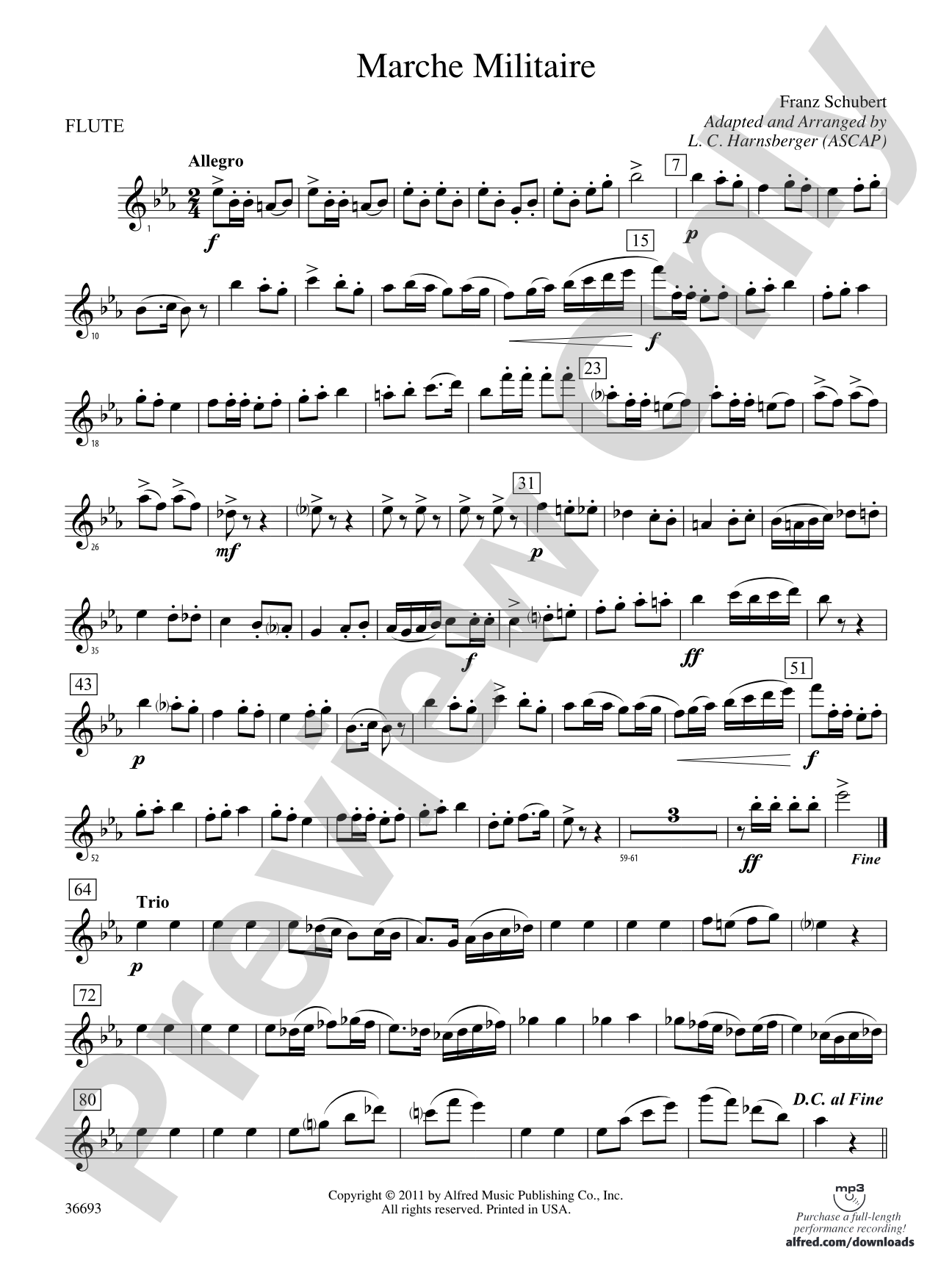

Marche Militaire: Flute
By Franz Schubert / adapted and arr. L. C. Harnsberger
Grade: 2 (Medium Easy)
Item: 00-PC-0015121_F1
$3.00
Pickup currently not available
Description
One of the most familiar and popular marches ever written is Franz Schubert's Military March No. 1. Schubert (1797--1828) was one of the most prolific composers of all time, having written symphonies, chamber music, piano works, and over 600 songs, yet he only lived to the age of 32. The march was originally written for piano four-hands, however, this arrangement for young band sounds as if it was first written for military band. Woodwinds, brass, and percussion all shine with fun and interesting parts that work well together. This arrangement is perfect for an opener or closer to any concert.


Don't just read it, hear it, play along with it, and watch your students grow with it. In MakeMusic Cloud, Marche Militaire: Flute comes alive with professional accompaniment, adjustable tempo, and built-in practice tools that turn solo practice into real progress.
Open in the Player
Jump straight in and assign it today.
Start Your Free Trial
Open this title and explore the full library in minutes.
Sample Audio
1
Audio File
--:--
0:00
0:00
Sample Video
No sample videos found.
Additional Details
Series:
Young Symphonic
Publisher:
Alfred Music
Page Count:
126
SKU:
00-PC-0015121_F1
More about this title
About the Composer: Franz Schubert
Franz Schubert (1797–1828) composed at a pace that defies belief. In his 31 years, he created nine symphonies, 35 chamber works, over 600 songs, and countless piano pieces, all while working as a freelance musician in Vienna during an era when steady income was scarce. His gift for melody was unmatched; he could write a perfect tune as easily as breathing, and his harmonic language bridged Classical restraint and Romantic imagination.
Schubert's marches occupy a unique place in his catalog. Written for piano four-hands (a popular domestic ensemble), they combine the architectural clarity of the Classical march form with the lyrical warmth that defines his best work. Military March No. 1 remains his most performed march, a piece that has survived nearly two centuries because its character is both dignified and genuinely fun to play.
Why we love this
This arrangement captures everything that makes Schubert's original appealing while distributing the melodic and harmonic material across a full concert band instrumentation. The parts aren't padding; woodwinds, brass, and percussion each carry melodically interesting lines that students actually want to play. Grade 2 accessibility combined with genuine musical sophistication makes this an unusually rewarding choice for young bands building their repertoire of classical masterworks.
What to expect
Straightforward, dignified, and propulsive. The march unfolds with Classical clarity, each section arriving exactly when you expect it, yet the melodies sing with Schubert's characteristic warmth. There's a pageantry to it, but not pomp; it feels like a procession of musicians who are genuinely enjoying themselves.
Who it's for
Young concert bands at the high school or advanced middle school level who are ready for Classical and Romantic-era masterworks but need arrangement that doesn't compromise the original's musical integrity. Directors building balanced concert programming who want a piece that opens or closes a show with elegance and immediate audience appeal.
How to get the most out of it
- Balance the melodic voices across sections. The woodwinds often carry the primary tune, but brass countermelodies deserve clarity; this isn't a situation where woodwinds dominate entirely.
- Maintain steady, confident tempo throughout. Schubert's march form relies on rhythmic propulsion; hesitation undermines the military character and the forward momentum that makes this piece work.
- Let the brass sections breathe during their thematic moments, particularly in the trio section. These passages are brief but essential to the overall architecture.
- Bring out the percussion with clear articulation, especially in the snare and bass drum parts. The rhythmic support anchors the ensemble and drives the march character home.
How to use it
Program this as an opener to establish strong ensemble presence and audience engagement from the first moment. The Grade 2 difficulty allows you to feature it early in the season before programming becomes more demanding, or place it strategically late in the year when your ensemble has developed the musicianship to shape Schubert's phrasing and balance with care.
Skills your students will build
- Reading and executing sustained melodic lines across multiple sections
- Maintaining steady tempo and rhythmic clarity in march form
- Balancing individual section voices while supporting overall ensemble texture
- Performing Classical-era articulation and phrasing conventions
- Executing coordinated entrances and section transitions in formal structures