
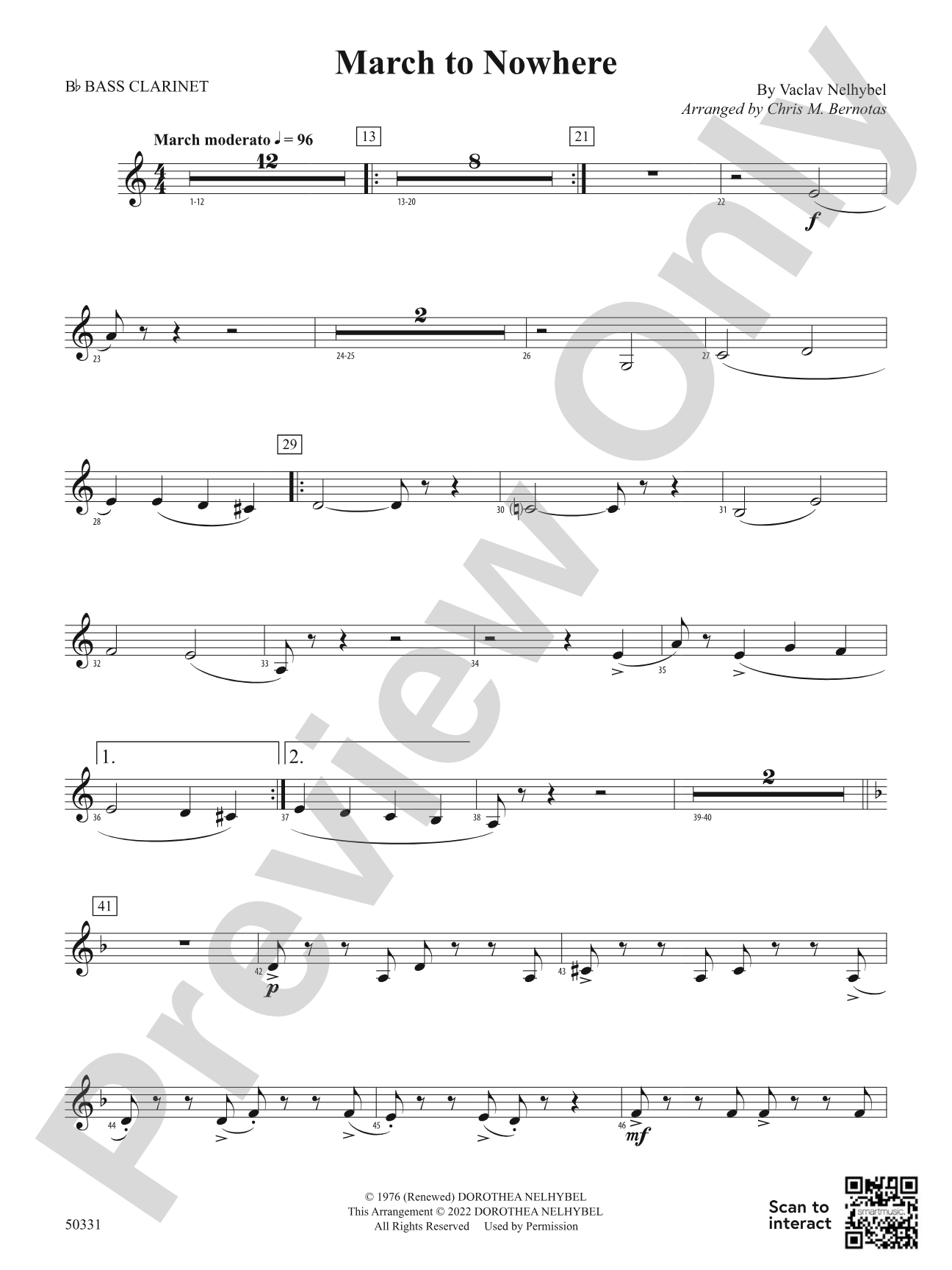

March to Nowhere: B-flat Bass Clarinet
By Václav Nelhýbel / arr. Chris M. Bernotas
Grade: 2.5
Item: 00-PC-0019174_BC
$3.00
Pickup currently not available
Description
March to Nowhere, by the renowned and brilliant Czech composer Václav Nelhýbel, was originally published in 1976. This arrangement, by Chris M. Bernotas, has been scored for intermediate-level bands as the perfect vehicle to introduce students to this significant and historic composer. The work's unique character and intriguing musical lines and textures will captivate your students. (3:40)


Don't just read it, hear it, play along with it, and watch your students grow with it. In MakeMusic Cloud, March to Nowhere: B-flat Bass Clarinet comes alive with professional accompaniment, adjustable tempo, and built-in practice tools that turn solo practice into real progress.
Open in the Player
Jump straight in and assign it today.
Start Your Free Trial
Open this title and explore the full library in minutes.
Sample Audio
1
Audio File
--:--
0:00
0:00
Sample Video
Additional Details
Series:
Belwin Young Band
Publisher:
Alfred Music
SKU:
00-PC-0019174_BC
More about this title
About the Composer: Vaclav Nelhybel
Václav Nelhýbel (1919-1996) was a Czech composer and conductor whose works became cornerstones of band and wind ensemble literature in the latter half of the twentieth century. His compositions are marked by strong melodic writing, skillful orchestration, and an ability to craft pieces that challenge musicians while remaining accessible to intermediate and advanced ensembles.
Nelhýbel's marches and band works earned him international recognition, and his music remains a fixture in concert band repertoires worldwide. His gift for creating memorable themes and transparent textures made his works ideal teaching pieces, introducing students to sophisticated compositional techniques without overwhelming their technical abilities.
Why we love this
This arrangement opens the door to genuine compositional craftsmanship at an intermediate level. Nelhýbel's original concept translates beautifully through Bernotas's scoring, giving students the experience of playing a work by a master rather than settling for generic concert material. The intriguing textures and musical architecture keep ensembles engaged while the Grade 2.5 difficulty makes it achievable without sacrificing musical substance.
What to expect
A march that refuses to be predictable. Beneath the familiar march structure lie intriguing harmonic colors and textures that shift the listening experience from marching-band pageantry to concert-hall reflection. The piece carries dignity and purpose without sentimentality, inviting players to discover musical substance in unexpected places.
Who it's for
Concert bands at the intermediate level looking to program repertoire with real artistic depth. This work suits groups ready to move beyond simplified concert pieces and engage with a twentieth-century composer whose name and music they will encounter again in their musical development.
How to get the most out of it
- Balance the melodic lines carefully across the band. Nelhýbel's writing often features countermelodies and supporting lines that deserve clarity; resist the urge to let full sections overshadow the conversations happening around them.
- Shape phrases with intention. The piece's character emerges through how you handle the transitions between sections and the breathing points within phrases rather than through heavy dynamic shifts.
- Maintain rhythmic precision without rigidity. The march framework provides structure, but allowing natural musicality in the ensemble's collective response will bring out the work's subtle sophistication.
- Rehearse the parts as written before considering any balance adjustments. Nelhýbel and Bernotas have scored the work thoughtfully; unexpected colors often become apparent once students play their lines with accuracy and confidence.
How to use it
Position this as a centerpiece on a concert focused on twentieth-century band classics, perhaps bookending it with a more traditional march and a contemporary piece to show the evolution of the form. It also works as an opener that demonstrates your ensemble's sophistication and musicianship early in a program.
Skills your students will build
- Following compositional texture and internal balance across multiple instrumental lines
- Interpreting a march structure with musical nuance rather than mechanical precision
- Responding to subtle harmonic language and voice-leading
- Sustaining focus through a work organized by compositional logic rather than obvious sectional contrasts