
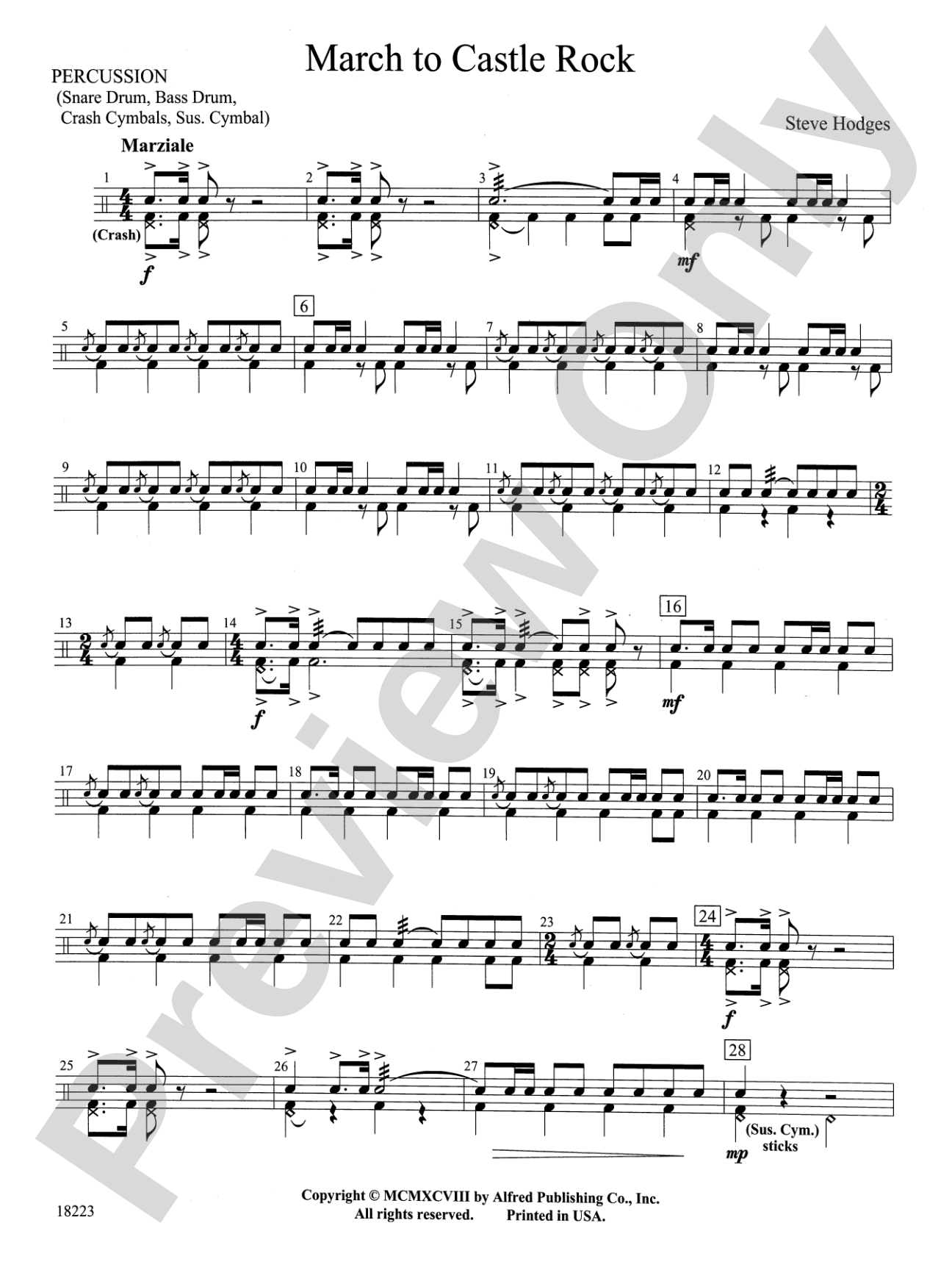

March to Castle Rock: 1st Percussion
By Steve Hodges
Grade: 1.5 (Easy)
Item: 00-PC-0000251_PC1
$3.00
Pickup currently not available
Description
Your students will love the excitement generated by this lively march in the minor mode. Set in a "Marziale" style, this piece begins and ends forcefully, with a flowing middle section to provide an effective contrast. Abounding with rhythmic vitality and aggressive dynamics, this march is guaranteed to get your young band fully energized!


Don't just read it, hear it, play along with it, and watch your students grow with it. In MakeMusic Cloud, March to Castle Rock: 1st Percussion comes alive with professional accompaniment, adjustable tempo, and built-in practice tools that turn solo practice into real progress.
Open in the Player
Jump straight in and assign it today.
Start Your Free Trial
Open this title and explore the full library in minutes.
Sample Audio
1
Audio File
--:--
0:00
0:00
Sample Video
Additional Details
Series:
Challenger Band Series
Publisher:
Alfred Music
Page Count:
120
SKU:
00-PC-0000251_PC1
More about this title
About the Composer: Steve Hodges

Steve Hodges holds degrees from Western Oregon University (Bachelor of Science) and Central Washington University (Master of Music Education). He spent four decades in public school music education, directing concert bands, choirs, and chamber ensembles across all levels before retiring from full-time teaching.
Since 1986, Hodges has composed over 120 concert band works published by Alfred Music, along with choral arrangements for Staff Music and Shawnee Press. His compositions have appeared at festivals and state conventions internationally, and several of his pieces were commissioned for honor bands and schools across Virginia, Iowa, Washington, Oregon, North Carolina, and British Columbia. His music has also been featured on TBS and ESPN programming. Hodges serves as an ASCAP member and continues to live in The Dalles, Oregon, where he remains active in community music with his wife.
Why we love this
This march captures everything young bands need to build confidence: clear, energetic writing that sounds impressive without requiring advanced technique. The minor key and "Marziale" style give students a taste of concert hall sophistication, while the rhythmic drive keeps the energy focused and engaging throughout rehearsal and performance.
What to expect
A forward-marching energy that never settles into routine. The minor mode gives the piece an almost heroic edge, especially during the forceful outer sections, while the flowing middle provides a moment of reflection without losing momentum. Students feel the lift and drive of a true march while exploring a tonal color slightly outside the everyday major key repertoire.
Who it's for
Beginning and intermediate concert bands ready to move beyond simple marches into more stylistically sophisticated literature. This piece works well for groups that have developed basic ensemble balance and articulation but still need accessible material for festival or concert performance.
How to get the most out of it
- Establish a crisp, military-style articulation from the opening forte section. Uniform tonguing across the full band will define the character immediately.
- Shape the middle section's flowing passage as a true contrast by pulling back slightly on the tempo and letting the melody sing without excessive weight.
- Balance the aggressive dynamics carefully in the ensemble so that forte passages cut through without losing the minor key's darker character.
- Drill the rhythmic figures in isolation before full-section rehearsals to ensure precision during the more active passages.
How to use it
Program this as an opening number to establish immediate energy and focus for your concert, or pair it with a softer ballad to highlight the contrast between sections. Its contest-festival credentials and straightforward technical demands make it ideal for spring performance schedules when younger ensembles are building toward end-of-year competitions.
Skills your students will build
- Articulation control in marcato and staccato styles
- Dynamic contrast and shaping within driving rhythmic contexts
- Reading and performing in minor keys with confident intonation
- Ensemble balance when multiple voices carry rhythmic figures simultaneously
- Phrasing awareness in both forceful and lyrical sections