
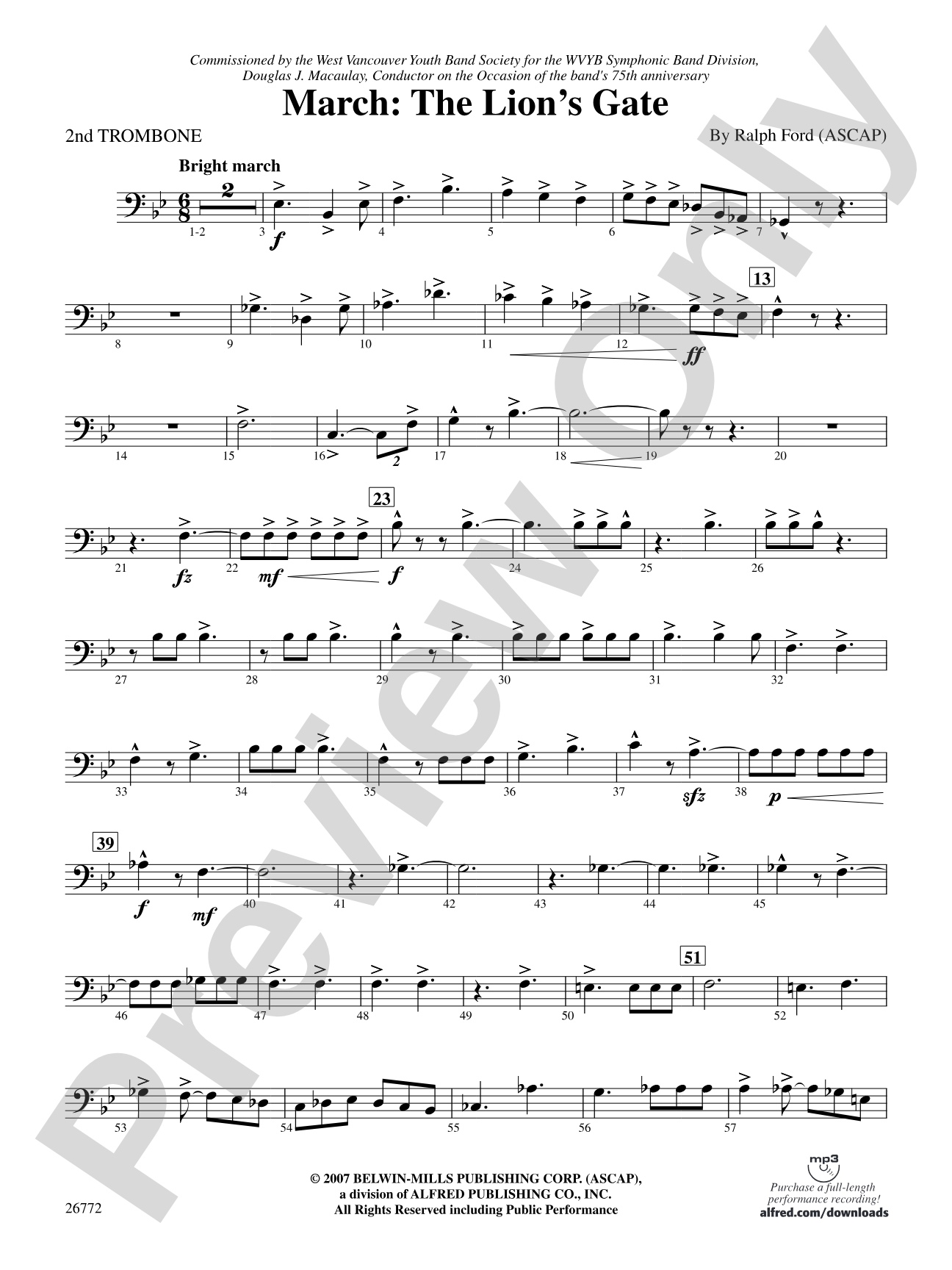

March: The Lion's Gate (Movement 1 from Sea to Sky): 2nd Trombone
By Ralph Ford
Grade: 4 (Medium)
Item: 00-PC-0001223_TN2
$3.00
Pickup currently not available
Description
The first movement from Ralph Ford's new work Sea to Sky is the bold opening to this epic composition. Representing this spectacular grandeur of the structure that begins the Sea to Sky Highway, this march is as well performed within the larger work as it is alone. A dynamic choice to display your symphonic band at its best. This title is available in MakeMusic Cloud.


Don't just read it, hear it, play along with it, and watch your students grow with it. In MakeMusic Cloud, March: The Lion's Gate (Movement 1 from Sea to Sky): 2nd Trombone comes alive with professional accompaniment, adjustable tempo, and built-in practice tools that turn solo practice into real progress.
Open in the Player
Jump straight in and assign it today.
Start Your Free Trial
Open this title and explore the full library in minutes.
Sample Audio
1
Audio File
--:--
0:00
0:00
Sample Video
No sample videos found.
Additional Details
Series:
Belwin Symphonic Band
Publisher:
Alfred Music
Page Count:
224
SKU:
00-PC-0001223_TN2
More about this title
About the Composer: Ralph Ford

Ralph Ford brings three decades of professional composition and arrangement experience to his work with the Belwin division of Alfred Music. A prolific creator with over 250 published titles spanning orchestra, concert band, jazz ensemble, and marching band, Ford has built a career balancing university teaching, media production, and original composition. His music has been premiered by ensembles ranging from school bands to professional orchestras across the globe.
Beyond the concert hall, Ford has worked extensively in broadcast and media, creating jingles, news packages, and sound design for television and radio. He earned his Master of Science degree from Troy State University, where he served as a faculty arranger and instructor for fifteen years before transitioning to full-time composition in 1999. His versatility across multiple musical contexts informs his approach to band writing, making his scores both technically engaging and performable at varied levels.
Why we love this
Ford has written a march that stands on its own as a showcase piece while functioning brilliantly as the gateway to a larger work. The orchestration and pacing give your band immediate musical substance to grab an audience, and the Grade 4 level ensures your ensemble can deliver genuine impact without overreaching.
What to expect
Bold and architectural, this march captures the majesty of the Lion's Gate structure with broad melodic gestures and driving rhythmic momentum. The sound is full and energetic, with sweeping lines that give conductors and players genuine expressive content to explore within the march form.
Who it's for
Concert band directors seeking a Grade 4 march that combines accessibility with musical substance. This piece works for bands that have solid fundamentals in place and want to program something that showcases their sound without demand for extreme technical virtuosity. It's also ideal for programs exploring Ford's larger work Sea to Sky, as this movement can serve as a compelling introduction.
How to get the most out of it
- Shape the march with clear phrase architecture rather than treating it as a steady-state march. Find the natural peaks and valleys within each section to maintain listener engagement.
- Balance the brass scoring so the melody sings above the harmonic support. Ford's writing often layers the melody across multiple voices, so ensure the primary line cuts through without the accompaniment overwhelming it.
- Pay attention to dynamic transitions and how they affect the sense of forward motion. This piece builds grandeur through graduated intensity, so transitions between sections should feel purposeful rather than abrupt.
- Lock the rhythm section (percussion and low brass) early. A solid foundation lets the upper voices breathe and helps the march feel inevitable rather than labored.
How to use it
Open a concert with this piece to establish immediate energy and confidence. Its standalone strength makes it an excellent choice for showcasing your band early in the program, or program it as the first movement if you later introduce audiences to the complete Sea to Sky work. It also pairs well in a concert that celebrates architectural or geographic themes through music.
Skills your students will build
- Balancing melodic lines across a full ensemble while maintaining rhythmic cohesion
- Shaping phrases within a march form to create forward momentum and musical arc
- Executing dynamic control and transitions that drive narrative intent
- Reading and executing parts within a Grade 4 orchestration that develops confidence on their instrument