March of the Paratroopers: 1st Percussion Sheet Music Preview

March of the Paratroopers: 1st Percussion

By Mark Williams

Grade: 1.5 (Easy)

Item: 00-PC-0000217_PC1

Digital Download
$3.00
Description
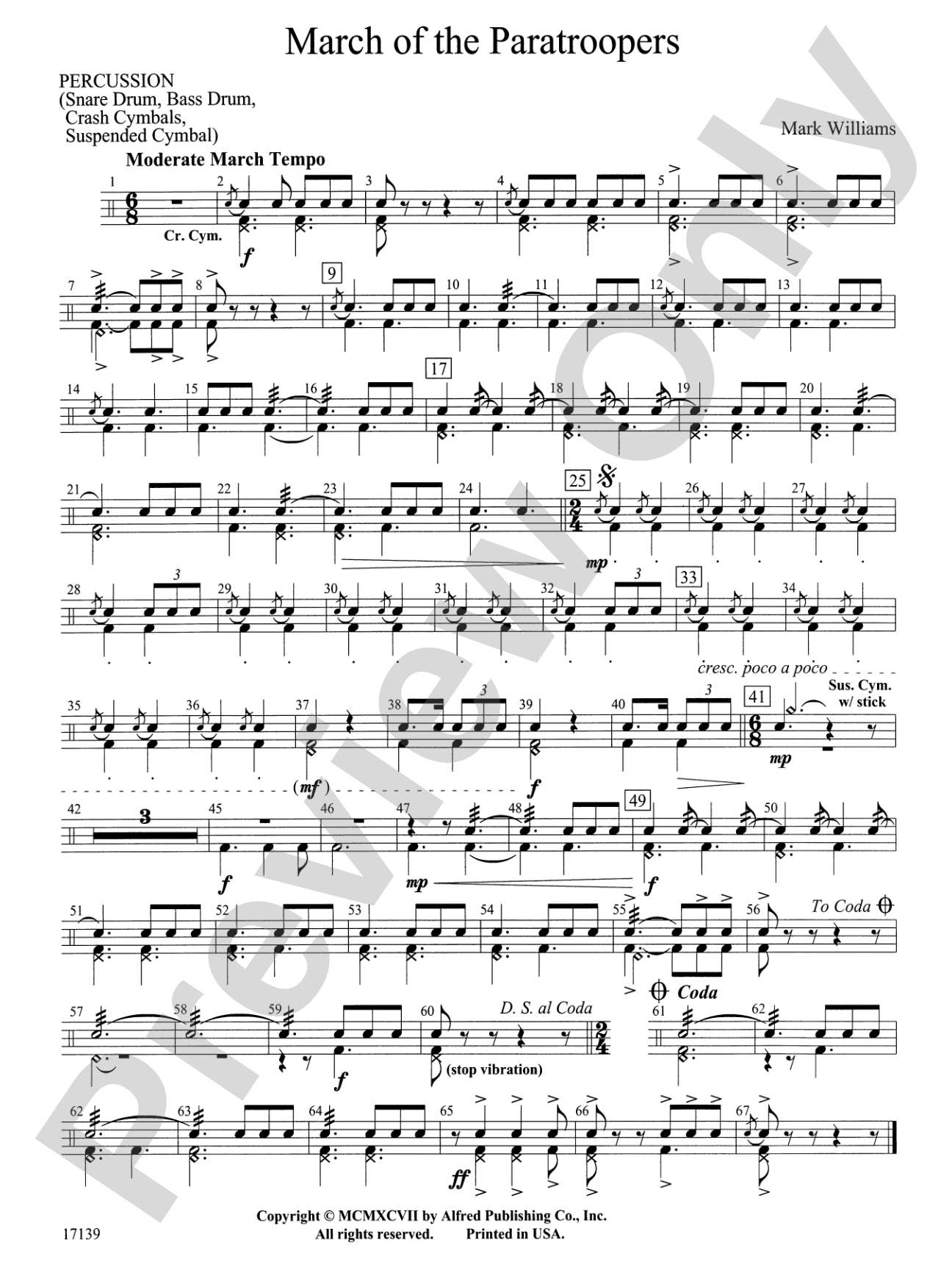
This easy, yet powerful 6/8 march is one of the best written at this grade level. Contrasting sections in 2/4 help to clarify the relationship between these two meters. An excellent teaching piece and an impressive concert or contest selection.

Don't just read it, hear it, play along with it, and watch your students grow with it. In MakeMusic Cloud, March of the Paratroopers: 1st Percussion comes alive with professional accompaniment, adjustable tempo, and built-in practice tools that turn solo practice into real progress.

Sample Audio
0:00
0:00
Sample Video
Additional Details
Series: Challenger Band Series
Publisher: Alfred Music
Page Count: 116
SKU: 00-PC-0000217_PC1

More about this title

About the Composer: Mark Williams

Mark Williams

Mark Williams built his reputation as one of the most prolific and respected composers for school ensembles. With over 200 published works and a co-authorship of the Accent on Achievement Band Method, he shaped the sound of countless school programs. His credentials as a clinician and guest conductor took him across 34 states, five Canadian provinces, and Australia, where he worked directly with students and teachers to advance the quality of band and orchestra music in schools.

Based in Washington state for much of his career, Williams combined his work as an elementary band specialist with extensive performance experience on bassoon and as an arranger for the 560th Air Force Band. He earned recognition through the Western International Band Clinic's Gralia Competition and multiple ASCAP Special Awards. Beyond the podium and classroom, he conducted the Spokane British Brass Band and brought the same compositional skill to works for band, orchestra, and choir.

Why we love this

Williams crafted this march with teaching in mind, and it shows. The interplay between 6/8 and 2/4 meters gives students a genuine compositional reason to understand metric relationships, rather than a dry exercise. The piece sounds confident and substantial at Grade 1.5, making it equally effective as a contest selection or a concert centerpiece that won't embarrass a young ensemble.

What to expect

The 6/8 march has forward momentum and swagger, with the kind of crisp articulation that makes even beginning players feel authoritative. When the 2/4 sections arrive, the rhythmic landscape shifts beneath your feet in a way that's surprising without being disorienting, giving the piece shape and sophistication.

Who it's for

This score and parts set works for Grade 1.5 concert bands of all sizes. It serves conductors who want to address meter relationships in a performance context rather than isolate the concept on a worksheet. Young musicians benefit from playing a piece that sounds mature while remaining technically accessible.

How to get the most out of it

  • Isolate the meter transitions in sectional rehearsals. Have students tap the pulse while the time signature changes; this kinesthetic awareness often clicks faster than counting alone.
  • Balance the contrast between sections deliberately. The shift from 6/8 to 2/4 should feel like a structural event, not a stumble, so mark tempo and dynamics clearly in your parts.
  • Shape the melodic lines even at this grade level. Young musicians respond well when they understand their part carries the tune, not just fills time.

How to use it

Open a concert with this march to set an energetic tone, or place it as a complementary piece alongside other Grade 1-2 repertoire in a festival program. Its contest viability also makes it valuable for spring festival seasons when you want a piece that demonstrates musical growth without technical strain.

Skills your students will build

  • Understanding the pulse relationship between 6/8 and 2/4 meters
  • Reading and performing metric modulation across contrasting sections
  • Articulation control and rhythmic precision in march style writing
  • Balance and blend across full ensemble textures at easy grade level

You May Also Like