
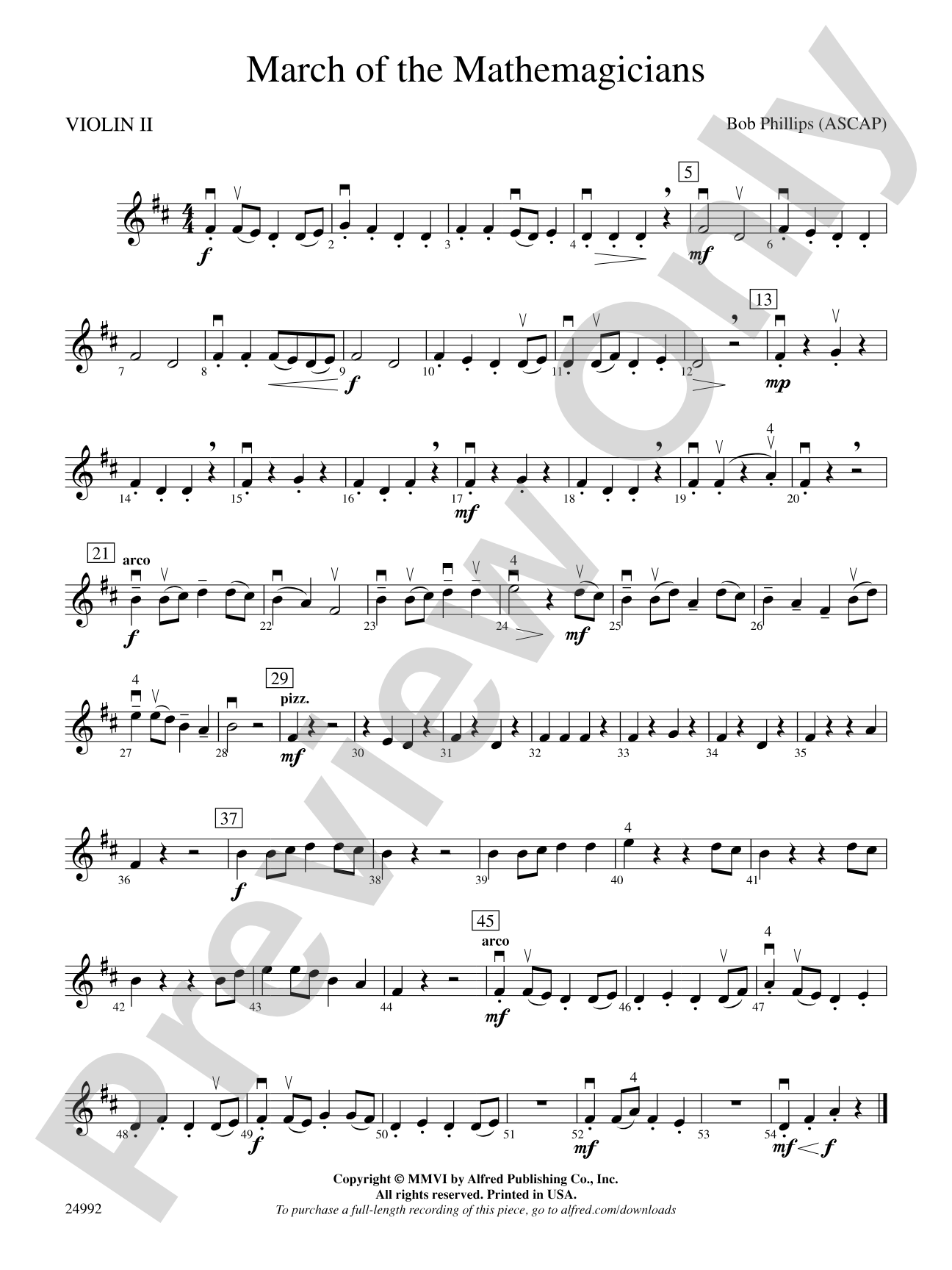

March of the Mathemagicians: 2nd Violin
By Bob Phillips
Grade: 1
Item: 00-PC-0000974_VN2
$5.99
Pickup currently not available
Description
Cast a spell up and down the fingerboard as fingers add and subtract. A strong string march rhythm provides structure and drive as young players practice beginning finger patterns! "March of the Mathemagicians" can be played by first year players who have mastered the D Major scale and all notes are in first position with no high 3s or forward extensions. With the exception of a few notes on the G in the basses, all sections use only the D and A strings. Each section has the opportunity to play the very easy melody. This catchy, toe-tapping tune is readily accessible for first year players and will be a highlight of any concert.


Don't just read it, hear it, play along with it, and watch your students grow with it. In MakeMusic Cloud, March of the Mathemagicians: 2nd Violin comes alive with professional accompaniment, adjustable tempo, and built-in practice tools that turn solo practice into real progress.
Open in the Player
Jump straight in and assign it today.
Start Your Free Trial
Open this title and explore the full library in minutes.
Sample Audio
1
Audio File
--:--
0:00
0:00
Sample Video
No sample videos found.
Additional Details
Series:
Belwin Very Beginning String Orchestra
Publisher:
Alfred Music
Page Count:
70
SKU:
00-PC-0000974_VN2
More about this title
About the Composer: Bob Phillips

Bob Phillips has shaped string education through decades of hands-on teaching and composing. Over his 27-year tenure building the Saline, Michigan string program to more than 700 students, he developed a national model that proved young musicians thrive when exposed to diverse musical styles alongside classical training. His published works exceed 200 pieces for orchestras and bands, and he has authored 25+ instructional book series, including Sound Innovations and the groundbreaking eclectic series Fiddlers Philharmonic, Jazz Philharmonic, Rock Philharmonic, and Mariachi Philharmonic.
Phillips' influence extends beyond the classroom. The Saline Fiddlers Philharmonic, an ensemble he founded, performed more than 80 shows annually and appeared at the White House and the Midwest Clinic. As an award-winning ASCAP composer and conductor for all-state orchestras across multiple states and the Blue Lake Fine Arts Camp, he has demonstrated mastery of both large group pedagogy and creative arrangement. His instructional DVDs, String Clinics to Go, reach thousands of teachers nationwide.
Why we love this
Phillips understood first-year string players; he built his approach on what makes them succeed and what keeps them engaged. The march form provides the rhythmic scaffolding young players need while the melody alternates between sections, so every student has moments to shine and moments to listen, building ensemble awareness naturally. It's the kind of piece that ends a concert with smiles and foot-tapping from the audience.
What to expect
A celebratory march that bounces with youthful energy. The melody has a playful, approachable character that never feels condescending, and the strong rhythmic drive keeps young musicians engaged and feeling like they're playing something real.
Who it's for
First-year string orchestra students who have learned the D Major scale and are comfortable in first position across all four strings. The piece works equally well in full orchestra settings or sectional rehearsals, and directors can rotate melody passages to build confidence in every player.
How to get the most out of it
- Establish a steady, confident tempo before the ensemble begins; the march character depends on rhythmic clarity, and young players will lock in faster when the pulse is unmistakable from the downbeat.
- Highlight the moment each section takes the melody so the piece maintains forward momentum and young players stay anchored to their role within the larger line.
- Balance the D and A string writing so the melody rings clearly without drowning out the harmonic foundation that keeps the march grounded.
How to use it
Close a concert's opening or middle section with this to reset audience energy before larger works, or place it as a finale where its cheerful character sends the ensemble and audience out together. It pairs naturally with other early-level orchestral works and stands up well in festival settings where first-year students need accessible repertoire that still impresses.
Skills your students will build
- Maintaining steady rhythm in march meter while playing multiple bowing patterns
- D Major scale fluency across D and A strings in first position
- Entering and exiting phrases cleanly as melody passes between sections
- Balancing melodic line against harmonic foundation in string ensemble texture