
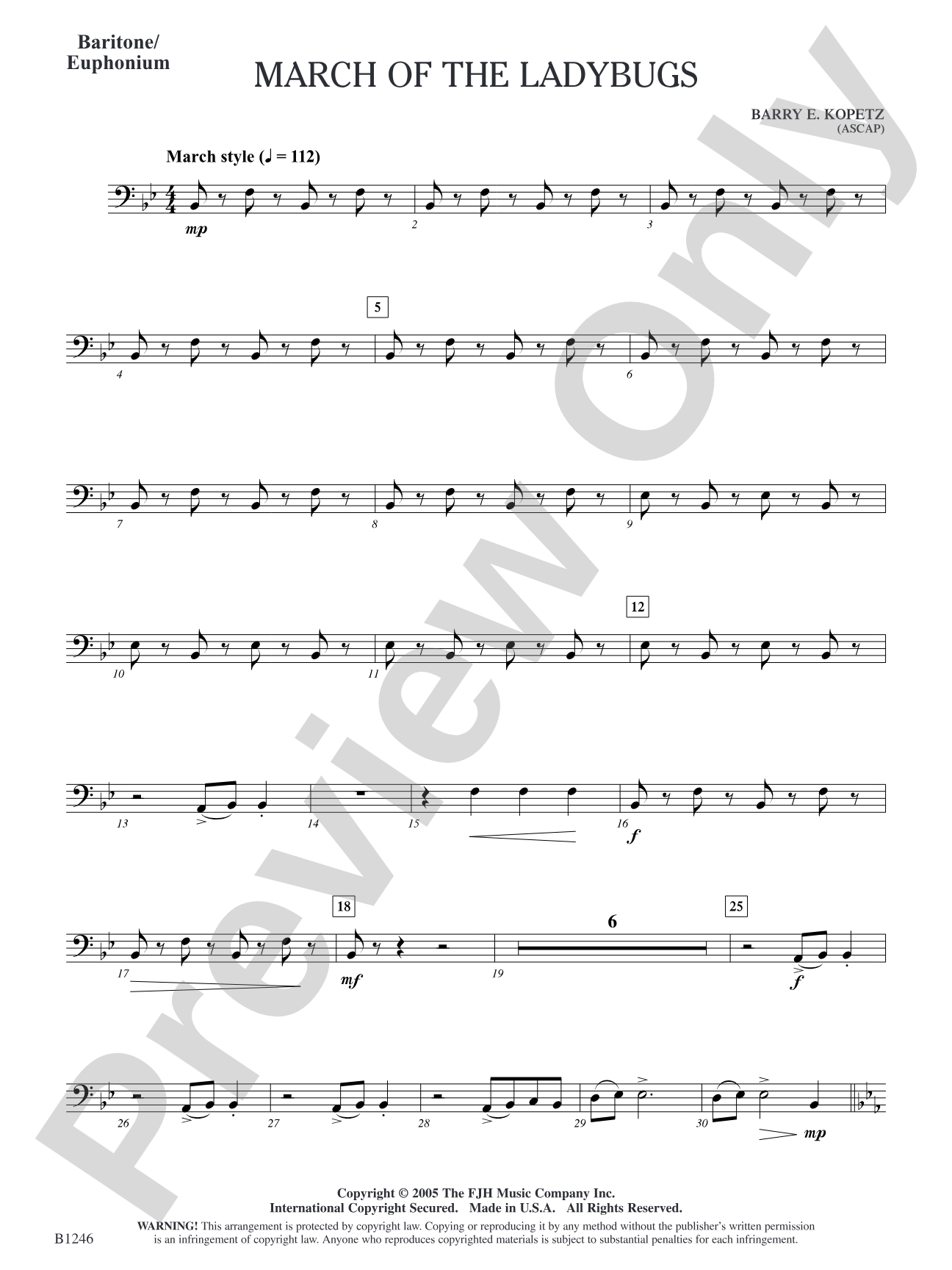

March of the Ladybugs: Baritone/Euphonium
By Barry E. Kopetz
Grade: 2
Item: 98-PC-DB1246_BBC1
$7.00
Pickup currently not available
Description
This clever march depicts a procession of ladybugs, those everyday insects that always seem to capture the spotlight. A persistent minor second interval depicts the occasional flapping of their wings, and the piece even comes complete with a "bug fight" - uhh...dog fight, that is! An excellent change of pace for your next program!


March of the Ladybugs: Baritone/Euphonium isn't in MakeMusic Cloud just yet...but it could be. Let us know you'd like to see it, and you'll help shape what comes next. In the meantime, start a free trial and dive into thousands of interactive titles your students can play along with today.
Request This Title
Tell us you want it.
Start Your Free Trial
Explore everything that's ready to play right now.
Sample Audio
1
Audio File
--:--
0:00
0:00
Sample Video
No sample videos found.
Additional Details
Series:
FJH Young Band
Publisher:
The FJH Music Company, Inc.
SKU:
98-PC-DB1246_BBC1
More about this title
About the Composer: Barry E. Kopetz

Barry E. Kopetz directs the Wind Symphony and Chamber Winds at Capital University in Columbus, Ohio, where he also teaches conducting, rehearsal techniques, and arranging. His academic journey includes positions at the University of Utah, University of Minnesota, and Bowling Green State University, along with public school teaching in Ohio and South Carolina. He earned his bachelor's and master's degrees from Ohio State University and a doctorate with distinction from Indiana University's School of Music.
Kopetz studied conducting under the legendary Frederick Fennell in Tokyo and previously with Frederick Ebbs, Ray Cramer, and Donald McGinnis. As a composer and arranger, he has over 50 published works in print and maintains an active schedule as a guest conductor and adjudicator across the United States and Australia. His recent work extends to orchestrations for television and film, and he contributes regularly to Instrumentalist magazine with analyses of standard band repertoire. He was elected to the American Bandmasters Association in 1998.
Why we love this
Kopetz captures something most Grade 2 marches miss: genuine personality without sacrificing musicality. The minor second interval motif works as both a compositional hook and a teaching tool, giving students a memorable harmonic element to latch onto. What really sets this apart is the playful narrative quality, the "bug fight" episode breaks up the predictable march structure and gives your ensemble permission to have fun while still maintaining the piece's musical integrity.
What to expect
Whimsical and lighthearted, with a soundtrack-like quality that brings an everyday garden scene to life. The persistent harmonic tension of the minor second creates curiosity before the piece resolves into straightforward march confidence, then tips into brief chaos before settling back into procession.
Who it's for
Grade 2 bands looking for a march that entertains without condescension. This works equally well for student ensembles building march fundamentals and community bands seeking accessible, charming repertoire that audiences genuinely enjoy.
How to get the most out of it
- Balance the persistent minor second interval so it reads as purposeful rather than dissonant; it needs clarity in the upper voices without overwhelming the harmonic foundation.
- Keep the opening procession steady and measured, the ladybugs haven't been disturbed yet. The tempo should feel deliberate, not rushed.
- Lean into the "bug fight" section with character and energy; this is where the ensemble can cut loose and show dynamic contrast against the rest of the piece.
- Shape the march's return after the fight with a sense of relief, as if order has been restored and the procession continues.
How to use it
Schedule this as a mid-concert energy shifter; it's the perfect palate cleanser between a lyrical selection and a heavier march or classical arrangement. The narrative quality and accessible difficulty make it ideal for family concerts, young band competitions, or programs where you want to showcase your ensemble's musicality and personality in equal measure.
Skills your students will build
- Executing minor second intervals with harmonic clarity
- Maintaining steady march tempo and meter through sectional independence
- Controlled dynamic shifts and character changes within a single piece
- Balance and blend in ensemble texture with prominent melodic and harmonic roles