
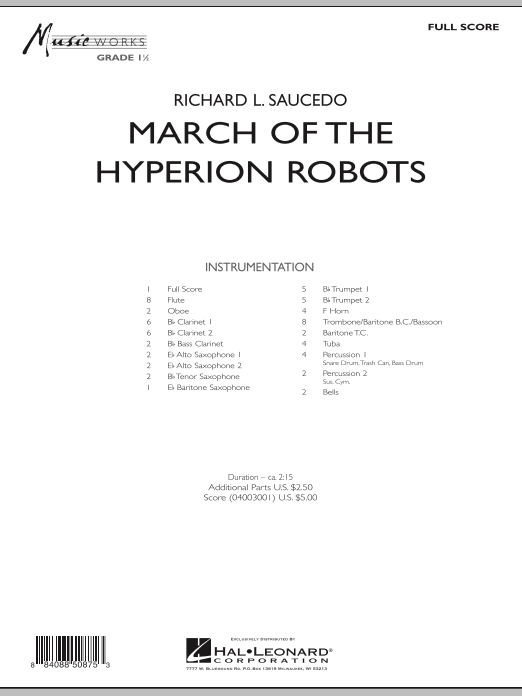

March Of The Hyperion Robots: Concert Band Conductor Score & Parts
By Richard L. Saucedo
Grade: 1.5
Item: 35-PK00156875
$45.00
Pickup currently not available
Buy Extra Parts (Digital PDF Download)
Parts Added to Cart!
Description
Hyperion, the mysterious moon of Saturn, boasts of a very musical race of robots! (Well, it makes for a fun story!) A perfect introduction to 6/8, this appealing and fresh-sounding work is written with easy-to-learn patterns, a single moderate tempo, and careful yet creative scoring for beginners. Dur: 2:10


March Of The Hyperion Robots: Concert Band Conductor Score & Parts isn't in MakeMusic Cloud just yet...but it could be. Let us know you'd like to see it, and you'll help shape what comes next. In the meantime, start a free trial and dive into thousands of interactive titles your students can play along with today.
Request This Title
Tell us you want it.
Start Your Free Trial
Explore everything that's ready to play right now.
Sample Audio
No sample audio found.
Sample Video
No sample videos found.
Additional Details
Publisher:
Hal Leonard
SKU:
35-PK00156875
More about this title
About the Composer: Richard L. Saucedo

Richard L. Saucedo spent 31 years as Director of Bands at Carmel High School in Indiana, building a program that earned state, regional, and national recognition across concert, jazz, and marching categories. His Wind Symphony I performed at the Music for All National Concert Band Festival three times and claimed the Indiana State Champion title in 2013. The Carmel Marching Greyhounds placed in the top ten at the Bands of America Grand National Championship for 17 consecutive years, capturing national championships in 2005 and 2012.
Beyond his teaching career, Saucedo has worked extensively as a freelance arranger and composer for marching bands, choral groups, concert bands, and orchestras. He served as Brass Arranger and Composer for the Cavaliers Drum and Bugle Corps, contributing to five DCI world titles, and currently coordinates music ensembles for the Blue Devils. Named Indiana's "Bandmaster of the Year" in 1998-99 and "Outstanding Music Educator" in 2010, he was inducted into the Music for All Hall of Fame in 2015 and the Drum Corps International Hall of Fame in 2022. He is an elected member of the American Bandmasters Association and serves as a Senior Educational Consultant for Music for All and Bands of America.
Why we love this
Saucedo brings a composer's clarity to rhythmic pedagogy. The piece introduces 6/8 through patterns that stick in students' ears rather than feeling forced, and the creative orchestration keeps a Grade 1.5 ensemble sounding fuller and more engaged than stock beginner fare. A two-minute ten-second duration means it works equally well as a concert opener, a teaching tool during rehearsal, or a confidence builder for younger ensembles.
What to expect
A whimsical machine in motion, all clean lines and purposeful rhythm. The scoring sparkles without demanding virtuosity; students feel accomplished the moment they nail the patterns, and audiences hear something genuinely composed rather than merely functional.
Who it's for
Beginning and early intermediate concert bands working toward rhythmic independence and confidence with compound meter. This piece works especially well for programs that prioritize solid fundamentals without sacrificing musicianship or joy.
How to get the most out of it
- Lock in the pulse by subdividing the dotted quarter note beat; have students conduct in 2 to feel the natural swing before they play
- Emphasize the distinctive melodic patterns early in sectionals so they become muscle memory; this payoff lets the band focus on blend and intonation during full rehearsals
- Keep the moderate tempo steady and intentional; rushing this piece undercuts the crisp rhythmic clarity that makes 6/8 stick for first-time learners
- Balance the melodic voices across sections so the easy-to-learn patterns remain audible; resist the urge to let any one color dominate the texture
How to use it
Open a concert with this piece to establish an upbeat tone and show audience members that young musicians can learn and perform fresh, contemporary writing. Slot it into a rehearsal rotation whenever you need a focused 10-minute block on compound meter without the cognitive load of simultaneous melodic complexity.
Skills your students will build
- Reading and performing in 6/8 time with confidence
- Recognizing and executing dotted quarter and eighth-note patterns
- Maintaining steady pulse within compound meter
- Listening for and balancing multiple melodic lines
- Sight-reading music with clear rhythmic and harmonic structure