
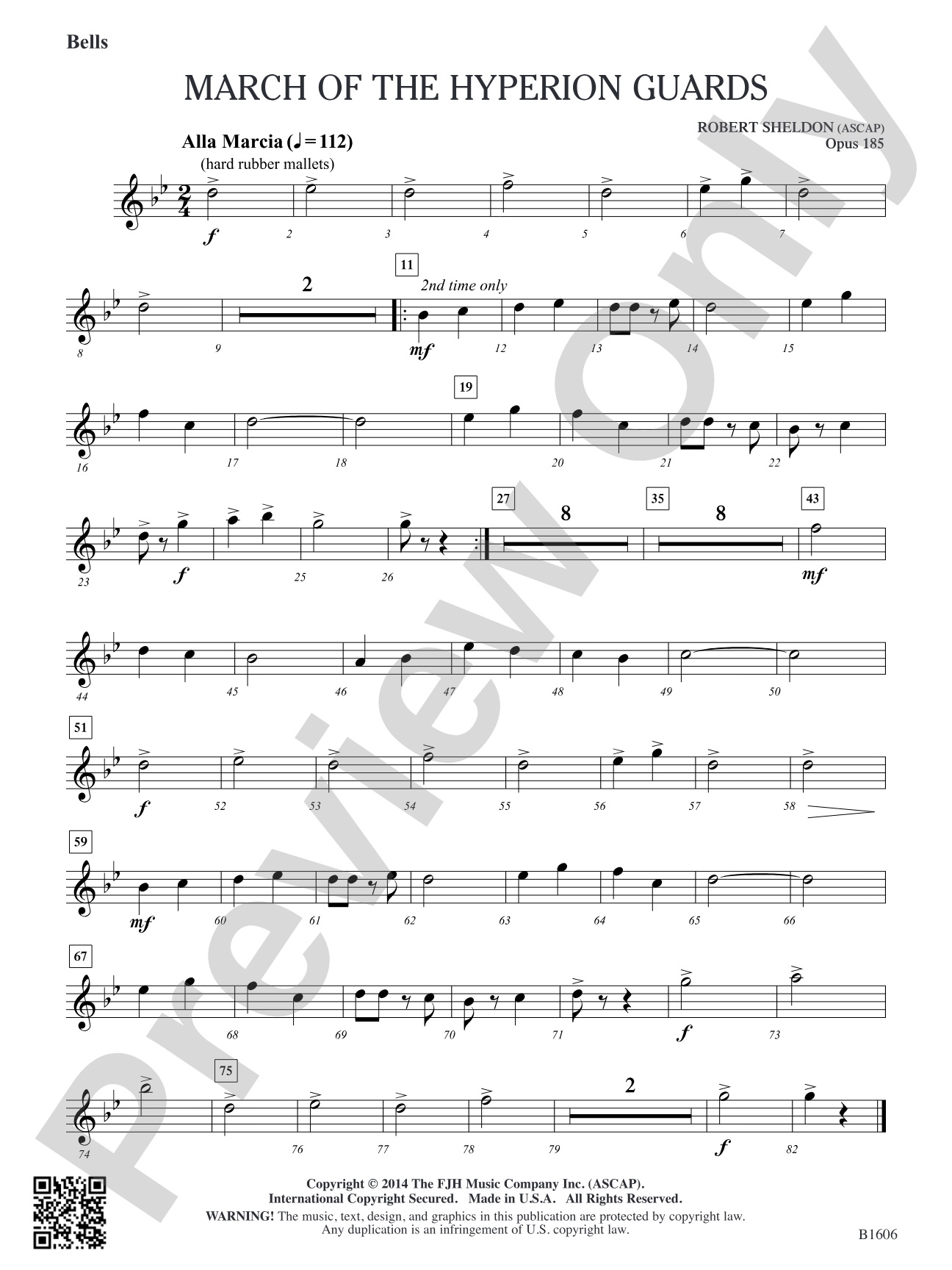

March of the Hyperion Guards: Bells
By Robert Sheldon
Grade: 1.5
Item: 98-PC-DB1606_B
$7.00
Pickup currently not available
Description
This march for young band was inspired by Greek mythology. Beginning ominously in a minor key, the tuneful main theme leads to a contrasting relative major section in the style of a British march. The piece ends by returning to the original minor key for its dramatic conclusion. A wonderful choice for directors looking for a “different” type of march!


Don't just read it, hear it, play along with it, and watch your students grow with it. In MakeMusic Cloud, March of the Hyperion Guards: Bells comes alive with professional accompaniment, adjustable tempo, and built-in practice tools that turn solo practice into real progress.
Open in the Player
Jump straight in and assign it today.
Start Your Free Trial
Open this title and explore the full library in minutes.
Sample Audio
1
Audio File
--:--
0:00
0:00
Sample Video
No sample videos found.
Additional Details
Series:
FJH MOS Performance
Publisher:
The FJH Music Company, Inc.
SKU:
98-PC-DB1606_B
More about this title
About the Composer: Robert Sheldon

Robert Sheldon's compositions saturate the wind band repertoire, performed by ensembles in schools and concert halls across the globe. His work appears consistently on state and national contest lists, and his influence extends to music education through his role as lead author of Sound Innovations for Concert Band. He has received recognition from the American School Band Director's Association, Phi Beta Mu, and ASCAP for compositions that balance musical sophistication with accessibility.
Sheldon maintains an active schedule as guest conductor for honor bands and clinician at universities and state music education conferences. His works have been heard in Carnegie Hall, Orchestra Hall, Symphony Hall, the Sydney Opera House, and the Kennedy Center. In 2020, VanderCook College of Music awarded him an honorary doctorate in recognition of his contributions to wind band music and music education.
Why we love this
This march subverts the familiar march formula in a way that keeps young players and audiences engaged. Sheldon grounds it in minor-key tension at the opening, which immediately signals something different from the typical bright march, then pivots into a lyrical British-style major section that feels earned and expansive. The return to minor for the dramatic finish gives the piece real dramatic arc rather than just running through expected moves.
What to expect
The piece opens with mythic tension, austere and minor-key dark. When the main theme arrives, it carries genuine tunefulness that emerges from that ominous ground. The shift to the relative major brings brightness and a sense of British ceremonial elegance, but the return to minor in the final section reestablishes the dramatic stakes set at the beginning, creating a sense of completion rather than repetition.
Who it's for
Young bands seeking a march with real musical personality and narrative arc. Grade 1.5 players have the technical foundation to handle the style shifts and accompanimental figures here, and teachers working with groups that are ready to move beyond generic march material will find this piece rewarding to rehearse and perform.
How to get the most out of it
- Establish the ominous minor key opening with clarity in the low reeds and brass; this sets the emotional foundation for the contrast to come, so don't rush the tempo or lighten the tone.
- Let the transition into the relative major breathe slightly; the shift in character is significant enough that a brief moment of space helps audiences hear the change as intentional rather than abrupt.
- Balance the main theme melody across your reed and brass sections so the tune sings clearly without overwhelming the harmonic support underneath.
- Shape the final minor section with forward momentum; this conclusion should feel inevitable and powerful, not like an anticlimax to the major section that preceded it.
How to use it
This works exceptionally well as an opener or closer on a concert where you want to signal that your band is tackling repertoire with musical substance. It pairs naturally with other works by Sheldon that young bands favor, or it can anchor a program section around thematic variety and contrasting styles. The Greek mythology inspiration also opens the door to a concert concept around classical storytelling in music.
Skills your students will build
- Executing dynamic contrast between minor and major key sections
- Maintaining clarity and forward motion through sustained harmonic passages
- Playing melodic material that sits across different instrumental families
- Understanding how key and mode create emotional color and structure