
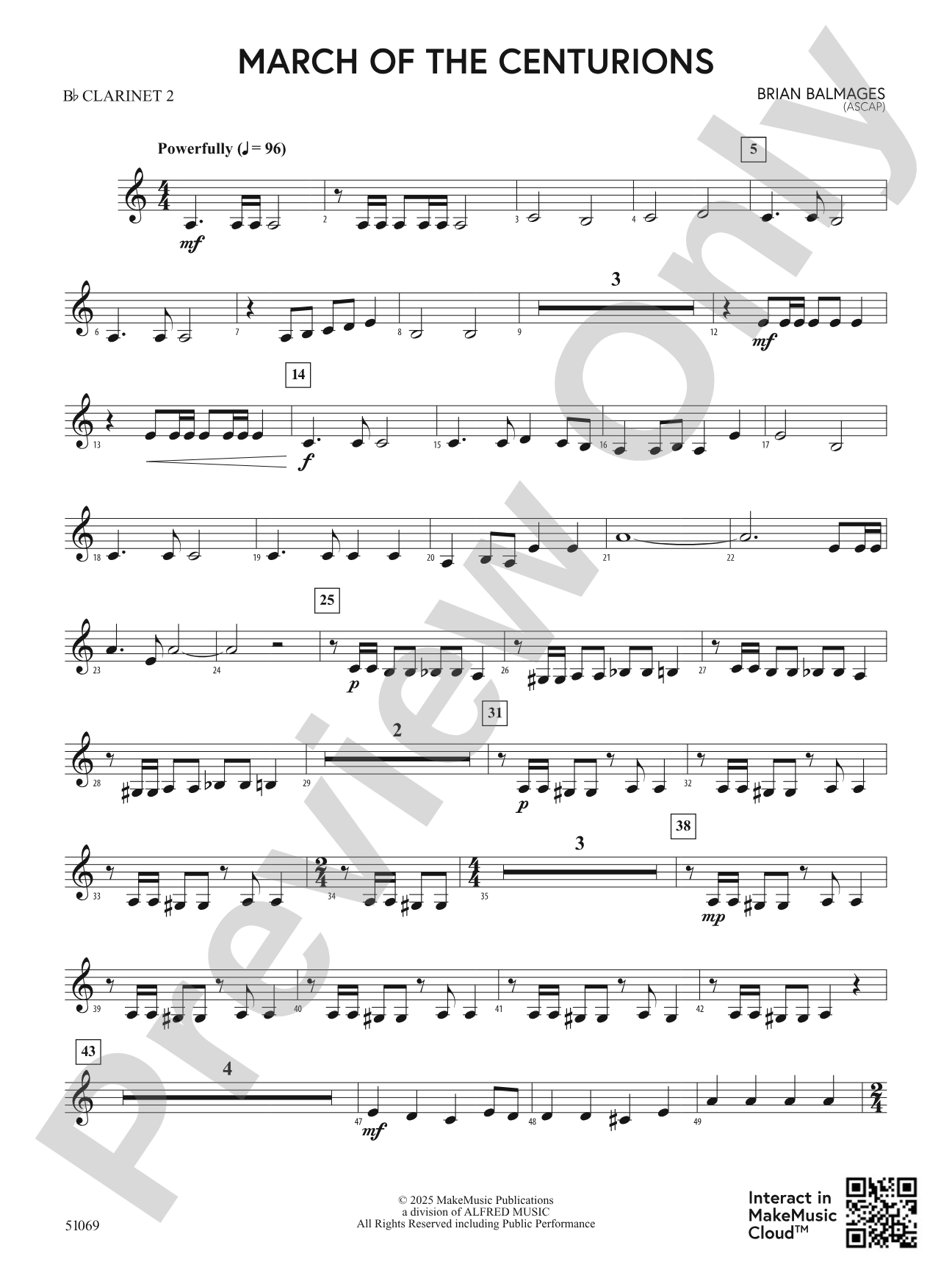

March of the Centurions: 2nd B-flat Clarinet
By Brian Balmages
Grade: 2.5
Item: 00-PC-0019392_C2
$3.00
Pickup currently not available
Description
The powerful group of Roman centurions process into the hall in perfect formation. Their collective movement is punctuated with bold melodic statements, a military-style cadence, and layered rhythmic and countermelodic elements. Brian Balmages has included optional antiphonal brass parts, perfect to include local high school or college students. March of the Centurions promises to be a jaw-dropping performance event! (4:00)


Don't just read it, hear it, play along with it, and watch your students grow with it. In MakeMusic Cloud, March of the Centurions: 2nd B-flat Clarinet comes alive with professional accompaniment, adjustable tempo, and built-in practice tools that turn solo practice into real progress.
Open in the Player
Jump straight in and assign it today.
Start Your Free Trial
Open this title and explore the full library in minutes.
Sample Audio
1
Audio File
--:--
0:00
0:00
Sample Video
Additional Details
Series:
MakeMusic Young Band
Publisher:
MakeMusic Publications
SKU:
00-PC-0019392_C2
More about this title
About the Composer: Brian Balmages

Brian Balmages has established himself as a composer and conductor with reach across orchestral, band, and chamber repertoires. His works have been premiered and performed by professional symphony orchestras, university ensembles, and school groups in venues including Carnegie Hall, the Kennedy Center, and the Sydney Opera House. He is an elected member of the American Bandmasters Association and received the A. Austin Harding Award from the American School Band Directors Association. In 2020, he won the NBA William D. Revelli Composition Contest for his composition Love and Light.
Balmages served as Director of MakeMusic Publications and Digital Education for Alfred and MakeMusic, bringing his deep understanding of music education to publishing and digital platforms. His conducting appearances span all-state and regional ensembles, university groups, and professional orchestras worldwide, including engagements at the Midwest Clinic, Western International Band Clinic, and numerous international venues. His work was performed at the 2013 Presidential Inaugural Prayer Service attended by President Obama and Vice President Biden.
Why we love this
Balmages builds clear narrative momentum within the reach of Grade 2.5 players, never condescending to the level. The optional antiphonal brass writing opens genuine programming flexibility, allowing you to expand the piece with student soloists or neighboring ensembles without rewriting a note. Audiences respond visibly to the Roman centurion imagery paired with the bold, processional character.
What to expect
Imagine the steady, inexorable advance of a Roman military formation entering a great hall, each footfall and gesture controlled yet undeniable. The music pulses with organized power, building from processional foundation into bold melodic proclamations that feel earned rather than rushed. It's ceremonial, commanding, and built on the kind of ensemble unity that makes audiences sit forward in their seats.
Who it's for
This score and parts set serves Grade 2.5 concert bands seeking a piece with genuine dramatic arc and visual appeal for contest or festival settings. Directors looking to program something beyond typical march fare will appreciate Balmages' sophisticated layering, which challenges students without demanding advanced virtuosity.
How to get the most out of it
- Establish the military precision early in rehearsals by treating the rhythmic figures as march fundamentals rather than mere accompaniment; lock the backdrop before layering melodic statements on top.
- Bring out the countermelodic lines by rotating rehearsal focus between sections, ensuring lower voices understand they're voicing independent material, not doubling the melody.
- If you're incorporating the optional antiphonal brass parts, place those players physically separated from the main ensemble so the call-and-response effect carries spatial impact.
- Shape the dynamics as a procession with weight; the piece builds through collective forward motion, not sudden dynamic spikes.
How to use it
Program this as a concert opener to establish energy and focus the audience's attention, or place it strategically mid-program where a dramatic shift in mood will reinvigorate both ensemble and listeners. The 4-minute duration and strong thematic closure make it ideal for festival adjudication, and the optional antiphonal brass parts create a natural showcase moment if you're programming a concert that includes guest musicians or advanced student soloists.
Skills your students will build
- Marching rhythm precision and steady pulse maintenance across changing textures
- Countermelodic independence while supporting a primary melodic line
- Dynamic control and phrase shaping across an extended processional form
- Ensemble balance in layered scoring with multiple simultaneous musical ideas
- Programmatic interpretation and character consistency from visual imagery