
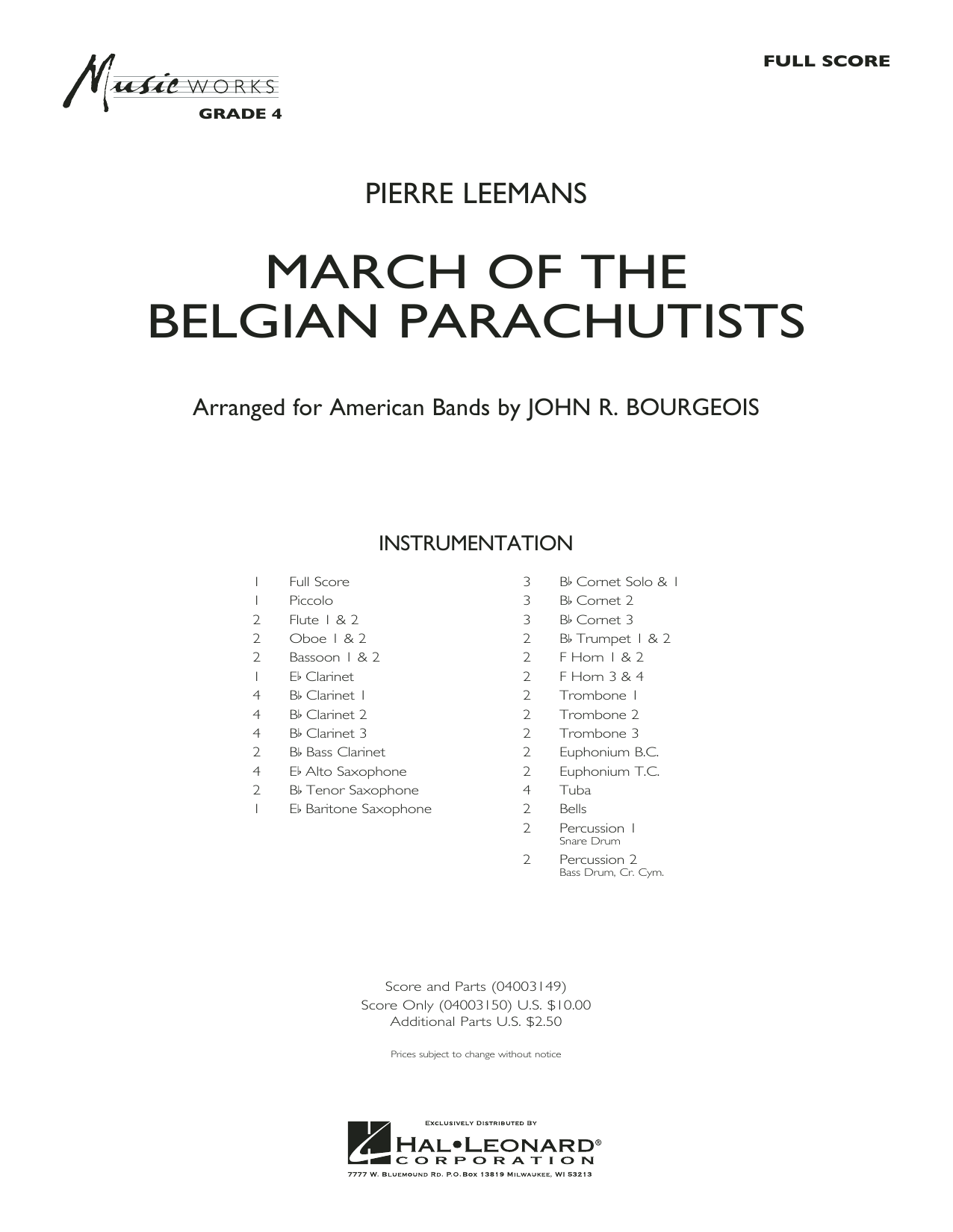

March Of The Belgian Parachutists: Concert Band Conductor Score & Parts
By Pierre Leemans / Arranged by John R. Bourgeois
Grade: 4
Item: 35-PK00244914
$75.00
Pickup currently not available
Buy Extra Parts (Digital PDF Download)
Parts Added to Cart!
Description
This immensely popular march, completed in Belgium near the end of World War II, is a lyrically upbeat European "walking march." Newly researched by Col. John R. Bourgeois, former conductor of the U.S. Marine Band, this edition contains several strains omitted from a previous edition. Delightful! Dur: 4:15


March Of The Belgian Parachutists: Concert Band Conductor Score & Parts isn't in MakeMusic Cloud just yet...but it could be. Let us know you'd like to see it, and you'll help shape what comes next. In the meantime, start a free trial and dive into thousands of interactive titles your students can play along with today.
Request This Title
Tell us you want it.
Start Your Free Trial
Explore everything that's ready to play right now.
Sample Audio
No sample audio found.
Sample Video
No sample videos found.
Additional Details
Publisher:
Hal Leonard
SKU:
35-PK00244914
More about this title
About the Composer: Pierre Leemans
Pierre Leemans (1904-1985) was a Belgian composer and conductor whose music captures the spirit of mid-twentieth-century Europe. Working during World War II, he composed works that resonated with the resilience and optimism of his time, blending accessible melody with solid compositional craft. His marches remain staples of the concert band repertoire, valued for their memorable themes and straightforward musicality.
Why we love this
This march has genuine personality without demanding virtuosity. Colonel Bourgeois's reworking restores material absent from earlier printings, giving you the composer's fuller vision while maintaining the accessibility that made this piece endure for nearly eighty years. It's the kind of piece that builds ensemble enthusiasm without overshooting a Grade 4 band's technical capabilities.
What to expect
Walking through a European city on a clear morning. The melody sits comfortably in the upper voices, supported by straightforward harmonic movement that sounds both elegant and unpretentious. There's patriotic warmth here without bombast, and a lilting quality that makes four minutes feel like the right length.
Who it's for
Grade 4 concert bands seeking a march with genuine musical substance. This works equally well for a band building its foundation in phrasing and sectional balance, or for an accomplished ensemble wanting a program opener that audiences recognize and remember.
How to get the most out of it
- Shape the melodic strains with clear phrasing rather than pushing tempo. A walking march lives or dies by its forward momentum and lyrical quality, not velocity.
- Balance the inner voices so the harmonic progressions read cleanly. Concert bands often bury the alto and tenor parts; bring them forward slightly during sustained passages.
- Let the rhythm section settle into a confident stride. Once your low brass and percussion find the pocket, everything else locks more easily.
- Emphasize the contrast between strains. If one section feels uptempo and bright, the next should feel noticeably warmer or more lyrical by comparison.
How to use it
This pairs well as an opening number before more demanding concert repertoire, or as a standalone feature that lets your audience settle in. It also works effectively in pops or community concert contexts where accessibility matters without sacrificing artistic integrity.
Skills your students will build
- Sustaining long phrase lines with steady air support
- Balancing melodic and harmonic layers in four-part writing
- Marching rhythms and consistent subdivision at moderate tempos
- Dynamic control and terraced transitions between contrasting sections
- Reading straightforward European march form and structure