
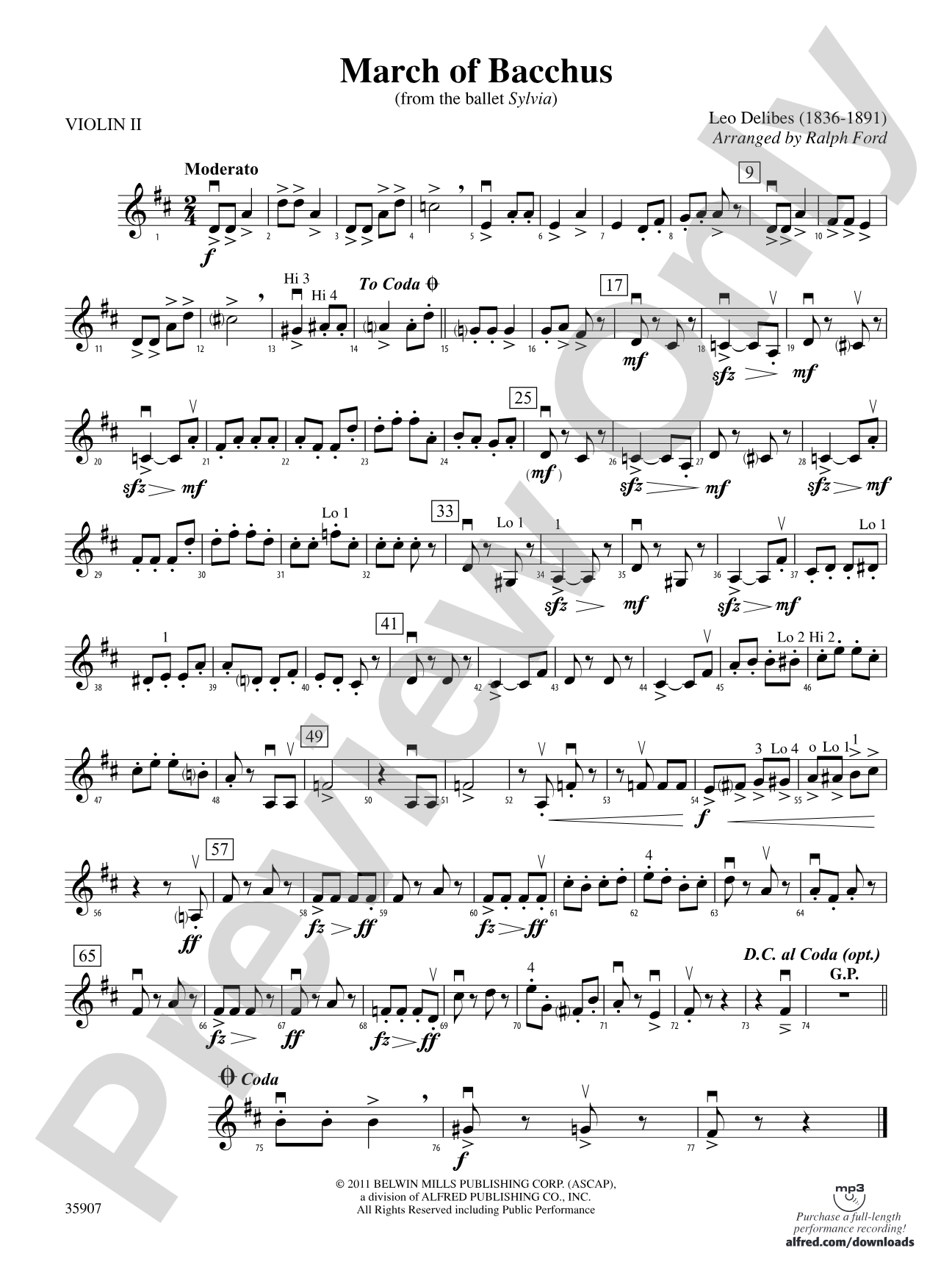

March of Bacchus (from the ballet Sylvia): 2nd Violin
By Léo Delibes / arr. Ralph Ford
Grade: 2.5
Item: 00-PC-0014991_VN2
$5.99
Pickup currently not available
Description
In this adaptation, the wonderful ballet music of Leo Delibes comes alive at the perfect level for young players. Originally presented as the opening of Act II of his Sylvia, ou La nymphe de Diane, it is both delicate and deliberate, with an almost "toy soldier" style. This title is available in MakeMusic Cloud.


Don't just read it, hear it, play along with it, and watch your students grow with it. In MakeMusic Cloud, March of Bacchus (from the ballet Sylvia): 2nd Violin comes alive with professional accompaniment, adjustable tempo, and built-in practice tools that turn solo practice into real progress.
Open in the Player
Jump straight in and assign it today.
Start Your Free Trial
Open this title and explore the full library in minutes.
Sample Audio
1
Audio File
--:--
0:00
0:00
Sample Video
No sample videos found.
Additional Details
Series:
Belwin Beginning String Orchestra
Publisher:
Alfred Music
Page Count:
76
SKU:
00-PC-0014991_VN2
Instrumentation:
string w/ vln3 and pno acc for rehearsal
More about this title
About the Composer: Leo Delibes
Leo Delibes (1836-1891) composed some of the 19th century's most enduring ballet scores, including Coppélia and La Source alongside Sylvia. His gift for melody and orchestral color made him a master of the Romantic ballet form, and his music remains central to the classical ballet repertoire performed worldwide.
Delibes wrote for the stage with remarkable clarity and charm. His orchestrations sparkle with detail, yet the core melodies and harmonic structures are direct enough that young players can grasp them immediately. For string orchestra arrangers, his ballet music offers ideal source material: it combines sophisticated compositional technique with the kind of accessibility that builds student confidence and musicianship.
Why we love this
Ralph Ford's arrangement preserves the character and orchestration of Delibes' original while scaling it perfectly for Grade 2.5 strings. The "toy soldier" quality mentioned in the description gives directors a piece that's genuinely fun to rehearse and perform, with clear rhythmic drive and moment-to-moment variety that keeps young musicians engaged. Programming a Romantic-era masterwork at an accessible level signals to your ensemble and audience that serious musical growth is happening.
What to expect
Stately and playful at once, like watching a formal procession that's slightly amused with itself. The orchestration shifts between delicate, almost impressionistic textures and moments of straightforward march-like conviction. Young players experience the confidence that comes from playing real music by a major composer, arranged thoughtfully for their abilities.
Who it's for
String orchestras at the Grade 2.5 level, whether they're building fundamentals or preparing for festival performance. Directors seeking high-quality Romantic repertoire that doesn't demand advanced technique will find this accessible without feeling simplistic.
How to get the most out of it
- Balance the rhythmic vitality against the delicate passages by rehearsing them as contrasting moods. The deliberate, marching sections need spring without becoming plodding; the lighter moments should float clearly above the accompaniment.
- Treat the ensemble as a single instrument, especially in the tutti sections. Intonation and articulation clarity will emerge naturally if players listen to the section around them rather than playing at individual interpretation.
- Use the optional rehearsal piano part to anchor the ensemble during sectional work, then remove it for full-orchestra runs to build independence and listening skills.
How to use it
This works beautifully as a concert opener, where its energy and clarity set an excellent tone for the ensemble. It also fits naturally into a program exploring European Romantic ballet music or serving as a stepping stone toward the more demanding Delibes arrangements typically tackled at higher levels.
Skills your students will build
- Reading and executing contrasting articulation styles within a single piece (crisp rhythmic passages versus sustained, lyrical lines)
- Balancing ensemble sound across different orchestral textures and dynamic ranges
- Understanding how an arranger adapts original music to serve younger players while preserving compositional intent
- Intonation and rhythmic precision in structured, march-like material with clear pulse