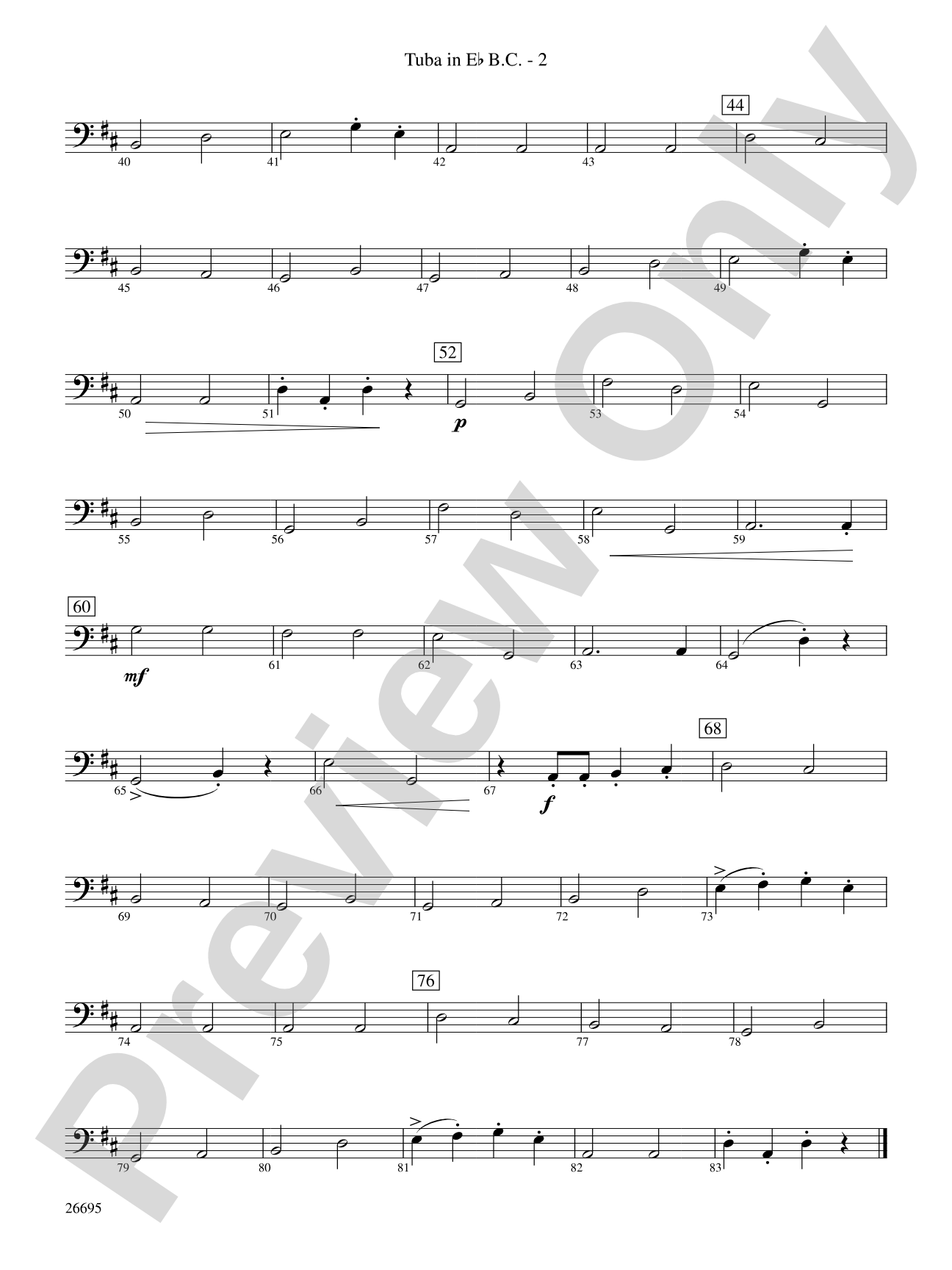
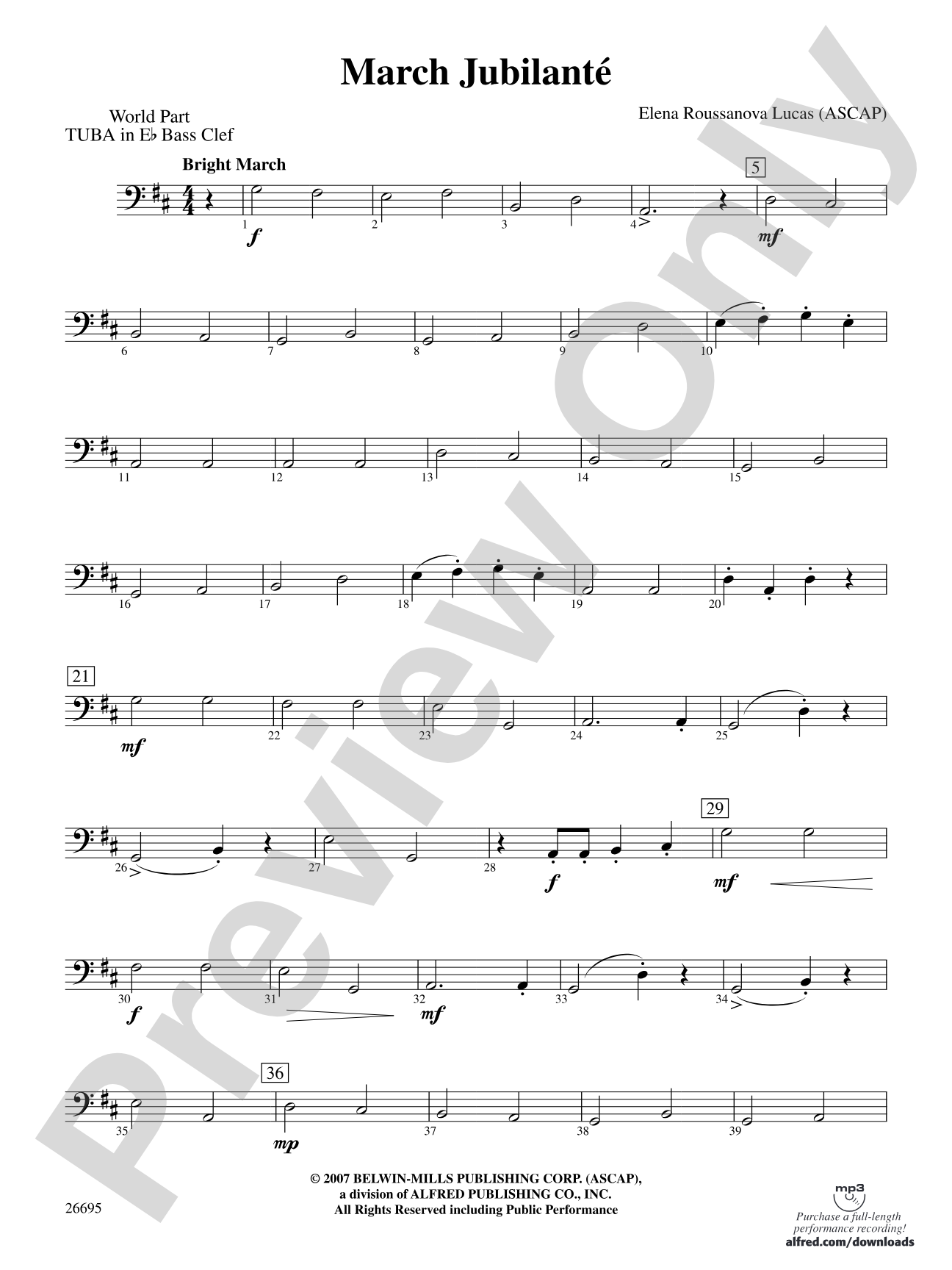
March Jubilante: (wp) E-flat Tuba B.C. Sheet Music Preview

March Jubilante: (wp) E-flat Tuba B.C.

By Elena Roussanova Lucas

Grade: 1 (Very Easy)

Item: 00-PC-0001176_wpTBEBC

Digital Download
$3.00
Description
Composed in the style of Percy Grainger, March Jubilanté is light and lively yet embraces a charismatic lilt. It is much easier than it sounds since all the melodies are simple to play. Elena Roussanova Lucas' spirited march is a wonderful opener or closer! This title is available in MakeMusic Cloud.

Don't just read it, hear it, play along with it, and watch your students grow with it. In MakeMusic Cloud, March Jubilante: (wp) E-flat Tuba B.C. comes alive with professional accompaniment, adjustable tempo, and built-in practice tools that turn solo practice into real progress.

Sample Audio
0:00
0:00
Sample Video
Additional Details
Series: Belwin Beginning Band
Publisher: Alfred Music
Page Count: 128
SKU: 00-PC-0001176_wpTBEBC

More about this title

About the Composer: Elena Roussanova Lucas

Elena Roussanova Lucas

Elena Roussanova Lucas trained at some of Russia's most rigorous conservatories, beginning piano studies at age three and advancing to Moscow's Central Music School for gifted young musicians. She earned her Red Diploma in Composition, Music History, Music Theory, and Instrumentation from the Tchaikovsky Conservatoire, studying composition under the mentorship of Tihon Khrennikov and Tatiana Choodova, and completed additional studies in Piano Pedagogy and Piano Accompaniment at the Ippolitov-Ivanov Music College.

Lucas is a member of the United Russian Composers Union, and her works have received performances by major orchestras including The Tchaikovsky State Orchestra of Moscow and The Russian National Orchestra Brass Quintet, as well as internationally renowned soloists and ensembles. She has taught composition at the Tchaikovsky Conservatoire and performed as a pianist throughout Moscow, the United Kingdom, The Netherlands, and the United States, earning First Prize in a Russia-wide piano competition sponsored by the Russian Ministry of Culture.

Why we love this

The Grainger-inspired style gives this march character and warmth while remaining genuinely accessible to young ensembles. Its construction is wonderfully transparent; the spirited energy and rhythmic drive sound sophisticated, yet your students play straightforward melodies that build their confidence immediately. It's the rare Grade 1 piece that works equally well as a concert opener or finale without feeling generic.

What to expect

Brisk and celebratory, with the rhythmic lift characteristic of Grainger's best marches. The spirited character carries forward without demanding technical showmanship; there's genuine musical joy in its simplicity.

Who it's for

Beginning concert bands and Grade 1 ensembles preparing their first concert season. This is ideal for groups still building fundamental rhythmic accuracy and ensemble balance while needing repertoire that sounds polished and stylistically interesting.

How to get the most out of it

  • Establish a clear, steady tempo in the opening rehearsals; the lilt and character emerge once the band locks into a confident pulse without rushing.
  • Balance the melody line across sections so it speaks above the accompaniment. This is simpler music, so clarity and blend matter more than complexity.
  • Shape phrases with slight dynamic swells even within the simpler passages; this prevents the ease of the material from sounding monotonous.
  • If you're using it as an opener, bring energy from the downbeat. If it closes the concert, emphasize the jubilant character without sacrificing control in the final measures.

How to use it

Its dual functionality as opener or closer makes it flexible for concert planning. Consider pairing it with contrasting slower work to highlight its energy, or use it early in the season to establish that young bands can perform with style and character from the start.

Skills your students will build

  • Sustaining ensemble blend at a steady march tempo
  • Balancing melodic lines against accompanimental figures
  • Articulating simple rhythmic figures with clarity and style
  • Shaping phrase contours in straightforward harmonic settings

You May Also Like