March In D Major Sheet Music Preview

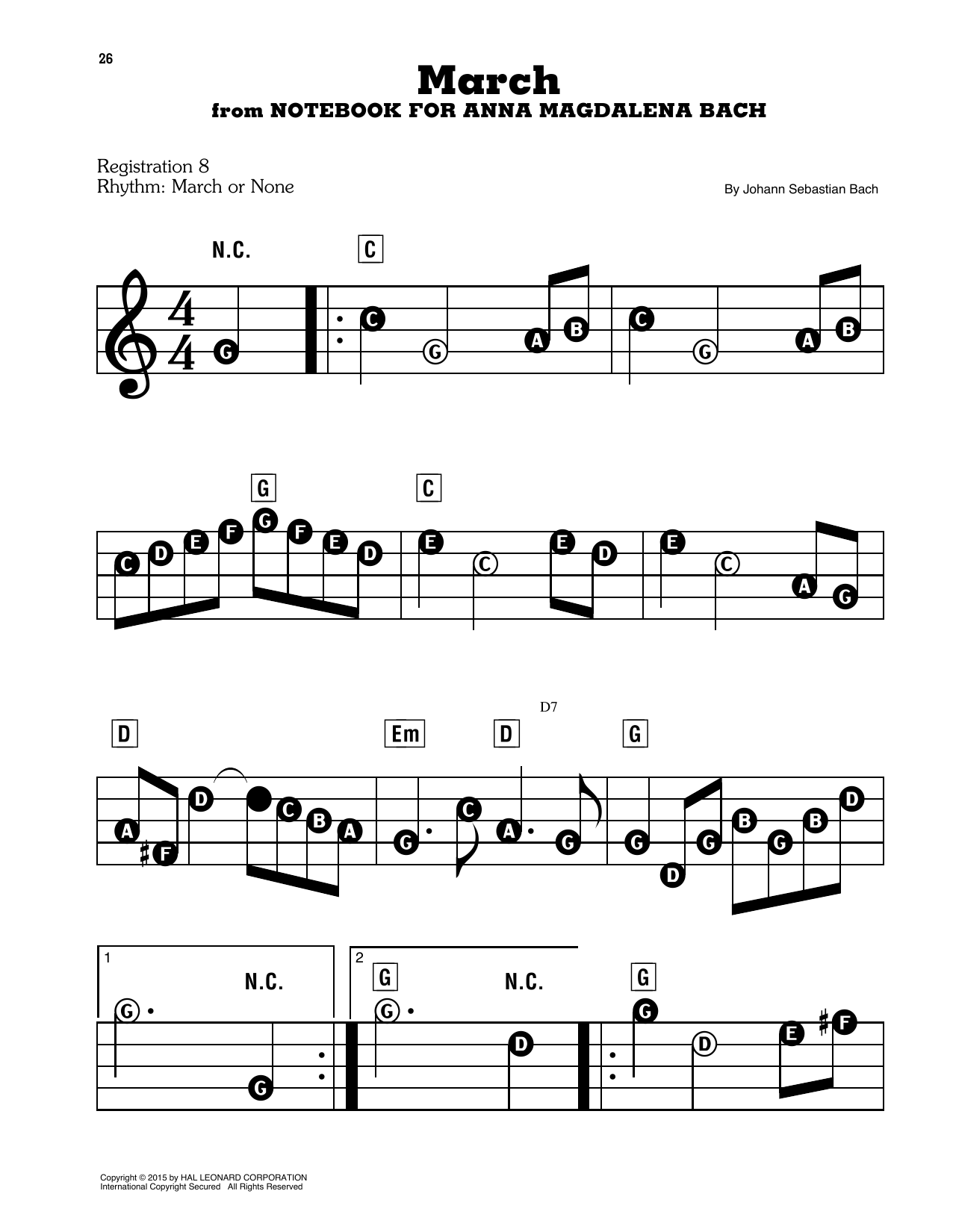
March In D Major: E-Z Play Today

By Johann Sebastian Bach

Item: 35-DS00733685

Digital Download
$4.99
Description

March In D Major: E-Z Play Today isn't in MakeMusic Cloud just yet...but it could be. Let us know you'd like to see it, and you'll help shape what comes next. In the meantime, start a free trial and dive into thousands of interactive titles your students can play along with today.

Sample Audio
No sample audio found.
Sample Video
Additional Details
Publisher: Hal Leonard
Page Count: 2
SKU: 35-DS00733685

More about this title

About the Composer: Johann Sebastian Bach

Johann Sebastian Bach (1685–1750) shaped Western music through his mastery of counterpoint, harmony, and structural clarity. His compositions span sacred works, secular suites, concertos, and keyboard music, each demonstrating a craftsman's precision and a composer's imagination working in concert. Bach's influence on music education remains foundational; his works teach voice leading, harmonic thinking, and the relationship between mathematical structure and expressive power.

Why we love this

Bach's marches belong in the early intermediate repertoire not because they're simplifications but because they're honest music, stripped of unnecessary decoration. The D Major tonality sparkles under student hands, and the steady pulse provides scaffolding for developing rhythmic independence and phrasing across both hands.

What to expect

Dignified and purposeful, with the clarity that Bach brought to his harpsichord music. The piece moves with quiet confidence, inviting the player to discover elegance in simplicity rather than relying on pedal or dramatic gesture.

Who it's for

Pianists in their first or second year of study who can navigate hand independence and basic two-part textures. This arrangement meets intermediate students where they can succeed with baroque idioms without the technical demands of the full keyboard works.

How to get the most out of it

  • Maintain evenness in the accompaniment figures so they don't overshadow the melodic line; think of the left hand as a supporting partner rather than a driving force.
  • Shape the melody by listening for the natural arch within phrases; resist the urge to accent every downbeat.
  • Anchor the tempo early in rehearsal so students internalize the march character; a metronome during practice prevents the rhythmic drifting common at this level.

How to use it

Open a spring or early summer recital with this Bach march; its brevity and charm serve as an excellent palate cleanser between weightier contemporary works. It also fits nicely into a baroque or "Keyboard Journeys" themed concert alongside pieces from later harpsichord suites.

Skills your students will build

  • Independence between melody and accompaniment
  • Baroque articulation and phrasing conventions
  • Steady pulse maintenance in march tempo
  • Right-hand melodic shape over left-hand patterns
  • Reading standard baroque notation and ornamentation

You May Also Like