
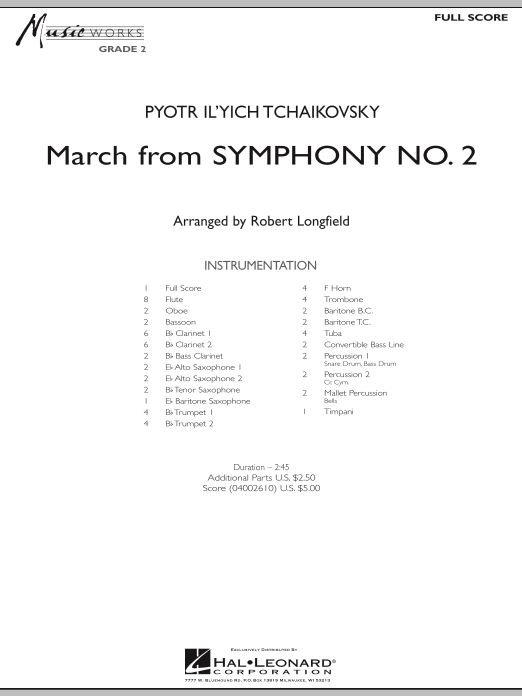

March from Symphony No. 2: Concert Band Conductor Score & Parts
By Pyotr Il'yich Tchaikovsky / Arranged by Robert Longfield
Grade: 2
Item: 35-PK00121023
$55.00
Pickup currently not available
Buy Extra Parts (Digital PDF Download)
Parts Added to Cart!
Description
Here's the famous march from Tchaikovsky's Symphony No. 2 skillfully arranged for younger players. Opening and closing with a solo timpani, this arrangement provides a wide range of dynamic contrasts and variety in scoring. From the delicate woodwind passages to the powerful full ensemble strains, this one works great! Dur: 2:45


March from Symphony No. 2: Concert Band Conductor Score & Parts isn't in MakeMusic Cloud just yet...but it could be. Let us know you'd like to see it, and you'll help shape what comes next. In the meantime, start a free trial and dive into thousands of interactive titles your students can play along with today.
Request This Title
Tell us you want it.
Start Your Free Trial
Explore everything that's ready to play right now.
Sample Audio
No sample audio found.
Sample Video
No sample videos found.
Additional Details
Publisher:
Hal Leonard
SKU:
35-PK00121023
More about this title
About the Composer: Pyotr Il'yich Tchaikovsky
Tchaikovsky stands as one of the most performed composers in concert halls worldwide, and for good reason. His gift for crafting memorable melodies and orchestrating them with precision and drama made him a master of the Romantic era. His symphonies, ballets, and concertos remain staples because they balance technical sophistication with emotional directness, qualities that translate beautifully across ensemble sizes and skill levels.
For school musicians, Tchaikovsky's work offers something rare: music that sounds substantial and professional while remaining accessible. His clear sense of form, his command of instrumental color, and his unapologetic use of melody make his scores ideal teaching tools. When students play Tchaikovsky, they're not just learning notes. They're absorbing how a master composer builds energy, sustains momentum, and makes an ensemble sound unified and purposeful.
Why we love this
This arrangement captures the sweep and character of Tchaikovsky's original without drowning younger players in complexity. The timpani bookends give the piece architectural clarity, while the alternating textures between solo sections and full ensemble keep energy levels high and provide natural moments for balancing and blend work. Grade 2 bands rarely get to play something this substantial that also sounds this exciting.
What to expect
Stately and propulsive. The timpani gives it a military bearing, but the woodwind writing softens that edge with lyrical moments that feel almost conversational. There's real drama in the dynamic swings, and the full ensemble passages carry genuine weight without ever feeling clumsy.
Who it's for
Grade 2 concert bands seeking a confident, musically substantial opener or closer. This works equally well for groups new to Tchaikovsky's orchestration or bands looking to program a recognizable work that doesn't sound like a simplified arrangement.
How to get the most out of it
- Treat the opening and closing timpani solo as the piece's dramatic anchor. Those moments need clarity and presence, so ensure your percussionist has a comfortable space to lock the tempo before the band enters.
- Shape the delicate woodwind passages by asking section leaders to play with a lighter dynamic foundation than they instinctively reach for. Transparency here makes the stronger tutti sections land with greater impact.
- Balance the full ensemble strains by checking that inner voices aren't drowning out your melodic lines. A quick sectional focusing on relative volumes between the melody and harmonic support will pay off immediately.
- Use the dynamic contrasts as rehearsal goals. Mark specific measures where the ensemble should audibly shift weight, and lock those transitions so they feel intentional rather than accidental.
How to use it
Open a concert with this to set a professional tone immediately. The 2:45 duration makes it a perfect companion to a longer work, or program it alongside other Romantic era arrangements to create a thematic set. Because it opens and closes decisively, it also serves well as a standalone feature when you need a strong singular statement.
Skills your students will build
- Balancing solo and ensemble textures
- Sustaining long dynamic arcs across a full piece
- Responding to clear architectural form (timpani bookends)
- Playing with control in both delicate and powerful dynamic ranges
- Listening for inner voice transparency in full ensemble passages