
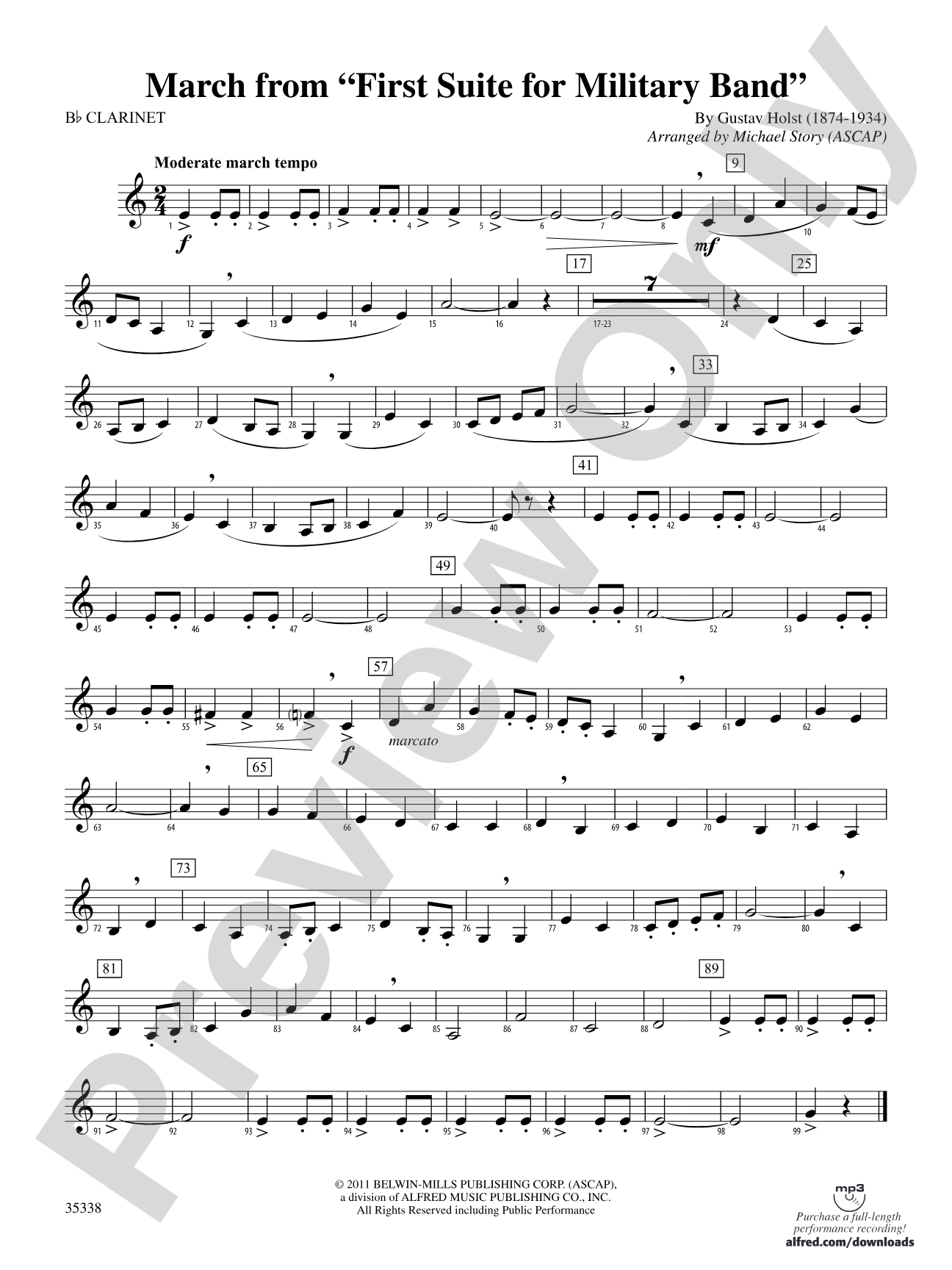

March from First Suite for Military Band: 1st B-flat Clarinet
By Gustav Holst / arr. Michael Story
Grade: 1 (Very Easy)
Item: 00-PC-0014893_C1
$3.00
Pickup currently not available
Description
Gustav Holst's First Suite in E-flat for Military Band, one of the first pieces written exclusively for military bands, was composed in 1909. This arrangement is based on the second theme of the March, a very lyrical melody reminiscent of British folk music. This setting brings this cherished work to the stands of your beginners. A welcomed addition to the beginning band repertoire!
"The limited ranges and technical demands make this a good way to introduce students to this important work at an early age."
- The Instrumentalist
This title is available in MakeMusic Cloud.


"The limited ranges and technical demands make this a good way to introduce students to this important work at an early age."
- The Instrumentalist
This title is available in MakeMusic Cloud.
Don't just read it, hear it, play along with it, and watch your students grow with it. In MakeMusic Cloud, March from First Suite for Military Band: 1st B-flat Clarinet comes alive with professional accompaniment, adjustable tempo, and built-in practice tools that turn solo practice into real progress.
Open in the Player
Jump straight in and assign it today.
Start Your Free Trial
Open this title and explore the full library in minutes.
Sample Audio
1
Audio File
--:--
0:00
0:00
Sample Video
Additional Details
Series:
Belwin Beginning Band
Publisher:
Alfred Music
Page Count:
130
SKU:
00-PC-0014893_C1
More about this title
About the Composer: Gustav Holst
Gustav Holst (1874-1934) was an English composer and teacher who fundamentally changed how the wind band was perceived as a concert medium. His First Suite in E-flat for Military Band, written in 1909, stands as one of the earliest major works composed specifically for military bands rather than arranged from orchestral sources. Holst's gift for melody and his respect for the capabilities of amateur musicians made him a champion of accessible yet artistically serious music for bands.
Holst's approach to band writing elevated the ensemble from parade ground functionality to concert hall legitimacy. He balanced technical accessibility with genuine musical substance, a principle that shaped decades of subsequent band composition. His influence extends far beyond his own works; he established a model for how serious composers could serve student and community musicians without compromising artistic vision.
Why we love this
Michael Story's arrangement captures the lyrical heart of Holst's original without overwhelming young musicians with technical barriers. The stripped-down ranges and uncomplicated harmonic language let students focus on phrasing and ensemble balance rather than fighting their instruments. Programming an accessible Holst validates beginning band musicians' musical taste while introducing them to a work that shaped the entire wind band repertoire.
What to expect
The March unfolds with the warmth of a British folk melody—accessible yet genuinely expressive, never simplistic. There's an understated dignity here, the kind of straightforward musical storytelling that appeals across age groups. The arrangement preserves Holst's elegant restraint, allowing young musicians to discover that simplicity and substance are not opposites.
Who it's for
This arrangement opens Holst's First Suite to beginning band students who lack the technical range and facility demanded by the original full score. Conductors introducing Grade 1 ensembles to concert repertoire beyond method-book standards will find this a gateway to genuine musical literature. Students encounter a work of genuine historical importance while building confidence in their abilities.
How to get the most out of it
- Balance the melody between sections; even at Grade 1, the lyrical quality of this British folk-influenced tune demands careful listening from non-featured players.
- Shape the phrase endings with slight broadening and dynamic softness rather than abrupt cutoffs—this small-scale work responds well to gentle musical architecture.
- Allow the march's forward momentum to breathe without rushing; younger ensembles often push tempo when excited, but Holst's melody needs air to sing.
- Emphasize the contrast between any forte sections and the returning lyrical material; beginning musicians benefit from clear textural landmarks.
How to use it
Place this early in a concert to establish musicality and engagement before advancing to higher-difficulty selections; the piece earns audience respect without requiring technical display. It pairs naturally with other Grade 1-2 classics or with original band works from the same era, building a program that reflects the band's historical roots. Consider this a bridge piece that helps students understand they're joining a tradition of serious musical expression, not just learning to read dots.
Skills your students will build
- Phrasing and breath management in sustained melodic lines
- Balance and blend between melody and harmonic accompaniment
- Understanding historical context and the concert band repertoire canon
- Attention to dynamic control in a work that prizes subtlety over range
- Ensemble listening and response to conductor interpretation