
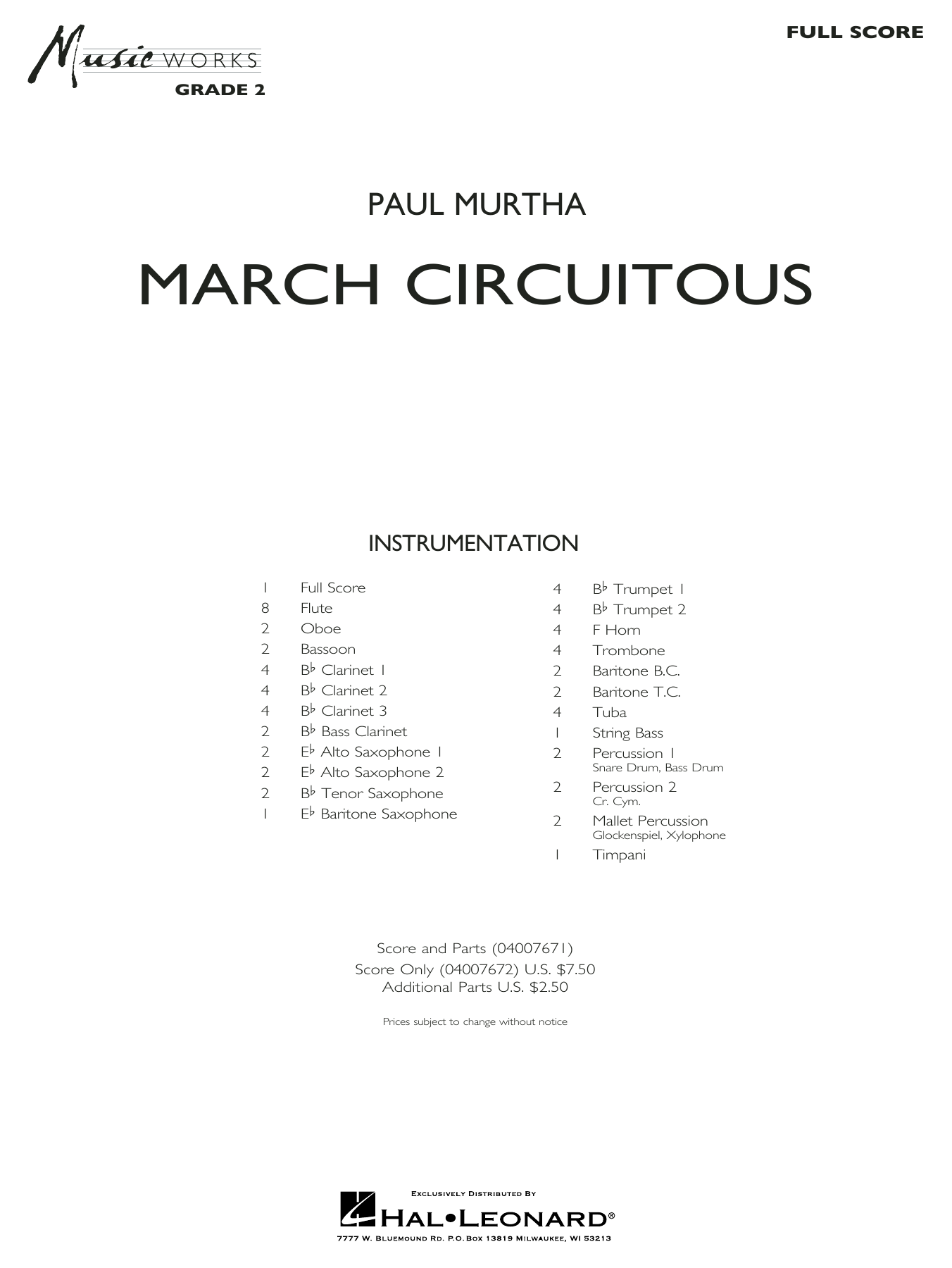

March Circuitous: Concert Band Conductor Score & Parts
By Paul Murtha
Grade: 2
Item: 35-PK01080857
$60.00
Pickup currently not available
Buy Extra Parts (Digital PDF Download)
| Product | Price | Quantity |
|---|---|---|
| March Circuitous - Full Score | $7.50 | |
| March Circuitous - Flute | $6.00 | |
| March Circuitous - Oboe | $6.00 | |
| March Circuitous - Bassoon | $6.00 | |
| March Circuitous - Bb Clarinet 1 | $6.00 | |
| March Circuitous - Bb Clarinet 2 | $6.00 | |
| March Circuitous - Bb Clarinet 3 | $6.00 | |
| March Circuitous - Bb Bass Clarinet | $6.00 | |
| March Circuitous - Eb Alto Saxophone 1 | $6.00 | |
| March Circuitous - Eb Alto Saxophone 2 | $6.00 | |
| March Circuitous - Bb Tenor Saxophone | $6.00 | |
| March Circuitous - Eb Baritone Saxophone | $6.00 | |
| March Circuitous - Bb Trumpet 1 | $6.00 | |
| March Circuitous - Bb Trumpet 2 | $6.00 | |
| March Circuitous - F Horn | $6.00 | |
| March Circuitous - Trombone | $6.00 | |
| March Circuitous - Baritone B.C. | $6.00 | |
| March Circuitous - Baritone T.C. | $6.00 | |
| March Circuitous - Tuba | $6.00 | |
| March Circuitous - String Bass | $6.00 | |
| March Circuitous - Percussion 1 | $6.00 | |
| March Circuitous - Percussion 2 | $6.00 | |
| March Circuitous - Mallet Percussion | $6.00 | |
| March Circuitous - Timpani | $6.00 |
Parts Added to Cart!
Description
Here is a creative take on the traditional march form. As the title implies, "March Circuitous" takes some inventive twists and turns along the way, providing a distinctive and rewarding march for young players. Dur: 2:40


March Circuitous: Concert Band Conductor Score & Parts isn't in MakeMusic Cloud just yet...but it could be. Let us know you'd like to see it, and you'll help shape what comes next. In the meantime, start a free trial and dive into thousands of interactive titles your students can play along with today.
Request This Title
Tell us you want it.
Start Your Free Trial
Explore everything that's ready to play right now.
Sample Audio
No sample audio found.
Sample Video
No sample videos found.
Additional Details
Publisher:
Hal Leonard
SKU:
35-PK01080857
More about this title
About the Composer: Paul Murtha
Paul Murtha is a prolific composer and arranger whose work spans concert band, jazz ensemble, and educational settings. His compositions demonstrate a gift for writing idiomatic parts that challenge young musicians while remaining within their technical grasp, and his marches have become standards in the Grade 2 repertoire.
Murtha's arrangements and original works are known for their clarity of orchestration and attention to rhythmic vitality. Directors consistently turn to his catalog when they need pieces that engage students without requiring advanced technique, making his output essential to school band programs across the country.
Why we love this
The real appeal here lies in what Murtha does with the march form itself. Rather than settling for a predictable A section into B section structure, he builds inventive harmonic and melodic detours that keep the ensemble and audience engaged. Young players feel the sophistication in the writing even as they're playing well within their abilities.
What to expect
Rhythmic and propulsive, with an underlying sense of discovery. The march walks forward with traditional confidence, but the harmonic and melodic turns create moments of playful surprise that make the listener perk up. It has character without being precious.
Who it's for
Grade 2 concert bands looking for a march that goes beyond formula, suitable for younger ensembles that are developing control over phrasing and section balance. This works equally well for groups preparing for festival competition or a concert program that calls for a spirited opener.
How to get the most out of it
- Anchor the first strain's forward motion by keeping the march tempo steady; younger bands often rush the upbeat figures, so a firm pulse from the bass line and percussion section will lock the feel in place.
- Balance the melodic lines in the trio section so the countermelodies don't overshadow the main tune. The "circuitous" character comes through when each voice occupies its own space.
- Bring clarity to any modulations or key shifts by slightly broadening the transition phrases. This gives the listener a moment to hear the harmonic turn rather than being swept past it.
- Pay attention to dynamics as structural markers; use them to highlight the inventive moments that distinguish this march from stock arrangements.
How to use it
Open a concert with this piece to set an energetic tone while signaling that the evening won't be entirely predictable. Pair it with a contrasting slow movement and a lyrical finale for a well-rounded set, or program it as a palate cleanser between heavier works.
Skills your students will build
- Maintaining steady tempo through rhythmic figures in the march idiom
- Balancing multiple melodic lines and countermelodies
- Identifying and executing harmonic modulations by ear
- Sustaining articulation and tone during fast-moving passages
- Following conductor cues through formal changes and structural turns