
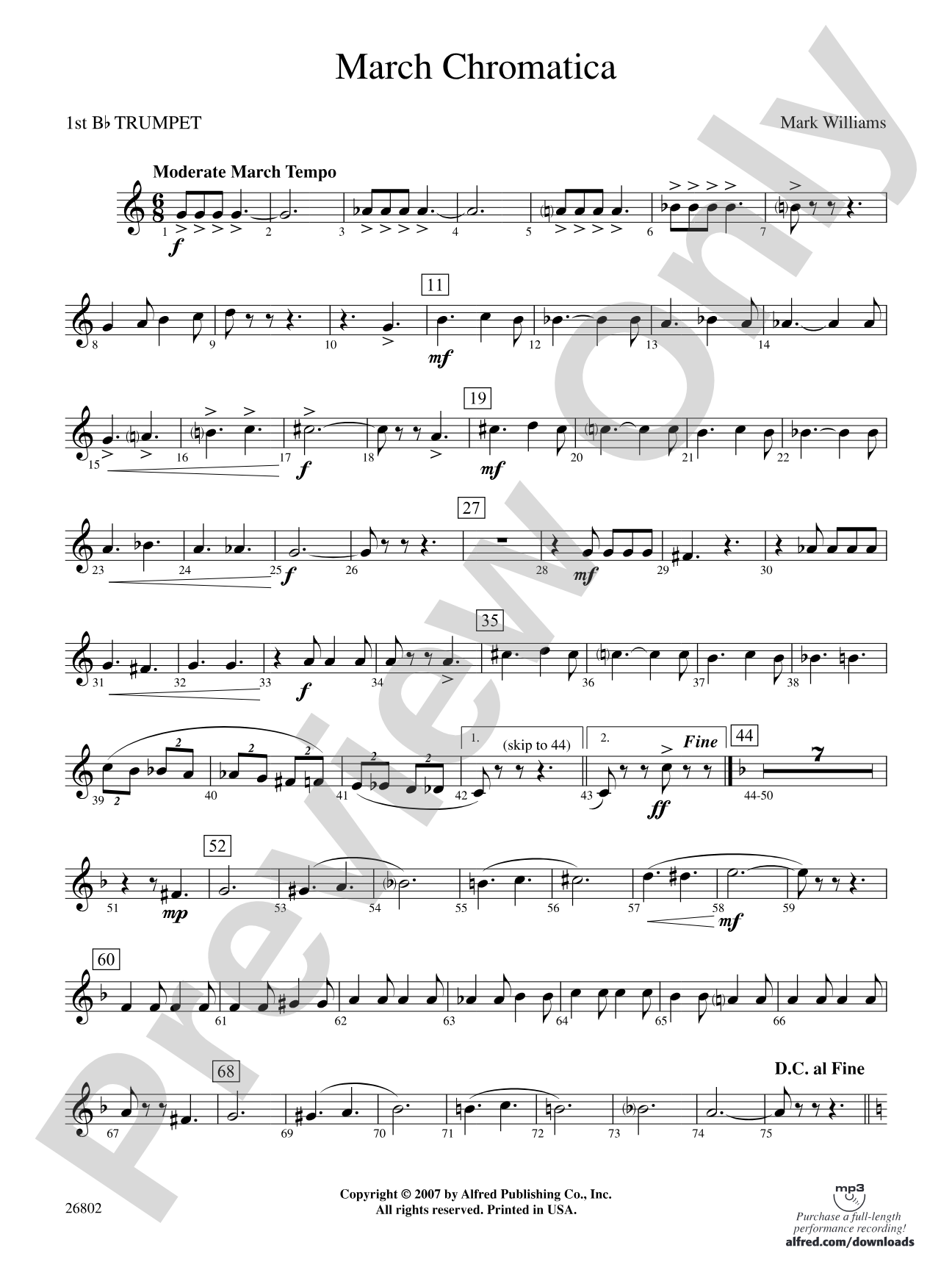

March Chromatica: 1st B-flat Trumpet
By Mark Williams
Grade: 1.5 (Easy)
Item: 00-PC-0001240_T1
$3.00
Pickup currently not available
Description
Destined to become a standard of the school band repertoire, the melodies of this classic old-time 6/8 march are based on the chromatic scale. In fact, the melodies and countermelodies in the "trio" section are pure chromatic scales (moving in opposite directions), and the superb harmonization makes it sound fantastic. You have to hear it to believe it! This title is available in MakeMusic Cloud.


Don't just read it, hear it, play along with it, and watch your students grow with it. In MakeMusic Cloud, March Chromatica: 1st B-flat Trumpet comes alive with professional accompaniment, adjustable tempo, and built-in practice tools that turn solo practice into real progress.
Open in the Player
Jump straight in and assign it today.
Start Your Free Trial
Open this title and explore the full library in minutes.
Sample Audio
1
Audio File
--:--
0:00
0:00
Sample Video
No sample videos found.
Additional Details
Series:
Challenger Band Series
Publisher:
Alfred Music
Page Count:
58
SKU:
00-PC-0001240_T1
More about this title
About the Composer: Mark Williams

Mark Williams built a career composing and arranging for school ensembles across North America and beyond. With a catalog exceeding 200 published works and credentials that include a co-authorship of the Accent on Achievement Band Method, Williams shaped the repertoire that generations of young musicians first encountered. His influence extended through clinician residencies in 34 U.S. states, five Canadian provinces, and Australia, where he advocated for accessible, engaging music that didn't compromise musicianship.
An educator first, Williams specialized in elementary band instruction throughout Washington state, grounding his compositional voice in the real needs of developing ensembles. His formal training at Eastern Washington University combined with his work as a woodwind performer and arranger for the 560th Air Force Band informed his distinctive orchestration and pedagogical clarity. He received recognition from the Western International Band Clinic's Gralia Competition and multiple ASCAP Special Awards, and later served as conductor and artistic director for the Spokane British Brass Band.
Why we love this
Williams uses a simple but brilliant concept here: pure chromatic scales become the melodic and harmonic backbone of a march that sounds polished and engaging at first reading. The 6/8 meter provides rhythmic lift, the opposite-direction chromatic movement in the trio creates genuine musical intrigue, and the orchestration stays transparent enough that Grade 1.5 bands can execute it cleanly without sacrificing impact. This is the kind of composition that reminds young musicians that clever composition and accessibility are not opposites.
What to expect
Bright, purposeful energy in 6/8 time that feels both familiar and fresh. The opening march strides forward with accessible melodic material, then surprises the ear in the trio where the chromatic lines shimmer in opposite directions, creating a moment of genuine harmonic sophistication within a piece any developing band can handle.
Who it's for
Any concert band at the Grade 1 to 2 level seeking repertoire that teaches harmonic thinking through an approachable melody. Directors looking for a march with substance and pedagogical merit will find Williams's chromatic concept both musically satisfying and straightforward to rehearse.
How to get the most out of it
- Establish a steady, lilting pulse in 6/8 by thinking of the measure as two beats rather than six; this settles the ensemble's groove and prevents the march from feeling rushed.
- Balance the chromatic lines carefully in the trio section, particularly where they move in contrary motion; highlight the outer voices so the harmonic effect lands clearly rather than sounding muddled.
- Use a slight taper into phrase endings to preserve the march's forward motion while still shaping the melodic line; avoid letting sections breathe so long that momentum stalls.
- Pay attention to dynamic continuity across the repeat; adjust balances if the band tightens or loosens tension on the reprise, since familiarity can flatten what should remain energetic.
How to use it
Use this to anchor a concert's opening or as the centerpiece of a "march show" program pairing it with other Grade 1 to 2 marches. Its straightforward demands make it ideal for winter or spring concert slots where you want to showcase ensemble technique without overextending rehearsal time, or program it early in the year when younger players are still building confidence.
Skills your students will build
- Sustaining steady pulse in 6/8 meter
- Reading and balancing chromatic melodic lines
- Playing contrary-motion harmony (trio section)
- Controlling dynamic continuity in march form
- Maintaining ensemble blend while articulating at tempo