
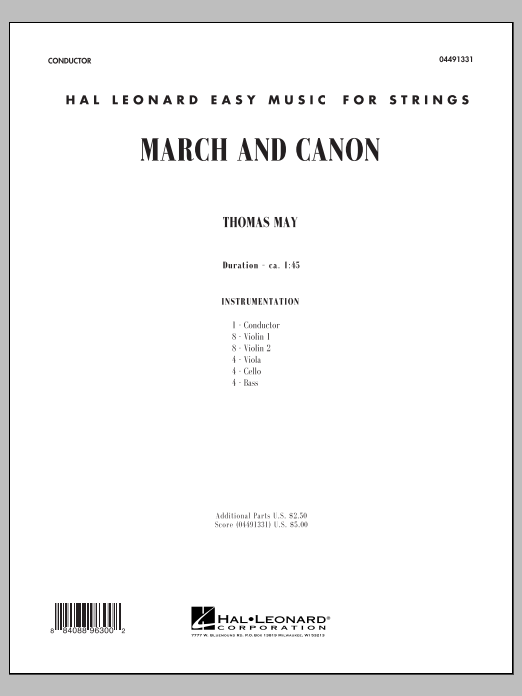

March and Canon: String Orchestra Conductor Score & Parts
By Tom May
Grade: 1
Item: 35-PK00287902
$35.00
Pickup currently not available
Buy Extra Parts (Digital PDF Download)
| Product | Price | Quantity |
|---|---|---|
| March and Canon - Conductor Score (Full Score) | $7.50 | |
| March and Canon - Violin 1 | $7.00 | |
| March and Canon - Violin 2 | $7.00 | |
| March and Canon - Viola | $7.00 | |
| March and Canon - Cello | $7.00 | |
| March and Canon - Bass | $7.00 |
Parts Added to Cart!
Description
Based on the famous "Canon in D" by Pachelbel, "March and Canon for Strings" helps students to reinforce basic rhythms that use half, quarter, and eighth notes in well-designed ensemble setting.
Dur: 1:45


March and Canon: String Orchestra Conductor Score & Parts isn't in MakeMusic Cloud just yet...but it could be. Let us know you'd like to see it, and you'll help shape what comes next. In the meantime, start a free trial and dive into thousands of interactive titles your students can play along with today.
Request This Title
Tell us you want it.
Start Your Free Trial
Explore everything that's ready to play right now.
Sample Audio
No sample audio found.
Sample Video
No sample videos found.
Additional Details
Publisher:
Hal Leonard
SKU:
35-PK00287902
More about this title
Why we love this
Tom May's arrangement strips Pachelbel's iconic progression down to its harmonic essence, then wraps it in straightforward rhythmic writing that lets students focus on ensemble precision without getting lost in complex notation. Young players hear themselves playing recognizable material, which builds confidence and engagement faster than abstract exercises.
What to expect
Stately and approachable. The march opening has ceremonial weight without pretension, and the canon section that follows feels like stepping into a music box version of Baroque elegance. The piece never asks students to play outside their comfort zone, which means they can actually listen to the sound they're making rather than struggling with the mechanics.
Who it's for
Beginning string orchestras making the jump from unison playing into functional part writing. This works equally well for teachers introducing students to ensemble standards based on classical repertoire and for conductors building a foundational concert program with music that audiences recognize.
How to get the most out of it
- Balance the melody against the accompanying voices by adjusting bow weight rather than speed; the march section especially needs clarity in the top line without drowning out the harmonic foundation.
- Establish a steady pulse in the march section before moving into the canon portion; the tempo shift between the two sections will feel more intentional if both are rock solid internally.
- Shape the repeated quarter note patterns in the accompaniment with subtle dynamic waves so they support the melody without becoming mechanical.
- Record a rehearsal run and play it back for the ensemble; hearing themselves against the piece often reveals balance issues the conductor's ear might miss at tempo.
How to use it
Use this as a concert opener or closer on a program with other accessible Grade 1 selections. The immediate recognition factor keeps audience attention early, and the modest duration makes it ideal for pairing alongside longer works. It also serves well as a end-of-unit or mid-year assessment piece once students have learned the rhythmic fundamentals.
Skills your students will build
- Reading half, quarter, and eighth note rhythms in a harmonic context
- Balancing melody and accompaniment within an ensemble
- Maintaining steady pulse while navigating an arrangement with distinct sections
- Listening to and adjusting for blend across four or more string parts
- Executing basic bowing patterns that support both rhythmic clarity and tonal consistency