Mapaleondo Sheet Music Preview

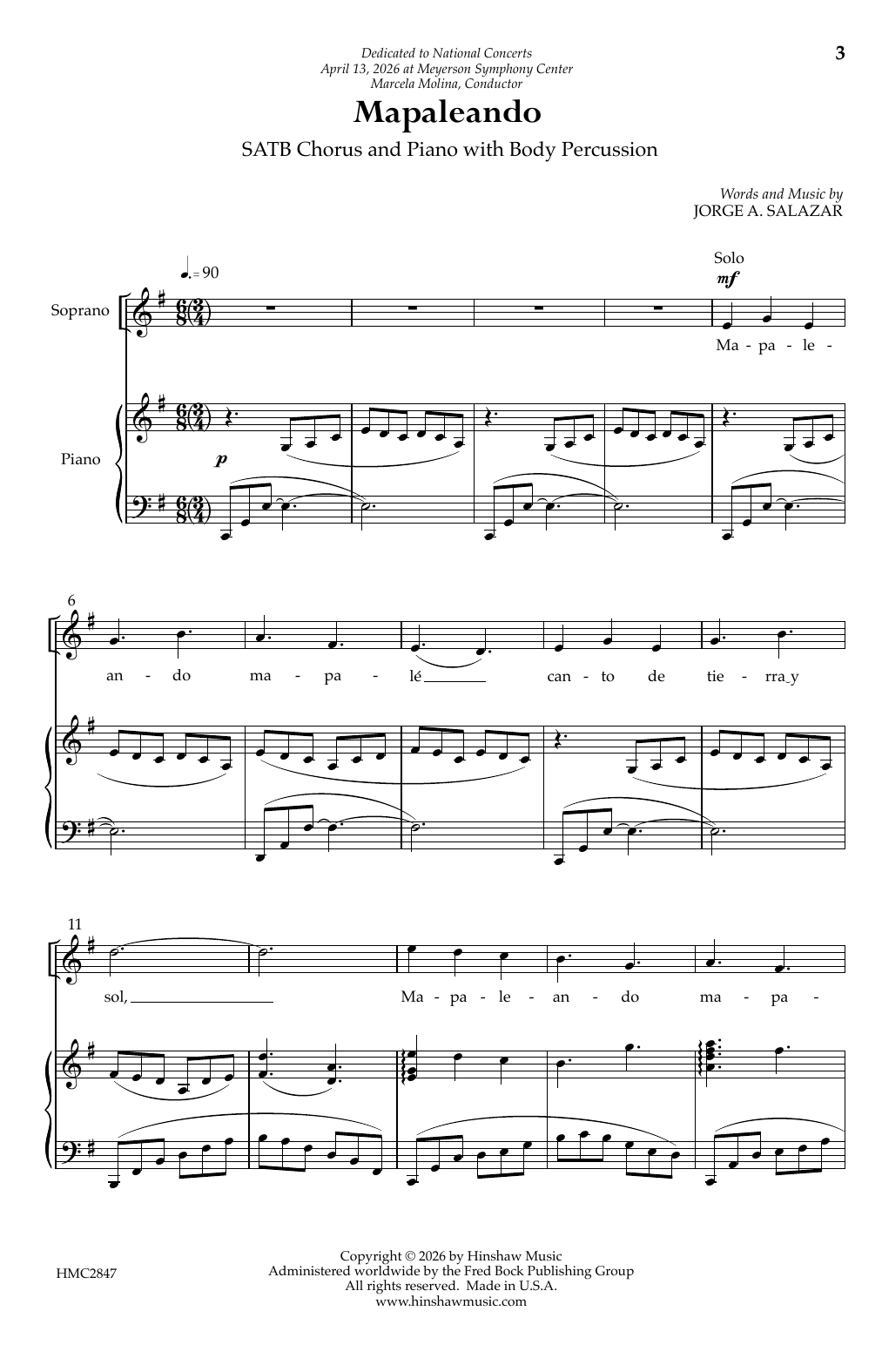
Mapaleondo: SATB Choral Octavo

By Jorge A. Salazar

Item: 35-DS01888832

Digital Download
$4.45
Description

Mapaleondo: SATB Choral Octavo isn't in MakeMusic Cloud just yet...but it could be. Let us know you'd like to see it, and you'll help shape what comes next. In the meantime, start a free trial and dive into thousands of interactive titles your students can play along with today.

Sample Audio
No sample audio found.
Sample Video
Additional Details
Publisher: Hal Leonard
Page Count: 19
SKU: 35-DS01888832

More about this title

About the Composer: Jorge A. Salazar

Jorge A. Salazar is a composer rooted in Latin American musical traditions, with a distinctive voice in choral writing. His work draws from the rich cultural landscapes of Spanish and Latin music, creating pieces that honor traditional idioms while engaging contemporary ensembles with accessible yet substantive arrangements.

Why we love this

Salazar writes choral music that feels both culturally grounded and immediately singable. The Spanish and Latin influences are woven throughout without requiring a specialized ensemble or prohibitive level of difficulty, making this an ideal choice for choirs looking to expand their multicultural repertoire without sacrificing musical authenticity.

What to expect

Mapaleondo carries the warmth and rhythmic vitality of Latin music while maintaining the refinement expected of concert choral writing. The piece radiates both celebration and reflective depth, creating moments of infectious energy alongside passages of genuine lyrical beauty.

Who it's for

This octavo serves choirs at intermediate to advanced levels who are ready to tackle Spanish text and Latin musical language. It works equally well for secular community choirs, university ensembles, and high school programs seeking to build cultural representation in their concert season.

How to get the most out of it

  • Pay attention to the text setting to shape natural phrasing; the Spanish language rhythms often guide breath placement and musical line architecture differently than English-language works.
  • Balance blend across the four parts with particular care to the characteristic melodic lines that may move between sections; Salazar's orchestration philosophy translates directly to how voices should balance.
  • Establish a clear harmonic foundation early in rehearsals by having the choir listen to how the chord progressions interact with the melodic contour, especially in moments where traditional Latin harmonic language meets contemporary color.

How to use it

This makes an excellent centerpiece for a multicultural concert program or a natural anchor for a set of Spanish and Latin American works. It also serves well as a standalone feature on a mixed repertoire concert, offering audiences an engaging entry point into contemporary Latin choral composition.

Skills your students will build

  • Singing in Spanish with authentic text stress and diction
  • Navigating Latin American harmonic progressions and melodic idioms
  • Maintaining rhythmic independence within a Latin ensemble context
  • Balancing traditional cultural elements with contemporary choral technique
  • Reading and interpreting 19-page choral scores with cultural specificity

You May Also Like