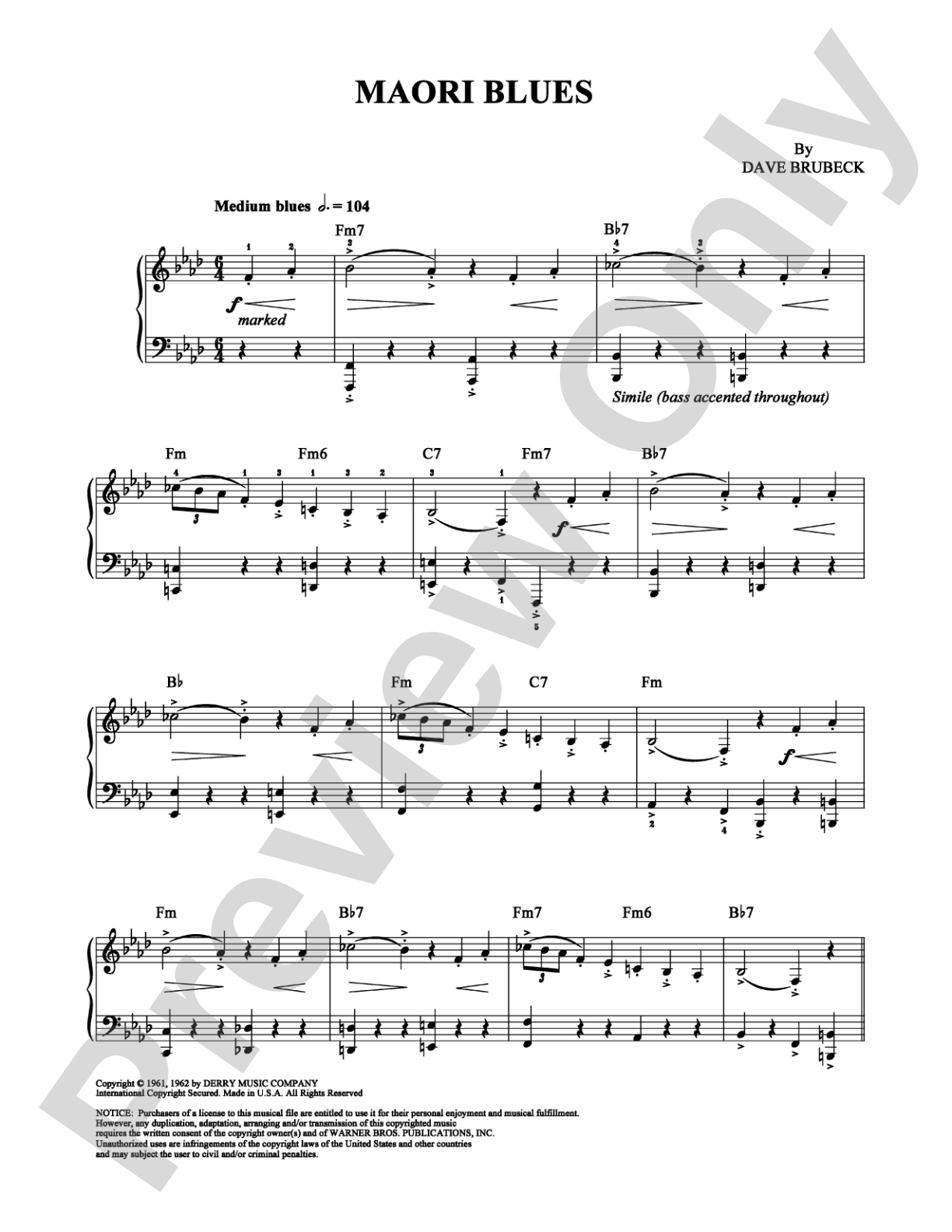
Maori Blues: Piano Digital Sheet Music

Maori Blues: Piano Digital Sheet Music

Dave Brubeck

Item: 00-PS-0000780

Digital Download
$3.99
Description

Maori Blues: Piano Digital Sheet Music isn't in MakeMusic Cloud just yet...but it could be. Let us know you'd like to see it, and you'll help shape what comes next. In the meantime, start a free trial and dive into thousands of interactive titles your students can play along with today.

Sample Audio
No sample audio found.
Sample Video
Additional Details
SKU: 00-PS-0000780

More about this title

About the Artist: Dave Brubeck

Dave Brubeck

Dave Brubeck stands as one of jazz's most significant figures, equally accomplished as an improviser and a formally trained composer. His output ranged across jazz standards and large-scale classical works including choral pieces, orchestral suites, and oratorios performed by ensembles like the London Symphony Orchestra. He studied composition with Darius Milhaud after World War II, an influence that shaped his lifelong integration of jazz language with classical forms.

Beyond his music, Brubeck was a cultural pioneer who challenged racial segregation in mid-20th-century America through his performances and collaborations. His album "Time Out" became the first jazz recording to sell over a million copies, and his composition "Take Five" achieved legendary status. His honors reflect his enduring impact: a Grammy Lifetime Achievement Award, the Presidential Medal of the Arts, and induction into the American Classical Music Hall of Fame in 2003.

Why we love this

Brubeck's jazz compositions demand serious musicianship from pianists without sacrificing the spontaneity and joy that draw people to jazz in the first place. "Maori Blues" gives students a chance to work with one of jazz's most respected voices on a piece that reveals how deeply composed and structured his thinking could be. Programming a Brubeck piece alongside classical repertoire reinforces the fact that jazz belongs in concert halls and recitals.

What to expect

The piece moves with the easiness of a blues while carrying the harmonic intelligence Brubeck was known for. There's a contemplative quality to the blues form here, tinged with the travel and cultural reflection suggested by the title. Playing it feels like stepping into a conversation between tradition and personal voice.

Who it's for

Pianists with solid jazz fundamentals and comfort with blues changes will find this piece both accessible and rewarding. It suits intermediate to advanced players looking to expand their understanding of composed jazz and Brubeck's distinctive voice. Students preparing for jazz festivals or recitals will benefit from its musical substance and cultural significance.

How to get the most out of it

  • Listen to Brubeck's recorded versions to internalize the rhythmic feel and harmonic sophistication before settling into your own interpretation. His touch carries both precision and swing.
  • Treat the blues changes as a foundation for exploration rather than a constraint. Brubeck's phrasing often sits just ahead of or behind the beat in ways that require careful listening to the harmonic framework.
  • Balance clarity in the left hand comping with melodic authority in the right. The blues idiom thrives on the conversation between bass and melody.

How to use it

Pair this with other jazz standards or composed jazz pieces to build a set that shows the breadth of the idiom. It works well in recitals that mix classical and jazz repertoire, signaling to audiences that both traditions deserve serious attention. This piece also serves as an excellent anchor for a concert theme exploring American composers or mid-century jazz innovators.

Skills your students will build

  • Comping and improvisation over 12-bar blues changes
  • Jazz swing feel and rhythmic flexibility
  • Harmonic awareness and voice leading in jazz contexts
  • Interpreting composed jazz with personal expression
  • Left-hand independence and rhythmic support

You May Also Like