Mannix Sheet Music Preview

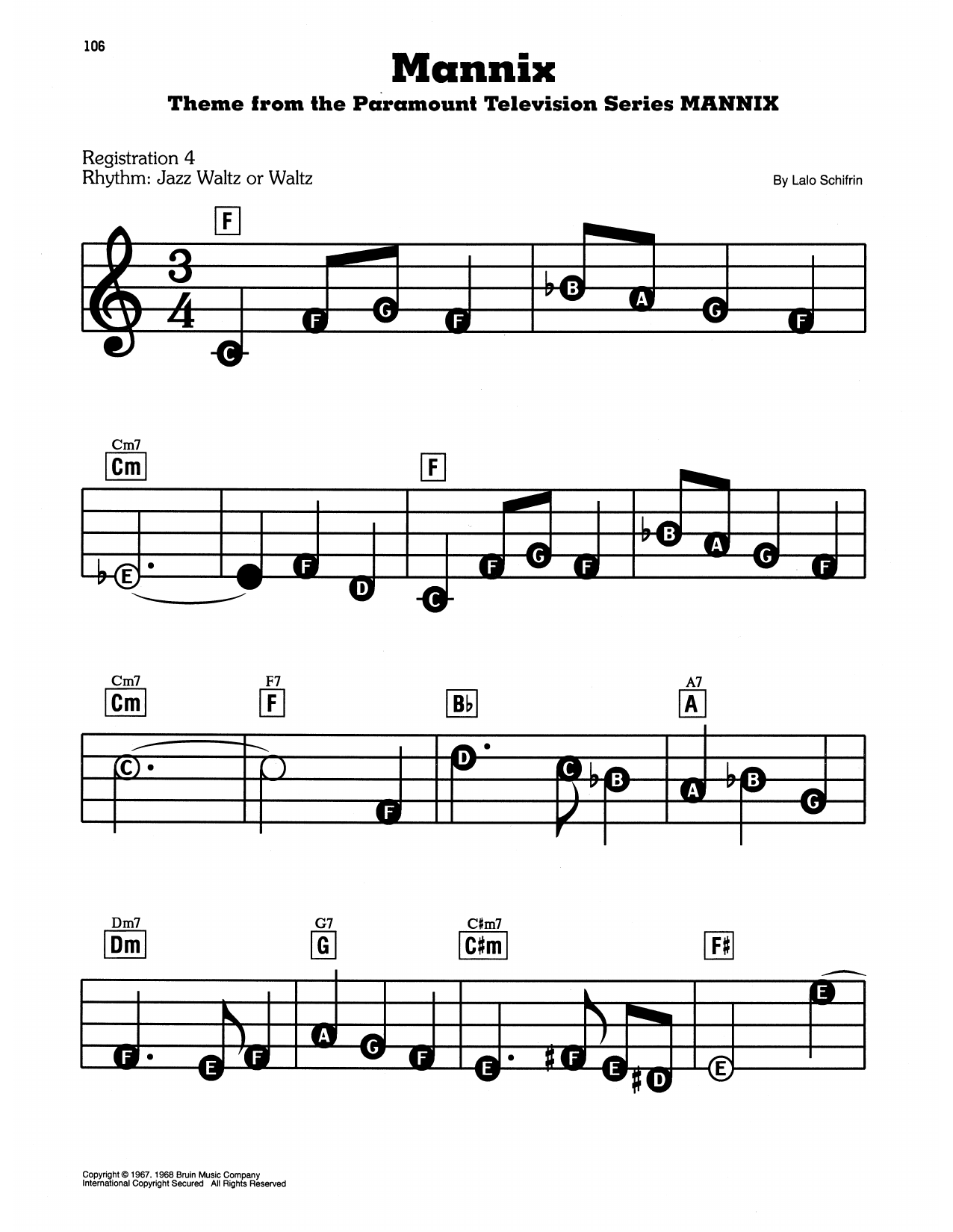
Mannix: E-Z Play Today

As performed by Lalo Schifrin

Item: 35-DS01863252

Digital Download
$4.99
Description

Mannix: E-Z Play Today isn't in MakeMusic Cloud just yet...but it could be. Let us know you'd like to see it, and you'll help shape what comes next. In the meantime, start a free trial and dive into thousands of interactive titles your students can play along with today.

Sample Audio
No sample audio found.
Sample Video
Additional Details
Publisher: Hal Leonard
Page Count: 3
SKU: 35-DS01863252

More about this title

About the Artist: Lalo Schifrin

Lalo Schifrin is an Argentine composer and pianist whose film and television scores became synonymous with the sound of 1960s and 70s spy thrillers. His work for Mannix, Mission: Impossible, and countless other productions established him as a master of tight, energetic orchestration that could drive narrative without overwhelming dialogue. Beyond Hollywood, Schifrin's classical training and jazz sensibility gave his commercial work genuine sophistication, making his scores both immediately engaging and musically substantive.

Schifrin's approach to film music prioritized clear, memorable themes that could anchor a dramatic moment in seconds. His piano writing captures the same propulsive energy and rhythmic precision that made his orchestral scores iconic, translating complex arranging concepts into accessible solo versions. For pianists and teachers, his work offers a direct line to professional composition craft rooted in storytelling.

Why we love this

The Mannix theme is instantly recognizable and sits perfectly for intermediate pianists who want to sound professional without technical overreach. Schifrin's economical writing here demonstrates how much dramatic impact comes from rhythm, articulation, and phrasing rather than finger-breaking passages, making it an ideal teaching tool for students learning to shape a pop idiom with intention.

What to expect

Sleek and purposeful. The theme moves with the confidence of someone walking into a room knowing exactly what they're after. There's an undercurrent of cool jazz sophistication beneath the top-line catchiness; you're playing something clever disguised as something simple.

Who it's for

Intermediate pianists drawn to film music, jazz, and popular styles will find this both musically rewarding and accessible. Music teachers can use this to introduce students to the language of functional harmony and rhythmic sophistication in the context of a piece they already know and love. It's also valuable for jazz students exploring how melody and harmony serve dramatic intention rather than harmonic complexity alone.

How to get the most out of it

  • Nail the rhythmic precision in the opening statement. This theme's power lives in its snap and drive, so lock into the grid without sounding mechanical; think orchestral tightness rather than robot precision.
  • Lean into the jazz harmonies with subtle voicing choices. Schifrin leaves room for interpretive color here, so experiment with how you voice the chords to add character without muddying the line.
  • Keep the tempo energetic but not rushed. The theme telegraphs urgency through rhythmic content, not speed; a patient tempo will let the listener feel the forward momentum.
  • Use dynamic contrast to separate the A and B sections. If the opening is your detective on the case, the bridge should feel like a plot twist; let the accompaniment texture change to reinforce the sectional shift.

How to use it

Include this in a pop or film music recital segment to bridge concert music and popular culture, or use it as a gateway piece to help jazz-curious students see the overlap between functional harmony and swing feel. It also works as an opener for community events where the audience recognizes the melody instantly, building immediate engagement before moving into other repertoire.

Skills your students will build

  • Rhythmic precision in swing and syncopated figures
  • Jazz voicing and comping techniques applied to a written melody
  • Sectional form awareness (using contrast to shape a short theme)
  • Balancing legibility with stylistic color in left-hand accompaniment
  • Articulation choices that serve genre (crisp, clipped attacks in a pop/jazz context)

You May Also Like