

Mangwani Mpulele: 2-Part Choral Octavo
(A Partner Song with "Hey, Mister Rain")
Sotho Folk Song / arr., with new words and music, by Mary Donnelly and George L. O. Strid
Item: 00-PO-0007864
$2.50
Minimum order quantity: 20 copies
Pickup currently not available
Related Items
Mangwani Mpulele: 2-Part Choral Octavo |
$2.50
|
View |
Description
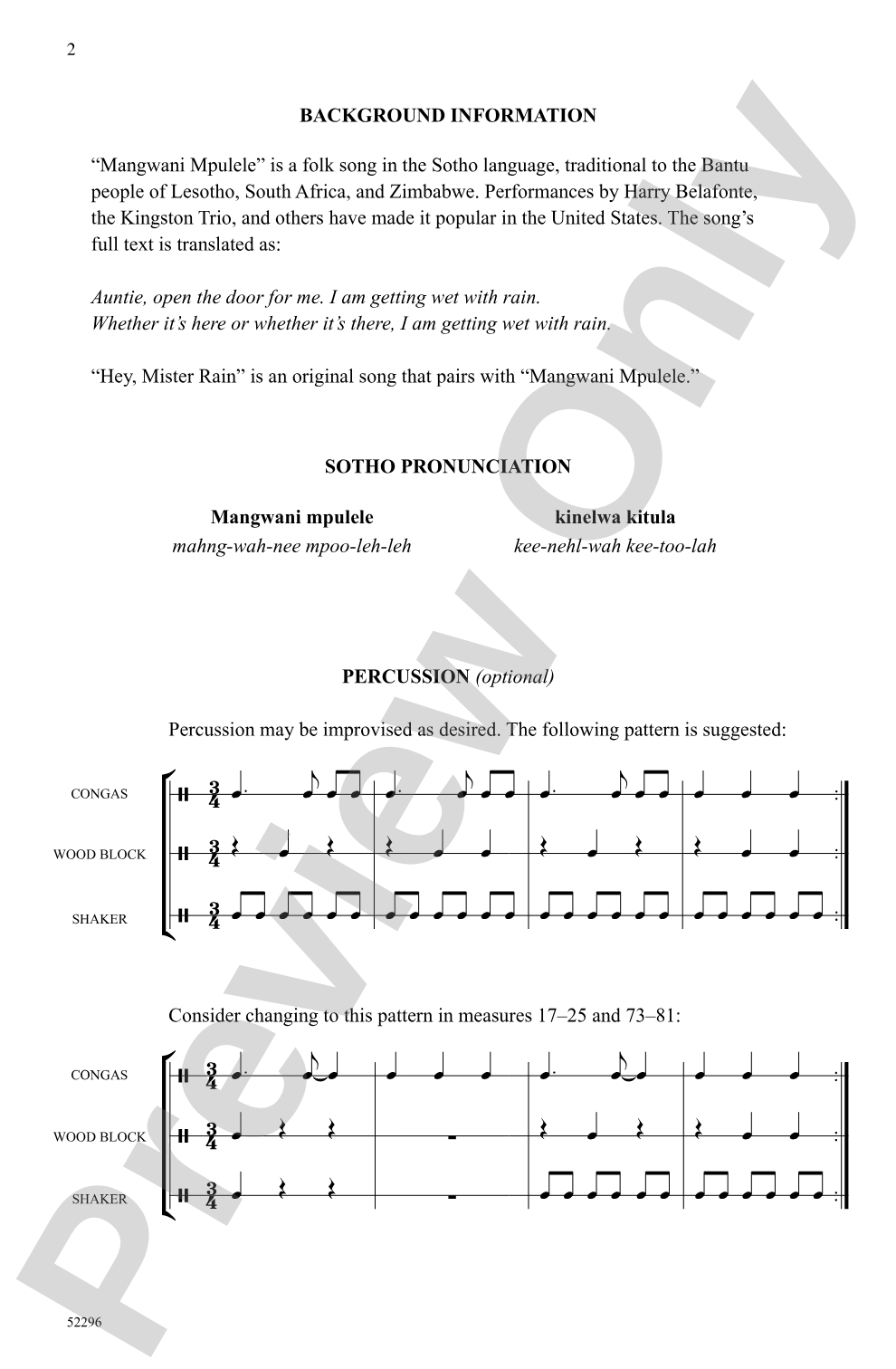
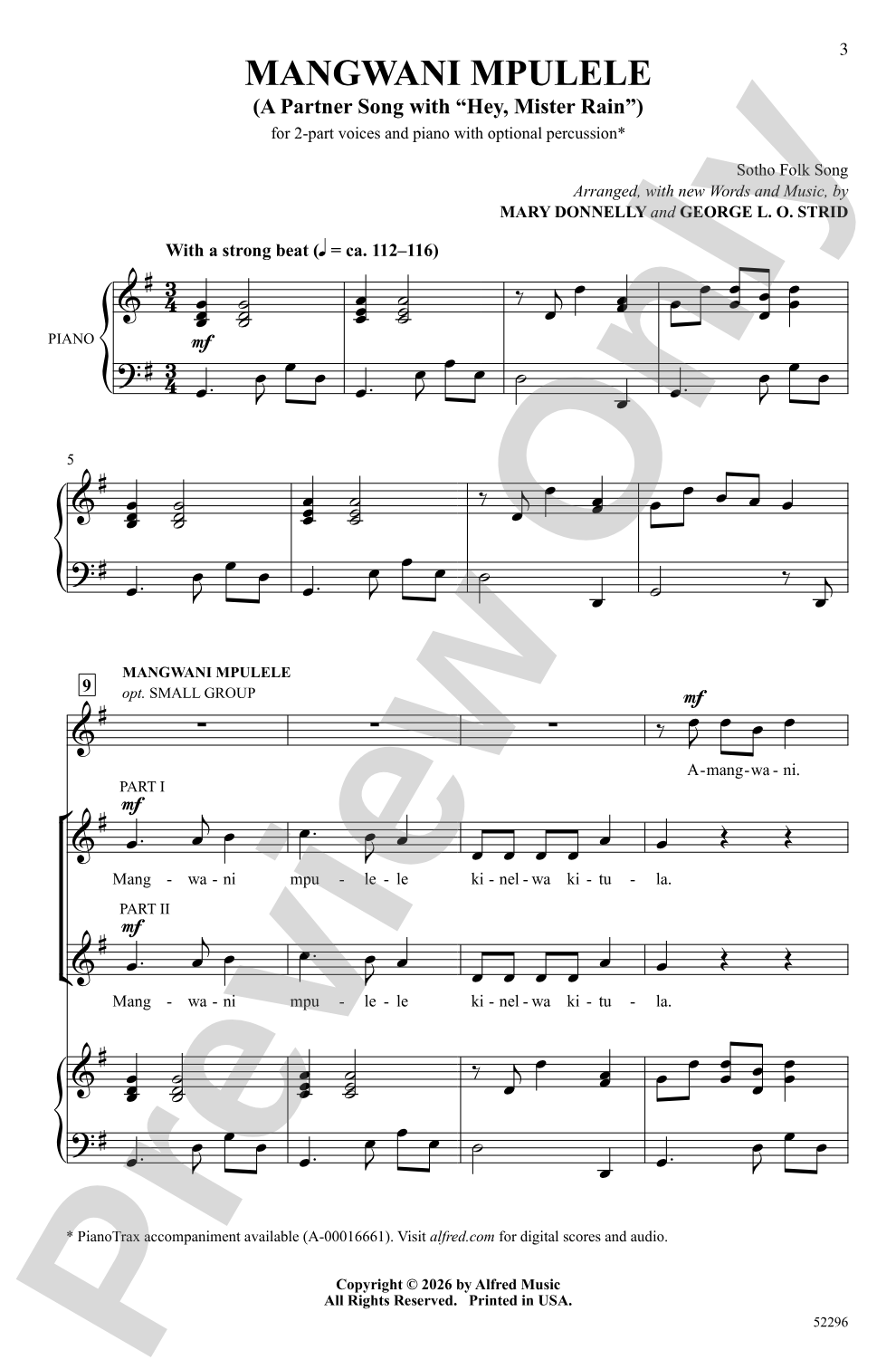
"Auntie, open the door for me. I am getting wet with rain." This charming folk song is most commonly associated with the Bantu people of Lesotho, South Africa, and Zimbabwe. The song became a global standard during the 1950s and 60s with recordings by The Kingston Trio and Harry Belafonte. This easy-to-assemble arrangement pairs the traditional tune with an original "Hey, Mister Rain" melody, plus optional small group interjections between phrases, creating the kind of call-and-response you'd expect from this genre. Optional percussion patterns add to the fun!


Mangwani Mpulele: 2-Part Choral Octavo isn't in MakeMusic Cloud just yet...but it could be. Let us know you'd like to see it, and you'll help shape what comes next. In the meantime, start a free trial and dive into thousands of interactive titles your students can play along with today.
Request This Title
Tell us you want it.
Start Your Free Trial
Explore everything that's ready to play right now.
Sample Audio
1
Audio File
--:--
0:00
0:00
Sample Video
Additional Details
Series:
Alfred Choral Designs
Publisher:
Alfred Music
Page Count:
12
SKU:
00-PO-0007864
More about this title
About the Arranger: Mary Donnelly

Mary Donnelly spent her formative years in Reno, Nevada, where she later returned to build her career in music education. After completing a Bachelor of Arts in English and French at the University of Nevada, Reno, she pursued formal training in music pedagogy, earning a Master's Degree in Education from Lesley College in Cambridge, Massachusetts, where she studied arts integration across the curriculum. She taught general music and choir in elementary and middle schools throughout the Washoe County School District for three decades before retiring.
In 1985, Donnelly met George L. O. Strid while co-teaching sixth-grade general music. When their principal challenged them to create a musical for Reading Week, they produced The Million Dollar Mystery and discovered a creative partnership that would span decades. Together they have composed over two hundred songs and created twenty-five musicals. Donnelly remains active in ACDA, NEA, and ASCAP, and continues to live in Reno with her husband, Rich.
Why we love this
This arrangement captures the infectious call-and-response spirit of the original while making it genuinely accessible for young singers. The interplay between the traditional Lesotho melody and the new "Hey, Mister Rain" countermelody creates engaging two-part writing that never feels forced, and the optional small group interjections and percussion patterns give you flexible ways to involve more voices and instruments depending on your ensemble's size and confidence level.
What to expect
Warmth and playfulness shine through from the opening. The familiar melody carries the ease of a song passed down through generations, while the original countermelody adds gentle sophistication without losing the work song's conversational feel. Optional percussion and small group voices create moments of gentle complexity that feel like a musical conversation unfolding in real time.
Who it's for
This arrangement works beautifully for middle school choirs and upper elementary groups with some singing experience. The two-part writing is forgiving enough for younger singers to succeed while remaining musically satisfying for more experienced ensembles, and the folk song's cultural roots make it an ideal choice for any program exploring world music or multicultural repertoire.
How to get the most out of it
- Clarify the call-and-response sections in rehearsal by having one group sing the traditional melody while the other learns the countermelody separately before combining them. Swapping parts halfway through builds ownership and prevents fixed listening patterns.
- If you include the optional small group interjections, assign them to confident singers who can maintain independence while listening to the main two-part texture. These moments should feel spontaneous, not rushed.
- Layer in percussion gradually during rehearsals. Start with the main sections before adding optional patterns, and let your rhythm section rehearse their parts independently so they can lock in without overshadowing the vocal lines.
- Emphasize the storytelling inherent in the lyrics. Even though the English text is brief and playful, singers who understand the narrative (a person asking an aunt to open the door during a rainstorm) will deliver more character and warmth.
How to use it
Program this as a bridge between a serious world music selection and lighter fare, or build an entire set around African and Caribbean repertoire by pairing it with other Donnelly-Strid arrangements. The recorded accompaniment makes it ideal for spring concerts when rehearsal time is thin, and its cultural authenticity complements educational programming around Lesotho, South Africa, or the folk music traditions of the African diaspora.
Skills your students will build
- Singing in two parts with independent melodic lines moving simultaneously
- Call-and-response phrasing and ensemble listening across divisi sections
- Cultural understanding of Lesotho folk traditions and diaspora music
- Rhythmic precision in optional percussion parts and their integration with vocal texture
- Storytelling and character in folksong interpretation