Manassas Memories: Viola Sheet Music Preview

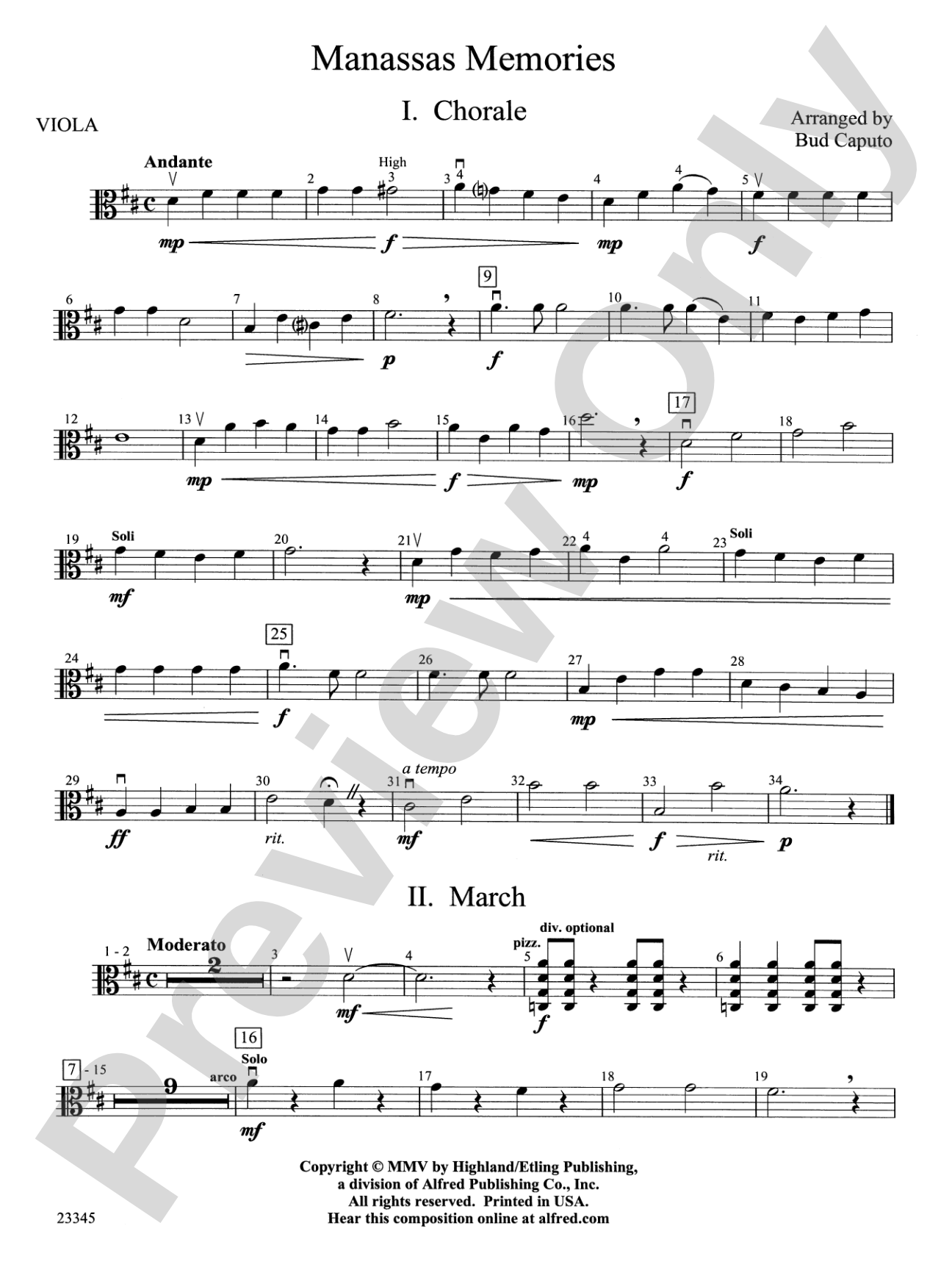
Manassas Memories: Viola

Arr. Bud Caputo

Item: 00-PC-0000690_VA1

Digital Download
$5.99
Description
Manassas Memories conjures memories of a trip through a small town in Northern Virginia during the civil war. It incorporates "Aura Lee," "The Battle Cry of Freedom," Dixie," Tenting Tonight," and "Just Before the Battle Mother."

Don't just read it, hear it, play along with it, and watch your students grow with it. In MakeMusic Cloud, Manassas Memories: Viola comes alive with professional accompaniment, adjustable tempo, and built-in practice tools that turn solo practice into real progress.

Sample Audio
0:00
0:00
Sample Video
Additional Details
Series: Highland/Etling String Orchestra
Publisher: Alfred Music
Page Count: 2
SKU: 00-PC-0000690_VA1

More about this title

About the Arranger: Bud Caputo

Bud Caputo

Bud Caputo brings decades of experience across public school music education, professional performance, and arranging to his work. He has held positions as a music consultant, instrumental coordinator, and teacher at multiple levels in Maryland, Virginia, and Florida; studied trombone with principal players from the New York Philharmonic, Metropolitan Opera, and National Symphony Orchestra; and performed with orchestras, military ensembles, and touring jazz bands throughout the East Coast. His arrangements and compositions are published with major houses including Carl Fischer, Alfred, Ludwig, and FJH Music, alongside numerous self-published works.

Caputo's educational background spans The Catholic University of America, the Manhattan School of Music, and the State University College at Potsdam. His work as a festival adjudicator and former jazz educator reflects a commitment to both classical and contemporary music traditions. His arrangement catalog demonstrates a particular gift for bringing American musical heritage into the rehearsal room in ways that engage students and audiences alike.

Why we love this

Caputo roots this arrangement in genuine historical and geographic specificity, weaving together five beloved Civil War-era songs into a narrative arc that honors a particular place and moment. The two-page format makes it accessible for student orchestras without oversimplifying the arranging craft, and the medley structure gives young musicians the satisfaction of recognizing familiar melodies while learning how a skilled arranger creates coherence from multiple sources.

What to expect

The arrangement honors the solemnity and sentiment of its source material while maintaining accessibility for younger players. Moving through "Aura Lee," "The Battle Cry of Freedom," "Dixie," "Tenting Tonight," and "Just Before the Battle Mother" creates a reflective journey that acknowledges loss, courage, and the human toll of conflict.

Who it's for

String orchestras at the intermediate level will find this arrangement both musically rewarding and programmatically useful. It works well for ensembles seeking 4th of July or summer patriotic programming without resorting to light or trivial fare.

How to get the most out of it

  • Balance the historical melodies so each tune registers clearly to the audience; resist the urge to let one voice dominate the texture simply because it carries the primary tune.
  • Establish the emotional weight of the material by attending to phrase shape and dynamic contour rather than rushing through transitions between songs.
  • Use the relatively modest length to your advantage: rehearse this thoroughly so that entrances and section hand-offs happen with precision, giving the medley a polished, intentional feel.

How to use it

This pairs naturally with other Americana or patriotic selections on a summer pops or independence day concert. Its modest length also makes it suitable as the opener or a transition piece within a larger program exploring American musical heritage.

Skills your students will build

  • Reading multiple melodic phrases across different instrument sections
  • Maintaining textural clarity when multiple tunes or musical ideas appear simultaneously
  • Interpreting dynamic and expressive markings that carry historical emotional weight
  • Coordinating ensemble transitions between distinct musical sections

You May Also Like