
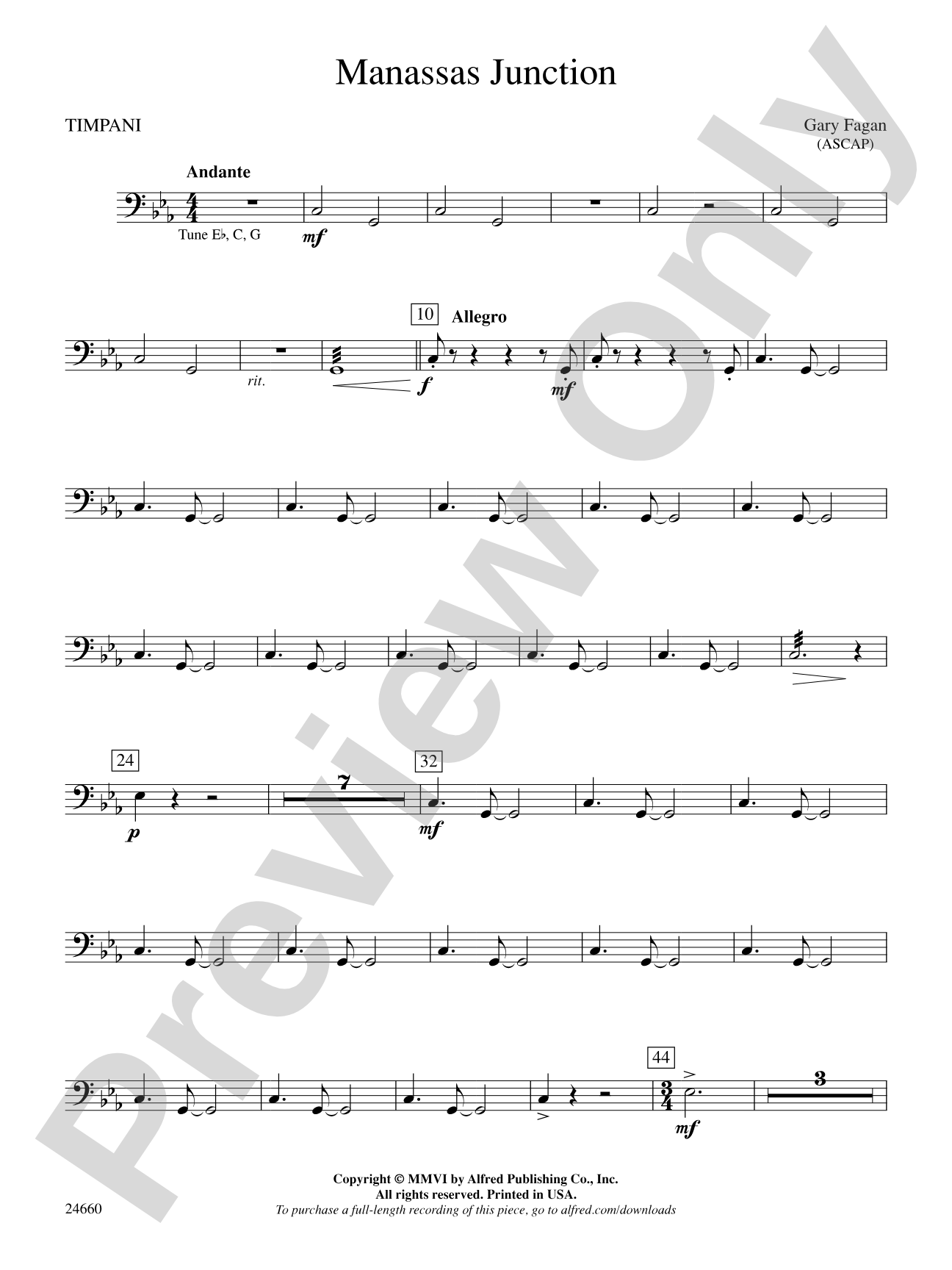

Manassas Junction: Timpani
By Gary Fagan
Grade: 2.5 (Medium Easy)
Item: 00-PC-0000828_TMP
$3.00
Pickup currently not available
Description
This dynamic work was named for the Manassas area of Virginia, and inspired by its rich history as a railroad town which caused it to play such a critical part in our nation's history during the Civil War. Students will enjoy the sudden dynamic changes and syncopated accompaniments that pepper this energetic work for band.


Don't just read it, hear it, play along with it, and watch your students grow with it. In MakeMusic Cloud, Manassas Junction: Timpani comes alive with professional accompaniment, adjustable tempo, and built-in practice tools that turn solo practice into real progress.
Open in the Player
Jump straight in and assign it today.
Start Your Free Trial
Open this title and explore the full library in minutes.
Sample Audio
1
Audio File
--:--
0:00
0:00
Sample Video
No sample videos found.
Additional Details
Series:
Young Symphonic
Publisher:
Alfred Music
Page Count:
280
SKU:
00-PC-0000828_TMP
More about this title
About the Composer: Gary Fagan

Gary Fagan brings more than three decades of classroom experience to his compositions and arrangements. A Bridgewater College graduate with a master's degree from James Madison University, he spent 36 years directing bands in Albemarle County before transitioning to higher education, where he now supervises student teachers at JMU and teaches arranging as adjunct faculty. His music has reached audiences at the Midwest Band and Orchestra Clinic, the White House, and the gubernatorial inauguration of Douglas Wilder.
Fagan's contributions to music education have earned him recognition as Central Virginia's Outstanding Middle School Teacher, an Outstanding Educator Award from the Virginia Governor's School for the Visual and Performing Arts, and honors from the Piedmont Council of the Arts. Active as a clinician, adjudicator, and percussionist with the Charlottesville Band, he serves the profession through involvement with MENC, the Virginia Band and Orchestra Directors Association, the National Band Association, and Phi Beta Mu Bandmasters Fraternity.
Why we love this
Fagan writes with an understanding of what middle-level bands can achieve musically without overcomplicating the technical demands. The syncopated accompaniments and sharp dynamic contrasts give students a real sense of control over color and character, while the historical inspiration grounds the piece in something tangible that students can discuss and research. At Grade 2.5, this sits in that sweet spot where ensembles feel genuinely engaged rather than simply playing through another serviceable march.
What to expect
Manassas Junction captures the urgency and forward drive of a railroad town in motion. Syncopated rhythms pulse beneath the main lines, creating a sense of propulsion, while sudden dynamic shifts punctuate the narrative like the arrival and departure of trains, making this a piece that sounds larger and more dramatic than its technical difficulty might suggest.
Who it's for
Concert bands at the Grade 2 to 2.5 level will find this piece accessible yet musically substantial. Directors seeking repertoire that engages students with historical context while developing rhythmic control and dynamic awareness will appreciate Fagan's thoughtful scoring.
How to get the most out of it
- Shape the sudden dynamic changes with intention; these shifts are the backbone of the piece, so rehearse them as deliberate musical choices rather than accidents of notation.
- Isolate the syncopated accompaniment patterns early and lock them in before layering the melodic material over top, which will prevent rhythmic smudging.
- Let the railroad imagery guide your interpretation: think momentum, transitions between sections, and the energy of movement rather than static virtuosity.
- Balance the sections so that inner voices carrying syncopation remain audible; this is where much of the character lives.
How to use it
This works well as a concert opener that establishes energy and captures attention immediately, or as a thematic centerpiece in a program exploring American history and cultural significance through music. The Grade 2.5 level makes it a confident showcase for developing ensembles, particularly those preparing for festival or competition where historical programming carries appeal.
Skills your students will build
- Dynamic control and contrast, especially sudden shifts between loud and soft
- Syncopated rhythm reading and ensemble coordination in accompaniment parts
- Sustained focus on ensemble balance when inner voices carry rhythmic ostinati
- Musical interpretation grounded in programmatic content and historical context