
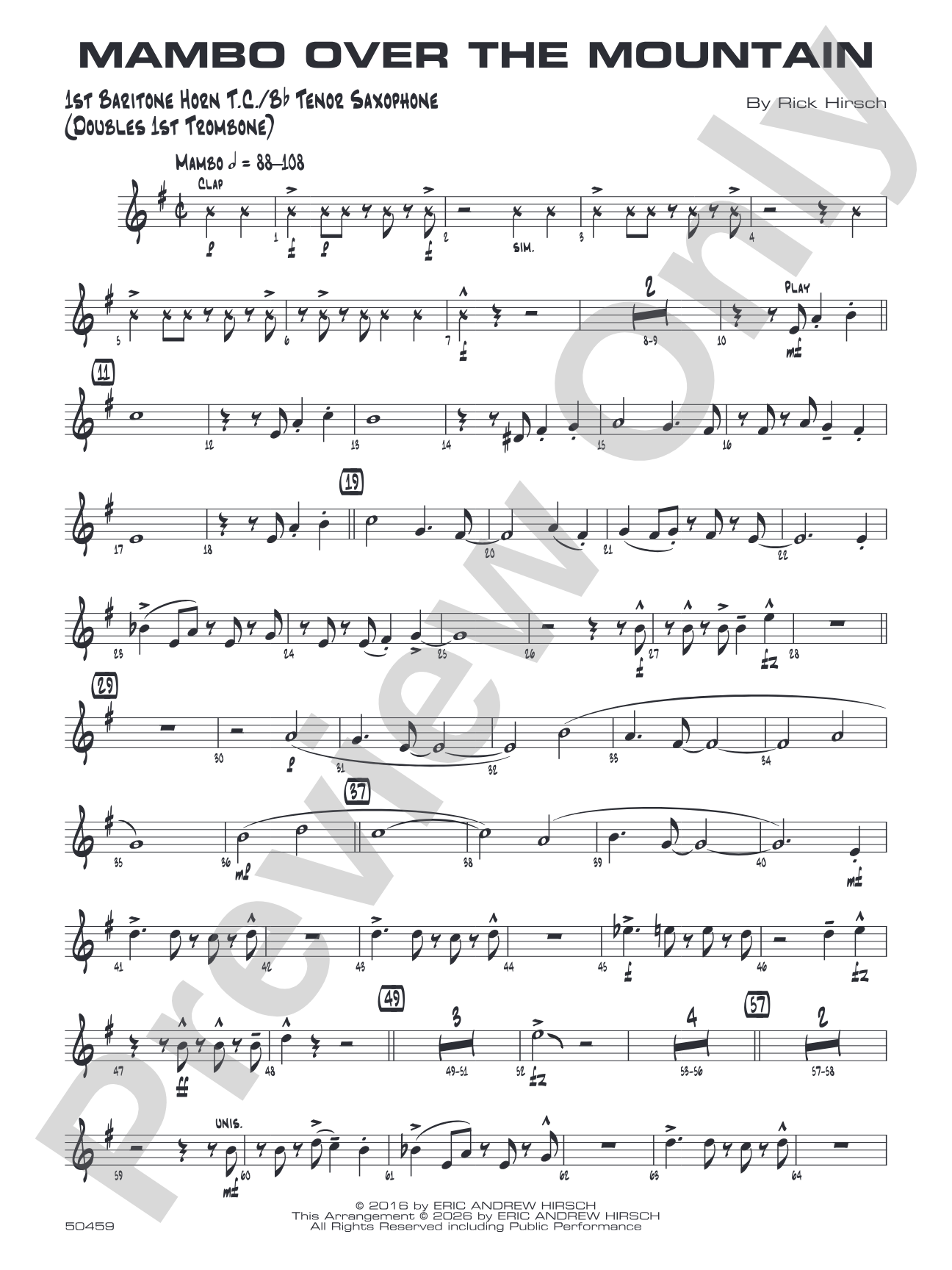

Mambo Over the Mountain: Baritone T.C.
By Rick Hirsch
Grade: 2.5
Item: 00-PC-0019863_BTC1
$3.00
Pickup currently not available
Description
Here's an exciting mambo, a very cool arrangement indeed! Played with half note=88-108 BPM. Highlights include alto and trombone solos, a sax section soli, and an auxiliary percussion part for congas. This is a well-constructed, fun to play yet accessible chart.


Mambo Over the Mountain: Baritone T.C. isn't in MakeMusic Cloud just yet...but it could be. Let us know you'd like to see it, and you'll help shape what comes next. In the meantime, start a free trial and dive into thousands of interactive titles your students can play along with today.
Request This Title
Tell us you want it.
Start Your Free Trial
Explore everything that's ready to play right now.
Sample Audio
1
Audio File
--:--
0:00
0:00
Sample Video
Additional Details
Series:
Belwin Young Jazz
Publisher:
Alfred Music
SKU:
00-PC-0019863_BTC1
More about this title
About the Composer: Rick Hirsch

Rick Hirsch studied composition and arranging at UMass-Amherst and Northern Illinois University, earning degrees that prepared him for a career at the intersection of jazz education and professional performance. Early in his career, he worked as a music copyist for renowned bandleaders Bob Mintzer and Toshiko Akiyoshi, an apprenticeship that deepened his understanding of big band orchestration and jazz writing. He has composed and arranged for distinguished musicians including Yusef Lateef and Eddie Henderson, and his work appears in the libraries of ensembles ranging from the Capitol Quartet to the Penn State Blue Band.
Hirsch's reputation as both composer and educator has made him a frequent guest conductor for All-State and District Jazz Bands across the country. He served on the music faculty at Penn State University and leads his own ensemble, BIG OL' BAND, whose 2017 debut album Pocono Git-Down showcases original compositions rooted in regional jazz traditions often overlooked by mainstream jazz discourse.
Why we love this
Hirsch writes with a keen ear for what works on the high school bandstand. The arrangement balances accessible part writing for younger players with genuine jazz sophistication in the harmony and section voicings, so no one sits passively. The built-in solos and soli passages create natural opportunities for differentiated casting, and the auxiliary percussion part opens the door to students who might not be primary melodic players but are ready to contribute musically.
What to expect
A mambo pulses with infectious rhythm and irresistible forward motion. This arrangement captures that energy while staying grounded in clear harmonic movement and idiomatic jazz phrasing. The solos and soli passages give the piece personality and allow individual voices to shine, creating moments of spotlight alongside the collective groove.
Who it's for
This chart suits jazz ensembles in their second or third year of playing together, when students have developed basic jazz vocabulary and ensemble listening skills but still need straightforward, rewarding repertoire. Directors seeking accessible Latin jazz that doesn't condescend to young players will find a genuine arrangement here, not a simplified version that loses its character.
How to get the most out of it
- Establish the mambo clave feel with your rhythm section before rehearsing the ensemble; the groove is the foundation, and ensemble cohesion depends on the drummer and bassist locking the pocket first.
- Feature your alto soloist in the spotlight by letting the rest of the ensemble settle into a supportive, conversational dynamic during that section rather than maintaining full volume throughout.
- Balance the sax section soli by voicing it as a unified block; ask the section to think of themselves as one voice rather than three independent parts.
- Give the conga player substantial rehearsal time with the rhythm section so the auxiliary percussion sits comfortably within the mambo groove rather than sitting on top of it.
How to use it
Position this as a concert-opener or mid-set energizer; its accessible grade level and immediate musicality make it an ideal piece for introducing jazz to a general audience or for building confidence in a developing ensemble. The auxiliary percussion part also makes it valuable for ensemble projects where you're integrating rhythm section students into the larger jazz band context.
Skills your students will build
- Reading and playing mambo clave patterns and Latin rhythmic figures
- Listening and responding to solo calls with section responses
- Jazz phrasing and swing feel in a Latin jazz context
- Section blend and unified articulation in soli passages
- Ensemble cohesion around a steady groove