
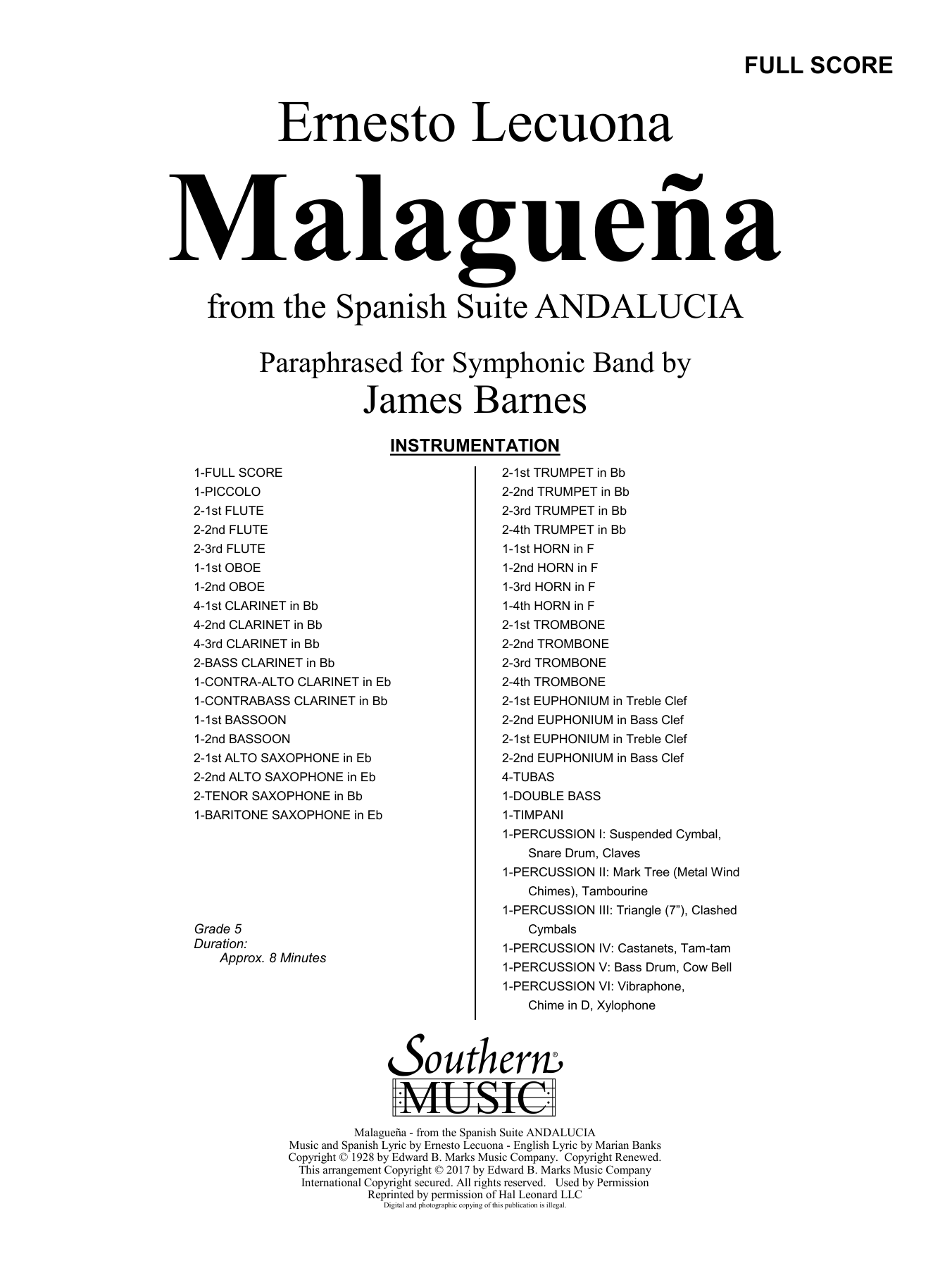

Malagueña (from the Spanish Suite Andalucia) (arr. James Barnes): Concert Band Conductor Score & Parts
By Ernesto Lecuona / Arranged by James Barnes
Grade: 5
Item: 35-PK01512991
$195.00
Pickup currently not available
Buy Extra Parts (Digital PDF Download)
Parts Added to Cart!
Description
Born in Havana, Cuba in 1895, Ernesto Lecuona is arguably Cuba's greatest serious composer. He was a gifted pianist who wrote hundreds of songs and piano works before he died in 1963. Most of his music is composed in a rich, authentic Cuban style. The most famous of his works is "Malagueña," the sixth movement of his Suite Andalucia for solo piano, which was first published in 1928. In 1976, James Barnes arranged Malagueña for the University of Kansas Marching Band. A few years later, with permission from the publisher, he expanded this original arrangement into a full work for symphonic band called "Prelude, Fantasy and Fandango on Lecuona's Malagueña." After several performances in the spring of 1978 (most notably at the MENC Convention in Colorado Springs), this work, along with over 200 other Barnes manuscripts, lay fallow in the KU Band Library. While packing up his office belongings when he retired from The University of Kansas in 2015, Barnes came across this long languishing arrangement, which remained in condensed score. In the fall of 2016, he completely re-composed the opening portion of the work, reduced the number of required percussion and disposed of the two harps in his 1978 version. This new setting features evocative, thinly scored, extended solo passages for clarinet, bassoon and flute before the full wind band concludes the work with a powerful, dramatic setting of the main themes of Lecuona's masterful Malagueña.


Malagueña (from the Spanish Suite Andalucia) (arr. James Barnes): Concert Band Conductor Score & Parts isn't in MakeMusic Cloud just yet...but it could be. Let us know you'd like to see it, and you'll help shape what comes next. In the meantime, start a free trial and dive into thousands of interactive titles your students can play along with today.
Request This Title
Tell us you want it.
Start Your Free Trial
Explore everything that's ready to play right now.
Sample Audio
No sample audio found.
Sample Video
No sample videos found.
Additional Details
Publisher:
Hal Leonard
SKU:
35-PK01512991
More about this title
About the Composer: Ernesto Lecuona
Ernesto Lecuona stands as Cuba's preeminent classical composer, bridging European concert traditions with authentic Cuban idioms. Born in Havana in 1895, he was a virtuosic pianist whose prolific catalog spans hundreds of songs, piano works, and orchestral pieces, all infused with the rhythmic vitality and harmonic richness of his island home. His music earned international recognition throughout the 20th century and remains a cornerstone of Latin American classical repertoire.
Lecuona's "Malagueña," the sixth movement of his 1928 Suite Andalucia for solo piano, emerged as his signature work. The piece exemplifies his gift for melody and his sophisticated harmonic language, combining Spanish flamenco elements with Cuban flavor to create something entirely his own. It has since become a standard in arrangements across multiple ensembles, proving its enduring appeal to performers and audiences alike.
Why we love this
James Barnes's revision transforms a long-overlooked 1978 arrangement into something genuinely fresh. By stripping away the original's orchestral padding, Barnes crafted a work that lives in the space between Spanish impressionism and Cuban warmth, with solo clarinet, bassoon, and flute passages that float beautifully over minimal accompaniment before the full band delivers the payoff. The Grade 5 difficulty sits perfectly for upper-level high school bands who are ready for coloristic sophistication without excessive technical demands.
What to expect
Languid and sultry, with the textures of a Spanish café at dusk. Delicate clarinet and flute solos drift above shadowy harmonic support before erupting into a spirited, full-voiced celebration of Lecuona's irresistible main theme, capturing both the yearning and the exuberance that define this masterwork.
Who it's for
Bands ready to program something beyond standard Grade 5 fare that offers genuine musical substance. Directors seeking a work with solo opportunities that doesn't relegate anyone to padding parts will find the reduced instrumentation refreshing, especially if your band has strong reed soloists.
How to get the most out of it
- Shape the opening solo passages with long phrasing lines; these intimate moments demand that your soloists breathe as singers, not as wind players taking mechanical breaths.
- Attend carefully to the transition into the full band section. The sudden fullness can feel jarring if the rhythm section hasn't locked the tempo and pulse absolutely.
- Balance the Spanish and Cuban elements by allowing rubato in the solo sections while maintaining rhythmic strictness once the ensemble enters.
- Clarify the harmonic movement beneath the soloists in rehearsal; many players will find these extended passages more comfortable when they understand the underlying progression.
How to use it
This arrangement works beautifully on a concert devoted to Latin American music or as a contrast piece between heavier contemporary work and standard repertoire. Its brief length and showstopping closer make it an ideal anchor for a themed set, or position it as a palate cleanser in a program mixing genres and moods.
Skills your students will build
- Sustained phrasing and breath management in solo passage work
- Balancing exposed ensemble playing with minimal harmonic support
- Executing rubato while maintaining ensemble coherence
- Reading thinly scored textures and understanding harmonic function beneath melodic lines
- Transitioning dynamically between intimate and full orchestral writing