Make Someone Happy: Piano Digital Sheet Music

Make Someone Happy: Piano Digital Sheet Music

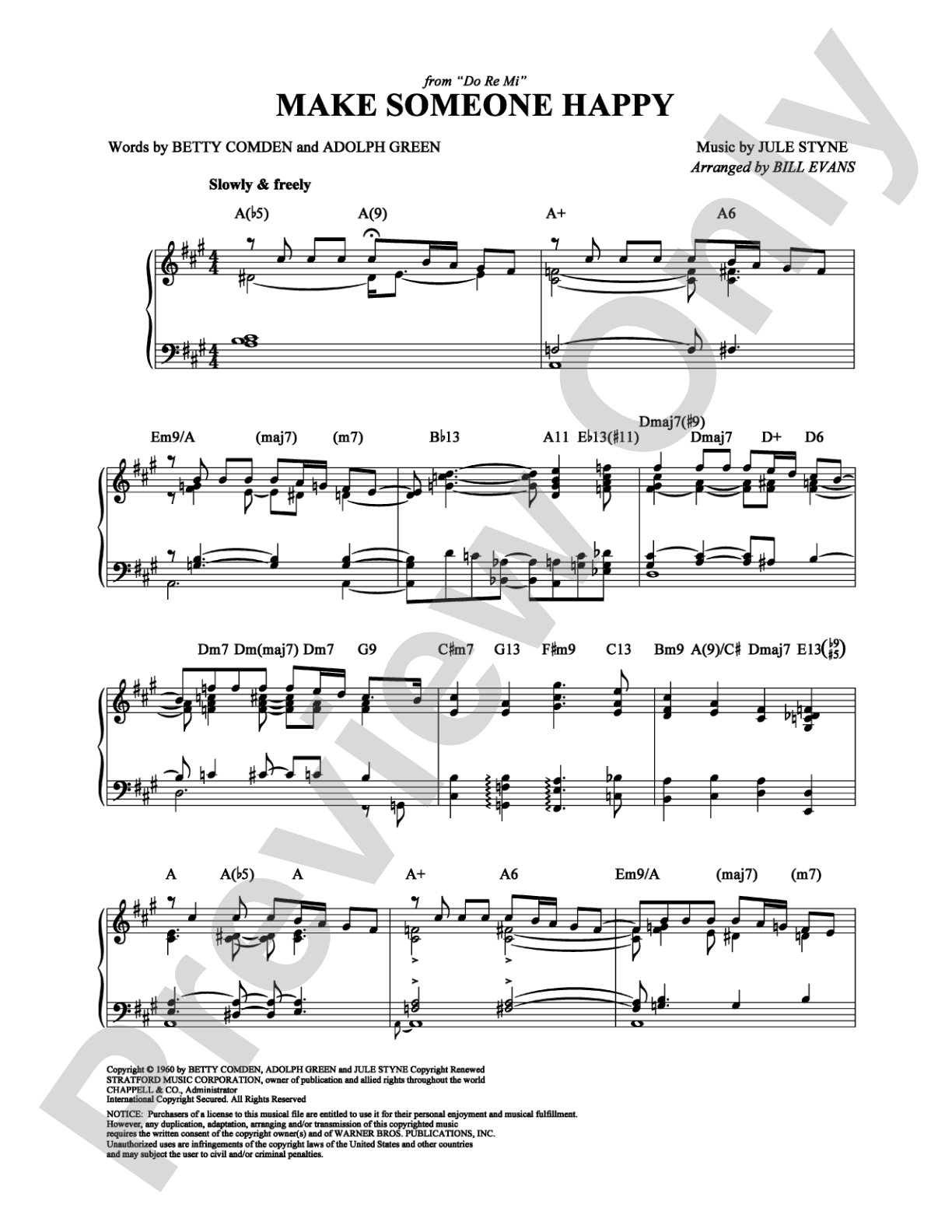
Jule Styne, Bill Evans

Item: 00-PS-0001518

Digital Download
$3.99
Description

Make Someone Happy: Piano Digital Sheet Music isn't in MakeMusic Cloud just yet...but it could be. Let us know you'd like to see it, and you'll help shape what comes next. In the meantime, start a free trial and dive into thousands of interactive titles your students can play along with today.

Sample Audio
No sample audio found.
Sample Video
Additional Details
SKU: 00-PS-0001518

More about this title

About the Artist: Bill Evans

Bill Evans (1929-1980) was a pianist and composer whose harmonic sophistication and lyrical touch fundamentally changed how jazz musicians approached the piano. His interpretations of jazz standards are marked by intricate voicings, sensitive reharmonization, and a classical musician's attention to texture and clarity. Evans' work as both performer and composer established him as one of the most influential figures in modern jazz.

Why we love this

Evans' reading of this standard showcases why his interpretations remain essential listening and teaching models. The voicings and comping choices reveal how a master pianist balances respect for a song's melody with complete harmonic reimagining, making it an ideal reference recording for students exploring jazz piano language.

What to expect

Intimate and thoughtful, with a gentle sense of longing. Evans' touch is unhurried; each chord breathes with space and intention, creating a reading that feels like a quiet conversation rather than a display.

Who it's for

Jazz pianists seeking to deepen their understanding of standard interpretation and harmonic sophistication. Students developing their listening skills in jazz history will benefit from studying this recording alongside the lead sheet.

How to get the most out of it

  • Study the voicing choices Evans uses under the melody; notate them to understand his harmonic voice-leading logic rather than trying to recreate his sound by ear alone.
  • Observe his left-hand independence and space; Evans never rushes the accompaniment to catch up with the melody, so practice comping and melody separately before integrating them.
  • Listen for the moments where Evans strips back to sparse textures, then builds density; this dynamic shaping is essential to capturing the emotional arc of his interpretation.

How to use it

Feature this as a model interpretation in jazz history curriculum or performance study sessions. Students can compare Evans' harmonic choices to other recorded versions of the same standard, or use the performance as a reference while learning the tune from the lead sheet.

Skills your students will build

  • Listening for and transcribing jazz voicings from recorded performances
  • Understanding reharmonization and chord substitution in a standard context
  • Developing sensitivity to dynamics, space, and textural clarity in accompaniment
  • Recognizing how comping choices support and complement melody

You May Also Like