Make It With You Sheet Music Preview

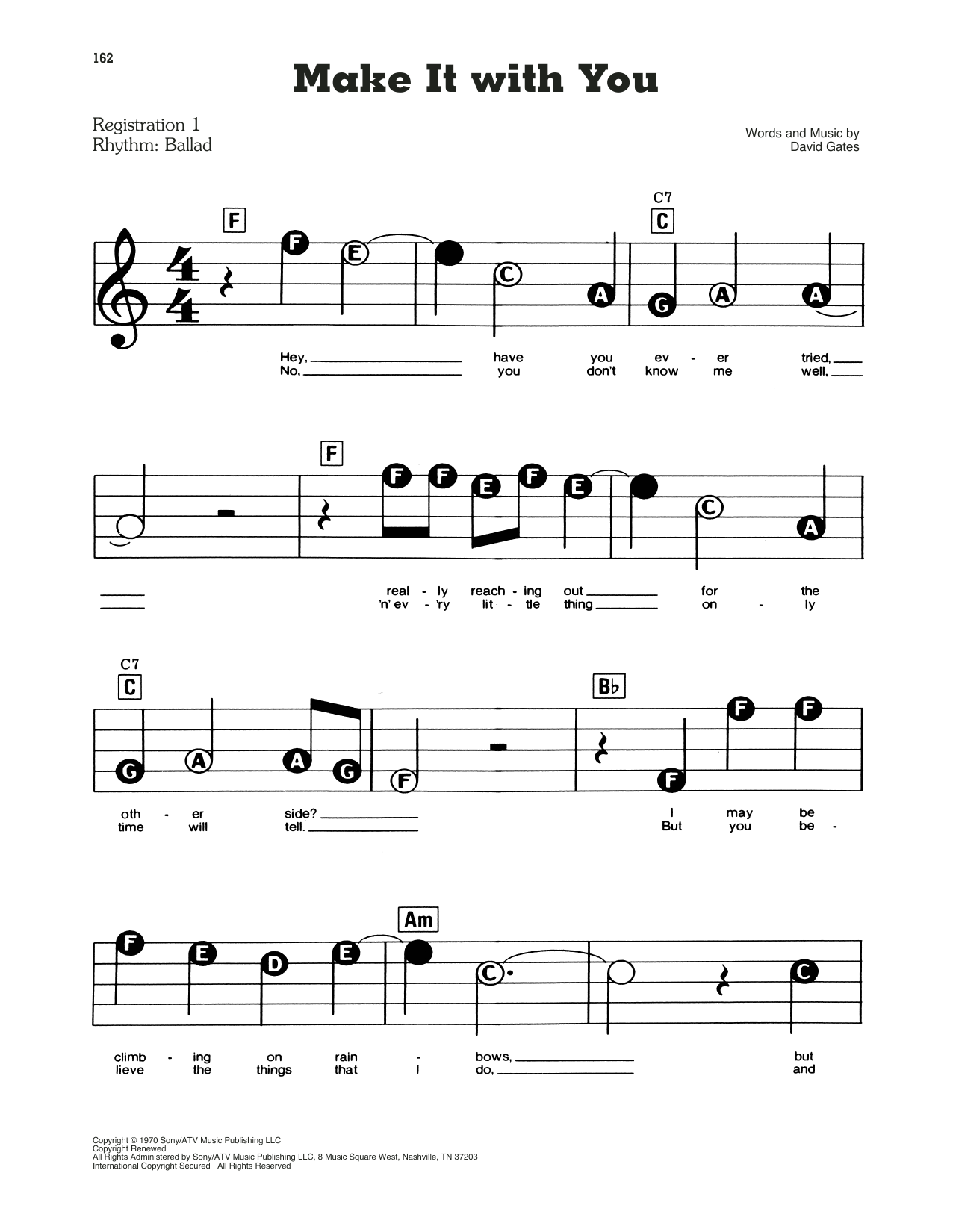
Make It With You: E-Z Play Today

As performed by Bread

Item: 35-DS01094719

Digital Download
$4.99
Description

Make It With You: E-Z Play Today isn't in MakeMusic Cloud just yet...but it could be. Let us know you'd like to see it, and you'll help shape what comes next. In the meantime, start a free trial and dive into thousands of interactive titles your students can play along with today.

Sample Audio
No sample audio found.
Sample Video
Additional Details
Publisher: Hal Leonard
Page Count: 4
SKU: 35-DS01094719

More about this title

About the Artist: Bread

Bread emerged from the Los Angeles session musician scene in the late 1960s, building a catalog of sophisticated soft rock and pop songs that showcased precise vocal harmonies and understated instrumental arrangements. David Gates, the band's primary songwriter and vocalist, crafted compositions that balanced commercial accessibility with genuine musical craft, earning multiple Grammy Awards and establishing Bread as one of the decade's most consistent hitmakers.

Why we love this

This arrangement captures what made Bread's original so enduring: the gentle melodic arc and the way the piano sits at the emotional center of the song. For pianists working on songs from the 1970s soft rock catalog, this 4-page realization offers a manageable entry point into both the style and the harmonic sensibility of the era.

What to expect

Warm and unhurried, with a gentle forward motion that never rushes. The song settles into its groove like a conversation between close friends, where sincerity matters more than flash.

Who it's for

Piano students exploring the pop and rock songbook of the 1970s, particularly those drawn to songs built on strong melodic hooks and warm harmonic language. Teachers looking to build repertoire that bridges classical technique with contemporary styles will find this accessible without feeling oversimplified.

How to get the most out of it

  • Keep the touch light and conversational rather than pushing for volume; the song's power comes from intimacy, not projection.
  • Listen carefully to the original recording to absorb the rhythmic relaxation in the verses; it's not strictly metronomic, and honoring that breathing room makes the performance sound natural.
  • Pay attention to any space between phrases where the piano might drop back slightly, creating room for the vocal line to land clearly if this becomes part of a larger arrangement.

How to use it

This works well as a palate cleanser in a recital between heavier classical works, or as a standalone piece for a student concert focused on 20th century popular song. It also pairs nicely in a thematic program exploring the evolution of the singer-songwriter tradition.

Skills your students will build

  • Balancing melody and accompaniment in the right hand
  • Maintaining steady pulse while playing with conversational phrasing
  • Understanding harmonic progressions common to 1970s pop song writing
  • Reading and executing chord symbols in context

You May Also Like