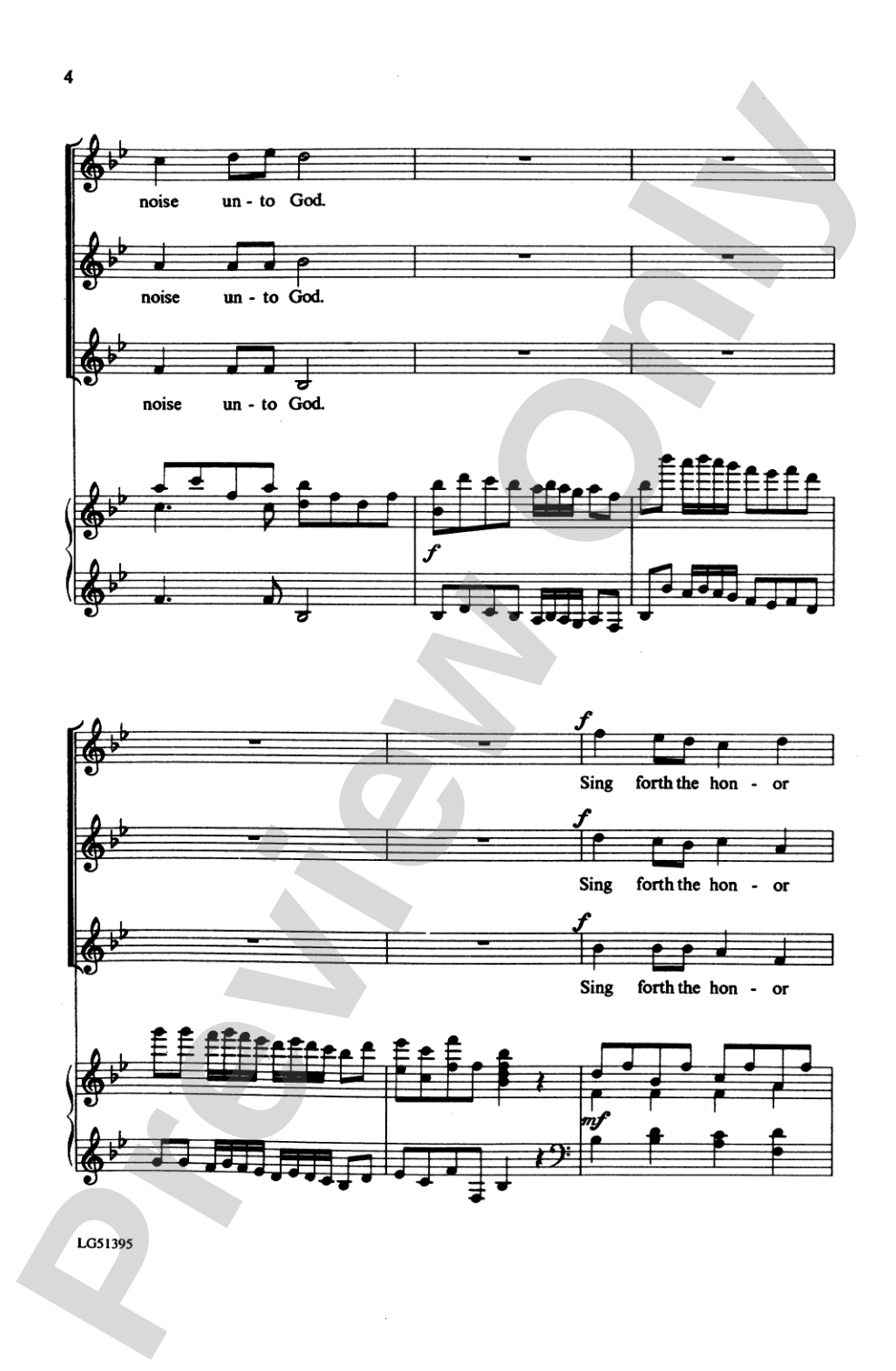
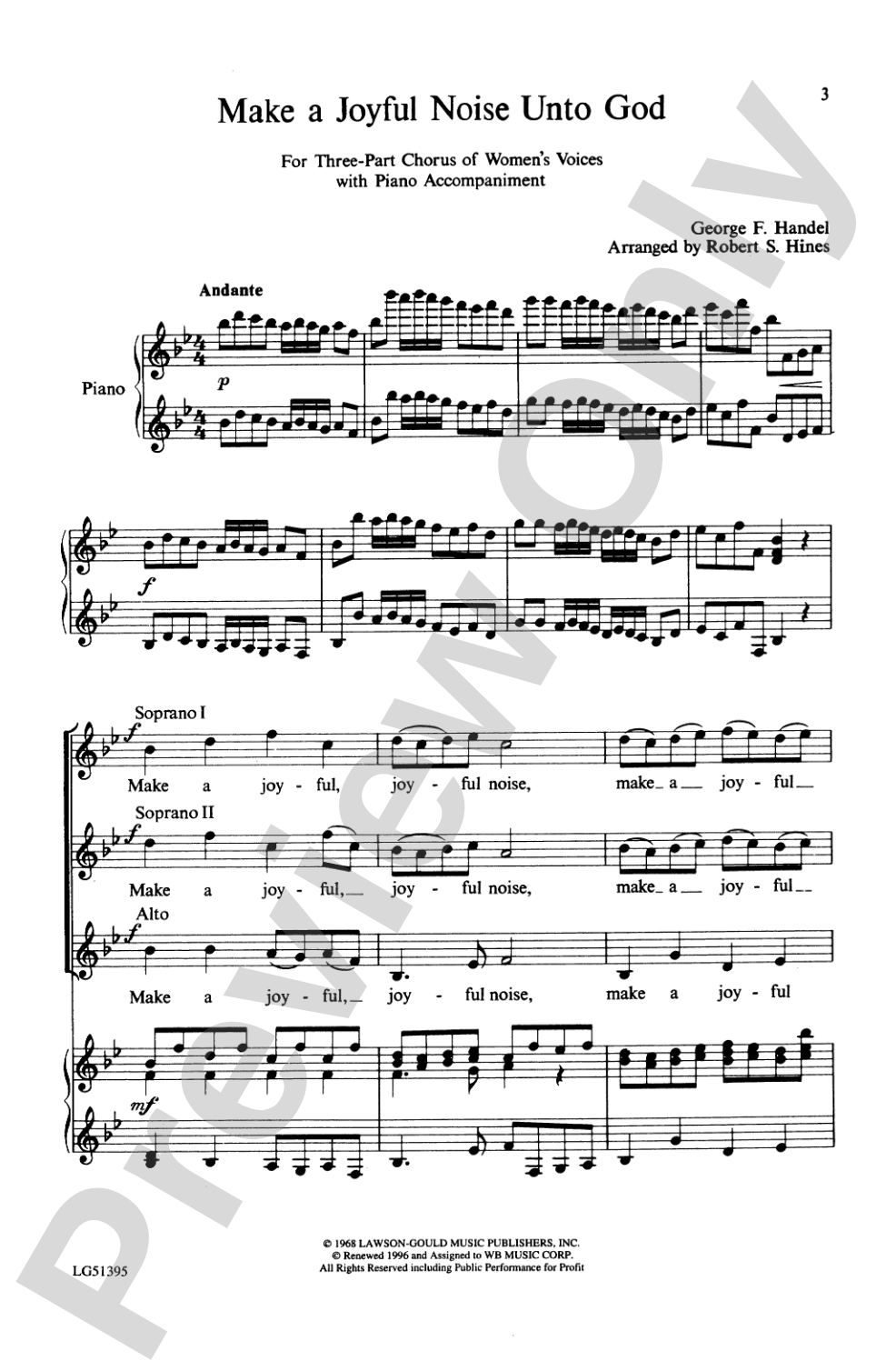
Make a Joyful Noise unto God Sheet Music Preview

Make a Joyful Noise unto God: SSA Choral Octavo

By George Frideric Handel / arr. Robert S. Hines

Item: 00-PO-0005000

Digital Download
$2.25

Minimum order quantity: 20 copies

Description

Make a Joyful Noise unto God: SSA Choral Octavo isn't in MakeMusic Cloud just yet...but it could be. Let us know you'd like to see it, and you'll help shape what comes next. In the meantime, start a free trial and dive into thousands of interactive titles your students can play along with today.

Sample Audio
No sample audio found.
Sample Video
Additional Details
Series: Alfred Archive Edition: Lawson-Gould Music Publishers
Publisher: Alfred Music
Page Count: 12
SKU: 00-PO-0005000

More about this title

About the Composer: George Frideric Handel

George Frideric Handel (1685-1759) shaped the musical landscape of Baroque Europe through instrumental brilliance and vocal splendor. Born in Halle, Germany, he spent his most productive years in England, where he became a dominant figure in opera, oratorio, and instrumental music. His works remain central to choral and orchestral repertoire today because they combine architectural clarity with emotional depth.

Handel's sacred music, particularly his oratorios, set the standard for how composers approached large-scale choral works. His melodies are direct and memorable, his harmonies sophisticated yet singable, and his structural sense impeccable. For choral directors, Handel represents the gold standard of vocal writing: music that sits naturally in the voice while demanding genuine musicianship from singers.

Why we love this

This arrangement brings authentic Baroque choral writing into a format that works for smaller ensembles without sacrificing Handel's architectural integrity. Robert S. Hines's setting preserves the harmonic sophistication and melodic sweep you expect from Handel while making the piece accessible to SSA/SSAA choirs. Programming a Handel work immediately signals serious musical intention and gives singers a chance to inhabit one of the great compositional minds in Western music.

What to expect

Joyful exuberance tempered by Baroque restraint. The text sets the tone for jubilation, but Handel's compositional language expresses that joy through intricate harmony and architectural design rather than sentimentality. The result is music that feels both celebratory and intellectually satisfying, energizing without being trite.

Who it's for

SSA and SSAA choirs seeking repertoire that combines technical challenge with manageable voicing. This works well for mixed ability choirs where you want to program something genuinely substantial without requiring a fourth voice part. It also suits community and church choirs that want to expand beyond contemporary sacred music into the classical choral canon.

How to get the most out of it

  • Shape the phrases according to text stress rather than bar lines; Baroque phrasing often runs counter to metered accents, and allowing the text to guide your conducting gives singers clarity.
  • Balance the soprano line as the principal melodic voice without drowning the harmonic support from lower voices; this creates the transparency Baroque music demands.
  • Approach the tempo as a vehicle for clarity rather than speed; a well-chosen moderate tempo that allows text articulation and harmonic motion to register will serve the music better than rushing.
  • Mark the cadences as structural signposts during rehearsal so singers understand the harmonic journey and can shape accordingly.

How to use it

This sits naturally on a concert that pairs Baroque sacred works with contemporary settings of similar texts, creating a historical perspective on how different eras approach devotional music. It also works as a concert opener, where its bright affirmation sets the tone for what follows. For a winter or spring sacred concert, this gives weight to a program without requiring large forces.

Skills your students will build

  • Reading and sustaining independent vocal lines in a three-part texture
  • Understanding Baroque harmonic language and phrase structure
  • Articulating text clearly while maintaining legit vocal tone
  • Balancing between melody and harmony in ensemble singing
  • Interpreting period-appropriate style and musical character

You May Also Like