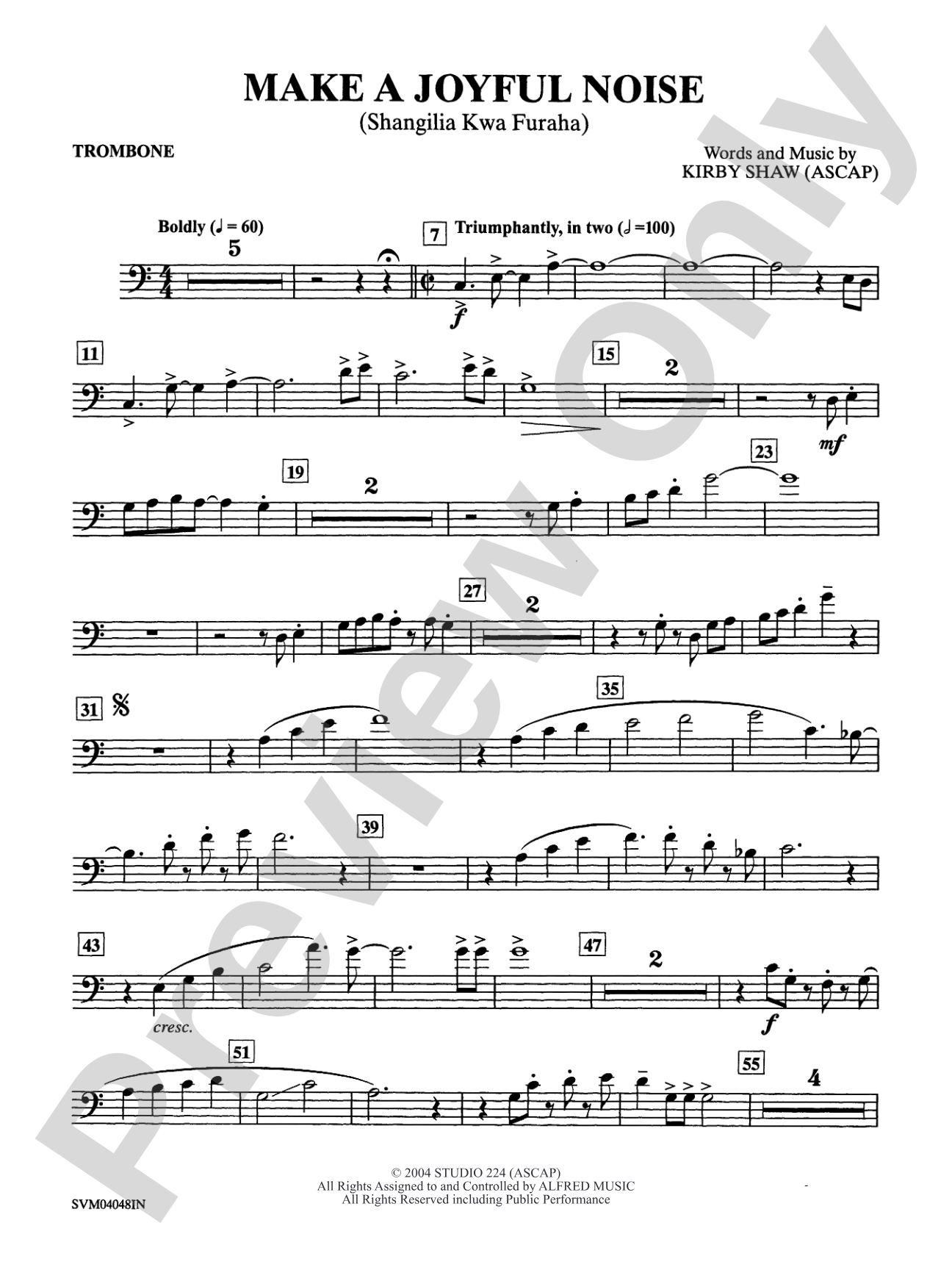
Make a Joyful Noise: 1st Trombone Sheet Music Preview

Make a Joyful Noise: 1st Trombone

Words and music by Kirby Shaw

Item: 00-PC-0017548_TN1

Digital Download
$3.00
Description
Your choirs will make many a "joyful noise" with this bold and energetic African style original from Kirby Shaw. The Swahili text is easily learned and brings with it a strong message of hope and caring. If you're looking for an opener or maybe a theme selection for your next concert, this is it.

Don't just read it, hear it, play along with it, and watch your students grow with it. In MakeMusic Cloud, Make a Joyful Noise: 1st Trombone comes alive with professional accompaniment, adjustable tempo, and built-in practice tools that turn solo practice into real progress.

Sample Audio
No sample audio found.
Sample Video
Additional Details
Publisher: Alfred Music
Page Count: 16
SKU: 00-PC-0017548_TN1

More about this title

About the Composer: Kirby Shaw

Kirby Shaw

Kirby Shaw stands among the most performed choral composers in music education, with over 2,500 arrangements and original compositions in print and nearly 20 million copies sold worldwide. His work has reached singers across 45 U.S. states and internationally in Canada, Australia, Scandinavia, and continental Europe. Shaw holds degrees in Music Education and Choral Composition from San Jose State University and a Doctor of Musical Arts in Choral Conducting from the University of Washington.

Shaw's teaching career spans public school classrooms and university choral programs, including directorship of highly regarded vocal jazz ensembles at the College of the Siskiyous, Colorado State University, and the University of Missouri at Kansas City. He has mentored with vocal artists including Bobby McFerrin, Mark Murphy, and Al Jarreau, and his prolific output has earned multiple ASCAP awards. Beyond his compositional work, Shaw co-wrote the musical Scroogical (an adaptation of Dickens' A Christmas Carol) and performs with Just 4 Kicks, a jazz-focused a cappella quartet.

Why we love this

Shaw's energetic arrangement taps into the rhythmic propulsion and melodic warmth of African musical traditions without requiring your singers to navigate complex harmony or demanding ranges. The Swahili text carries genuine meaning, so your ensemble learns an authentic message of hope and community care rather than phonetic syllables. It works equally well as a powerful concert opener or as a unifying theme throughout your program.

What to expect

The piece radiates infectious joy and movement, built on African rhythmic traditions that invite physical and emotional engagement from your singers. You'll feel the immediate lift in your ensemble's energy the moment you add the instrumental parts; the groove is undeniable, and the Swahili text lends both authenticity and a sense of shared purpose.

Who it's for

This piece engages choirs of mixed experience levels who want to program something energetic and uplifting without staging a large production or commissioning new arrangements. It suits community, school, and college choirs seeking repertoire with genuine cultural roots and a message that resonates beyond the moment of performance.

How to get the most out of it

  • Honor the rhythmic pulse by having your ensemble feel the forward momentum in their body during rehearsal; this piece lives in the energy it generates, not in precision alone.
  • Layer the instrumental parts strategically during early rehearsals so singers can lock onto the groove before adding complexity or full voicing.
  • Bring out the Swahili text with clear articulation and natural speech rhythm; let the meaning shine through rather than treating it as exotic ornamentation.
  • Use the recorded accompaniment in rehearsal to establish tempo and feel, then gradually reduce reliance on it so your ensemble builds confident internal pulse.

How to use it

Open your concert with this bold statement, or use it strategically to reset the room's energy between more introspective selections. Its message of hope and caring also serves well as a thematic anchor if you're building a program around community, celebration, or social responsibility.

Skills your students will build

  • Rhythmic independence while singing over African-influenced groove patterns
  • Pronunciation and phrasing of Swahili text with musical meaning
  • Ensemble cohesion through rhythmic unison and call-and-response textures
  • Connection between text and physical expression in performance

You May Also Like