
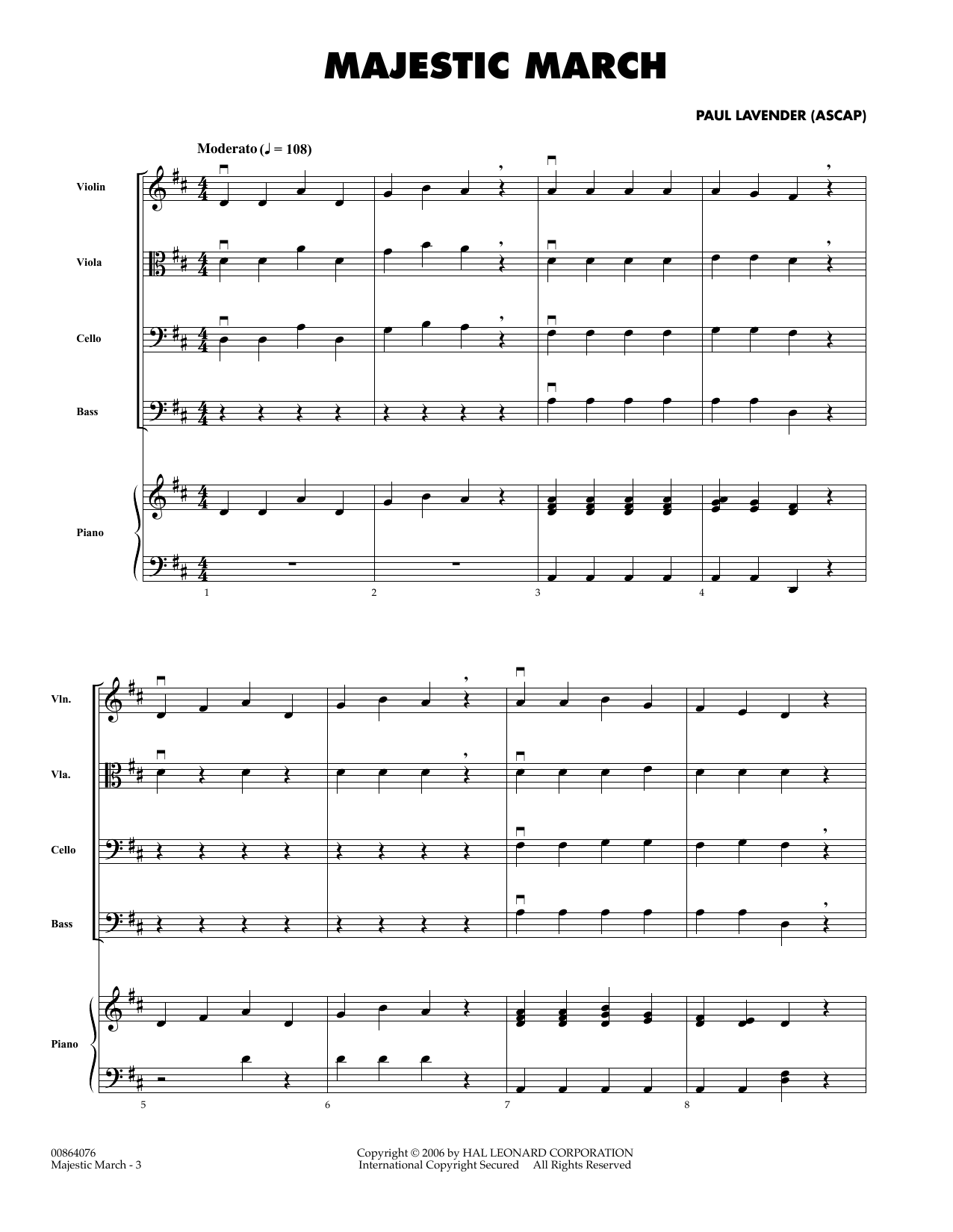

Majestic March: String Orchestra Conductor Score & Parts
By Paul Lavender
Grade: 0.5
Item: 35-PK00320760
$35.00
Pickup currently not available
Buy Extra Parts (Digital PDF Download)
| Product | Price | Quantity |
|---|---|---|
| Majestic March - Full Score | $7.50 | |
| Majestic March - Violin | $6.00 | |
| Majestic March - Viola | $6.00 | |
| Majestic March - Cello | $6.00 | |
| Majestic March - String Bass | $6.00 | |
| Majestic March - Piano | $6.00 |
Parts Added to Cart!
Description
Explorer level.


Discover MakeMusic Cloud: thousands of interactive titles your students can play along with today.
Sample Audio
No sample audio found.
Sample Video
Additional Details
Publisher:
Hal Leonard
SKU:
35-PK00320760
More about this title
About the Composer: Paul Lavender
Paul Lavender has built a reputation as a composer who understands what young musicians need: music that sounds professional without overwhelming them technically. His work spans band, orchestra, and wind ensemble literature, with a particular gift for crafting memorable melodies that engage students while teaching solid musicianship.
Lavender's compositions are standard fare in school music programs across the country, prized by directors who want their students playing music that feels substantial and rewarding. His understanding of pedagogy shows in every score; he knows where to place challenges and where to let the music sing.
Why we love this
Lavender delivers genuine nobility and pageantry here without requiring advanced technique from your string players. The scoring lies perfectly for young orchestras, with straightforward bowings and accessible ranges that let musicians focus on playing with shape and pride rather than surviving the part.
What to expect
Majestic March lives up to its title with bright, purposeful energy and a sense of occasion. The writing has clear lines and strong harmonic underpinnings that let young players feel the structure of the music, making rehearsals productive and performances satisfying.
Who it's for
String orchestras at the first or second year of a program, or any ensemble looking for accessible material with genuine character. This works equally well for school concerts, festival performances, or as a confidence builder early in the season.
How to get the most out of it
- Shape the main melody with a natural crescendo and decrescendo, even in unison passages. Younger players often play mechanically, so model the arc you want by conducting it clearly.
- Balance your accompaniment voices so the harmonic foundation sits behind the primary line. Check mix frequently in rehearsal; what feels balanced at the podium may not project from the audience.
- Invest time in unified bowing early. Clean sectional bowings in the first week of rehearsal pay dividends when you combine parts.
- Keep the tempo steady and confident. This march should have forward momentum; a hesitant tempo flattens the character immediately.
How to use it
Open a concert with this to set a confident tone, or pair it with lighter character pieces to showcase range. It also works beautifully as a festival selection where you want material that impresses adjudicators and parents without requiring months of preparation.
Skills your students will build
- Sustaining tone with consistent vibrato
- Playing as a unified section with clean attacks and releases
- Following a conductor's interpretation of phrase shape
- Maintaining rhythmic precision in accompanimental figures
- Balancing melodic lines against harmonic accompaniment