
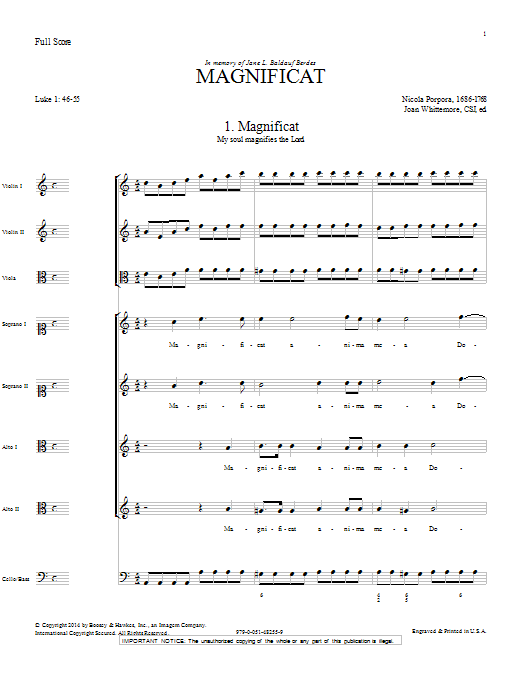

Magnificat in A Minor: Choral Instrumental Pak
By Nicola Porpora / Arranged by Joan Whittemore
Item: 35-PK00292911
$20.00
Pickup currently not available
Buy Extra Parts (Digital PDF Download)
Parts Added to Cart!
Description
The Magnificat for treble voices with optional strings is by the Baroque composer Nicola Porpora and is written in six contrasting choral movements. Editor Whittemore brings considerable knowledge and research to the project and conductors can be assured of excellent scholarship.
Duration: ca. 9 minutes.


Magnificat in A Minor: Choral Instrumental Pak isn't in MakeMusic Cloud just yet...but it could be. Let us know you'd like to see it, and you'll help shape what comes next. In the meantime, start a free trial and dive into thousands of interactive titles your students can play along with today.
Request This Title
Tell us you want it.
Start Your Free Trial
Explore everything that's ready to play right now.
Sample Audio
No sample audio found.
Sample Video
No sample videos found.
Additional Details
Publisher:
Hal Leonard
SKU:
35-PK00292911
More about this title
About the Composer: Nicola Porpora
Nicola Porpora (1686–1768) was a dominant figure in eighteenth-century music, equally celebrated as a composer and vocal pedagogue. His reputation as a maestro di cappella and teacher of singers shaped the careers of some of the era's finest performers, and his compositions for voice showcase the technical brilliance and expressive depth his students were trained to deliver.
Portora's sacred works, including his Magnificats, blend the contrapuntal sophistication of the stile antico with the lyrical elegance of the galant style. These settings remain valuable additions to any choral program seeking substantive Baroque repertoire that challenges singers while remaining accessible to modern ensembles.
Why we love this
Whittemore's edition provides treble choirs with a six-movement sacred work of genuine musical substance, where each section presents distinct character and textural variety without demanding excessive rehearsal time. The optional string scoring allows flexibility in performance context, whether your ensemble performs with full accompaniment or a cappella, making this both economical and artistically rewarding.
What to expect
The music moves between moments of intimate lyricism and fuller harmonic richness, with the text's spiritual contemplation shaping each movement's emotional trajectory. Porpora's melodic gift and attention to word painting create moments of genuine beauty that reward singers' effort, while the contrasting sections keep the work from becoming static or overly academic.
Who it's for
Treble choirs, boys' choirs, and youth vocal ensembles seeking sacred repertoire with Baroque authenticity and manageable rehearsal demands. This edition works equally well for secondary school programs and community choirs looking to expand beyond contemporary arrangements into historically informed classical literature.
How to get the most out of it
- Balance the dialogue between solo voices and full choir across the six movements. Each movement's design suggests specific moments for pulling back texture; attend to these shifts as compositional architecture rather than accidental variation.
- Establish clear vowel consistency in your treble section early. Porpora's writing exposes uneven production in quick passagework and sustained lines, so unification across high voices directly impacts intonation and blend.
- If performing with strings, allow the instrumental introduction to establish the harmonic and expressive tone for each movement before voices enter. This preparation simplifies intonation issues and gives singers a secure tonal center.
- Consider the work's total duration (approximately nine minutes) when planning rehearsal pacing. Breaking the piece into two or three focused sectional rehearsals prevents fatigue while allowing singers to absorb the stylistic demands of this unfamiliar idiom.
How to use it
Pair this with other Baroque sacred works for a focused concert celebrating the period, or nest it within a broader program that spans Renaissance through contemporary styles. The moderate length and flexible instrumentation make it ideal for spring or festival programming when rehearsal time is limited but artistic impact remains essential.
Skills your students will build
- Singing in Baroque style conventions, including articulation and ornament handling
- Reading treble clef voice parts with eighteenth-century harmonic language
- Balancing solo and tutti passages within a multi-movement structure
- Sustaining focused tone through contrasting emotional territories
- Ensemble precision with optional string accompaniment