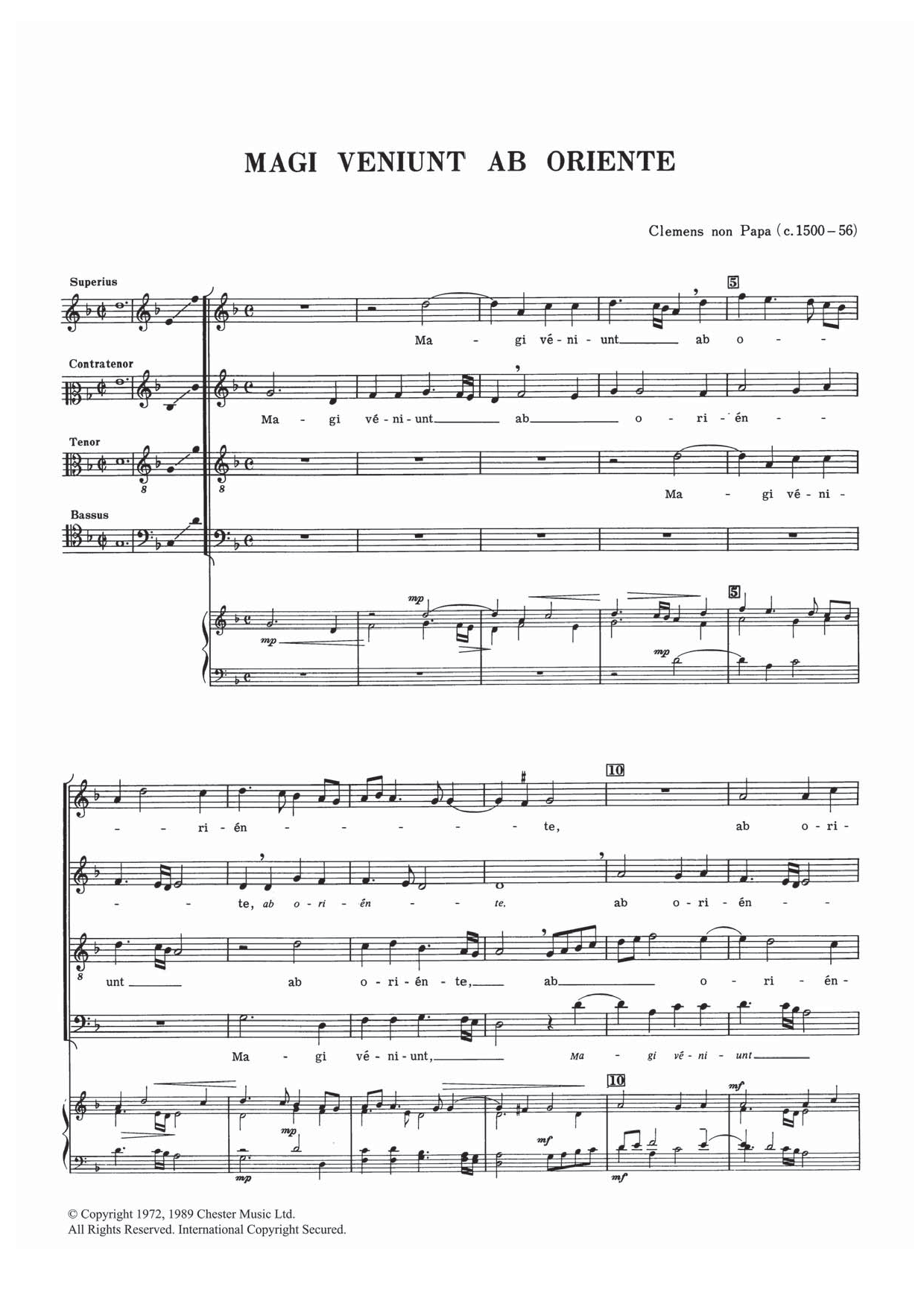
Magi Veniunt Ab Oriente Sheet Music Preview

Magi Veniunt Ab Oriente: SATB Choral Octavo

As performed by Jacob Clemens Non Papa

Item: 35-DS00366732

Digital Download
$2.99
Description

Magi Veniunt Ab Oriente: SATB Choral Octavo isn't in MakeMusic Cloud just yet...but it could be. Let us know you'd like to see it, and you'll help shape what comes next. In the meantime, start a free trial and dive into thousands of interactive titles your students can play along with today.

Sample Audio
No sample audio found.
Sample Video
Additional Details
Publisher: Hal Leonard
Page Count: 4
SKU: 35-DS00366732

More about this title

About the Artist: Jacob Clemens Non Papa

Jacob Clemens Non Papa (c. 1510-1555) stands among the most prolific Flemish composers of the Renaissance, yet remains less celebrated than his contemporaries Josquin and Palestrina. Active primarily in Liège and Antwerp, he produced over 200 motets and numerous secular works that demonstrate mastery of polyphonic writing and textual underlay. His style bridges the Franco-Flemish tradition and emerging Renaissance clarity, making his music accessible yet sophisticated.

For choral programs, Clemens Non Papa offers an invaluable resource: music that engages singers with elegant voice leading and meaningful harmonic progressions without demanding virtuosic athleticism. His Latin sacred works remain staples in early music circles and increasingly in educational settings where directors seek historically informed yet immediately musical repertoire.

Why we love this

This four-part setting of the Epiphany text arrives with the gift of genuine harmonic beauty built on straightforward voice leading. Clemens Non Papa's clarity of texture means every section hears itself and finds natural phrase support, making rehearsals efficient even as musical satisfaction grows with each run-through.

What to expect

Graceful and hushed reverence define this setting. The text 'Wise men come from the East' unfolds through gently imitative passages that feel like voices arriving and joining a procession, each carrying the melody forward before yielding it to another. Harmonic resolutions carry quiet warmth rather than dramatic punctuation.

Who it's for

High school and college choirs seeking early music that sits comfortably in the voice and builds confidence with Renaissance polyphony. This octavo works equally well for concert choirs wanting liturgical context and secular ensembles exploring the sacred repertoire that shaped Western choral writing.

How to get the most out of it

  • Shape phrases by releasing consonants cleanly on the final syllable of text fragments; this style demands articulation clarity without modern diction weight.
  • Balance the alto and tenor lines especially carefully, as Clemens Non Papa frequently places melodic interest in these inner voices rather than the soprano.
  • Avoid excessive vibrato in the alto and soprano; the overlapping voices need space to blend and allow harmonic movement to register with listeners.

How to use it

Pair this with a Baroque or Renaissance carol to create a thematic holiday concert segment without relying solely on 19th century repertoire. Alternatively, use it to anchor an Epiphany service or educational concert exploring Renaissance compositional technique, where singers and audiences alike encounter the architectural clarity of early polyphony.

Skills your students will build

  • Reading Renaissance notation and melodic phrase structure
  • Singing inner voice independence in four-part imitative writing
  • Balancing overlapping voice entries without loss of text clarity
  • Understanding harmonic function in modal and transitional tonality
  • Ensemble blend across multiple simultaneous melodic lines

You May Also Like