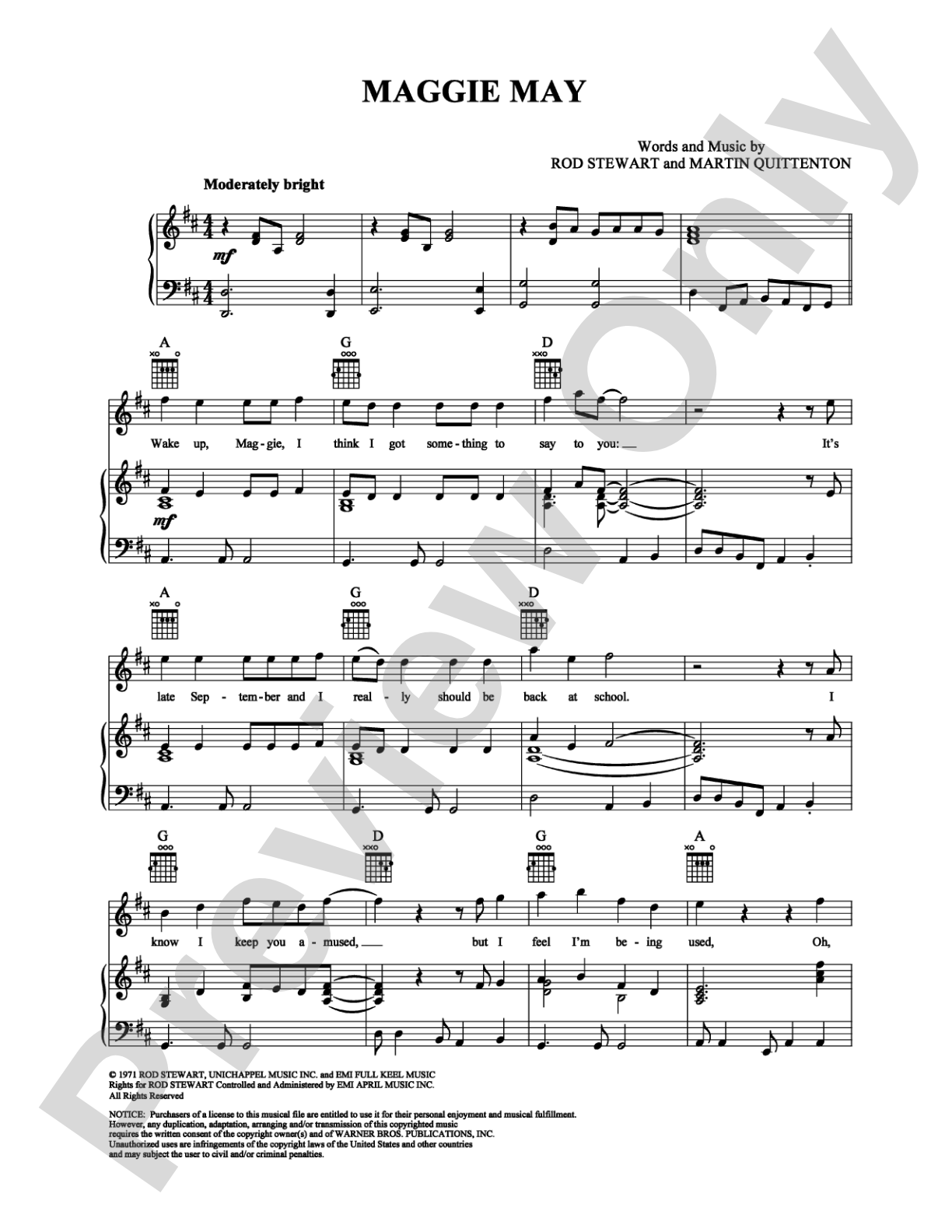
Maggie May: Piano/Vocal/Chords Digital Sheet Music

Maggie May: Piano/Vocal/Chords Digital Sheet Music

Rod Stewart, Martin Quittenton

Item: 00-PS-0005772

Digital Download
$3.99
Description

Maggie May: Piano/Vocal/Chords Digital Sheet Music isn't in MakeMusic Cloud just yet...but it could be. Let us know you'd like to see it, and you'll help shape what comes next. In the meantime, start a free trial and dive into thousands of interactive titles your students can play along with today.

Sample Audio
No sample audio found.
Sample Video
Additional Details
SKU: 00-PS-0005772

More about this title

About the Artist: Rod Stewart

Rod Stewart rose to prominence in the early 1970s with a distinctive raspy voice and an instinctive gift for melody. His work spans rock, soul, and folk influences, making him one of the most commercially successful recording artists of his era. Stewart's songs have become standards in popular music, recorded and performed across countless genres and contexts.

Why we love this

This is the kind of song students actually want to play and sing. The melody sits naturally in the voice, the chord progressions reward solid harmonic understanding, and the combination of accessible pop-rock groove with genuine emotional weight keeps performers engaged through repeated rehearsals.

What to expect

Nostalgic yet immediate, casual yet emotionally direct. The arrangement captures the warmth and intimacy of Stewart's original recording while leaving room for interpretation. You'll find yourself inhabiting the storytelling voice of the song rather than just playing through chord changes.

Who it's for

Pianists and vocalist duos, as well as singers working with piano accompaniment. This is ideal for intermediate performers who want to tackle a recognizable song with genuine musicality and contemporary relevance.

How to get the most out of it

  • Balance the vocal line so it sits clearly over the piano part without forcing; the song's charm lies in its conversational quality, not in belting.
  • Anchor the rhythm section feel by committing to a consistent groove in the left hand; the pocket here is more important than strict tempo changes.
  • Pay attention to the lyrical phrasing and let the punctuation guide your breath marks rather than forcing divisions on beat boundaries.

How to use it

Use this as a contemporary feature in a pop-rock showcase or as a recital closer that connects with audiences of many ages. The song works equally well as a solo vocal piece with piano accompaniment or as a duet, making it flexible for different performance settings.

Skills your students will build

  • Balancing vocal melody with instrumental accompaniment
  • Playing swing-influenced rhythms and groove-based chord voicings
  • Reading and interpreting slash chords and chord symbols accurately
  • Phrasing lyrics musically while maintaining harmonic support

You May Also Like