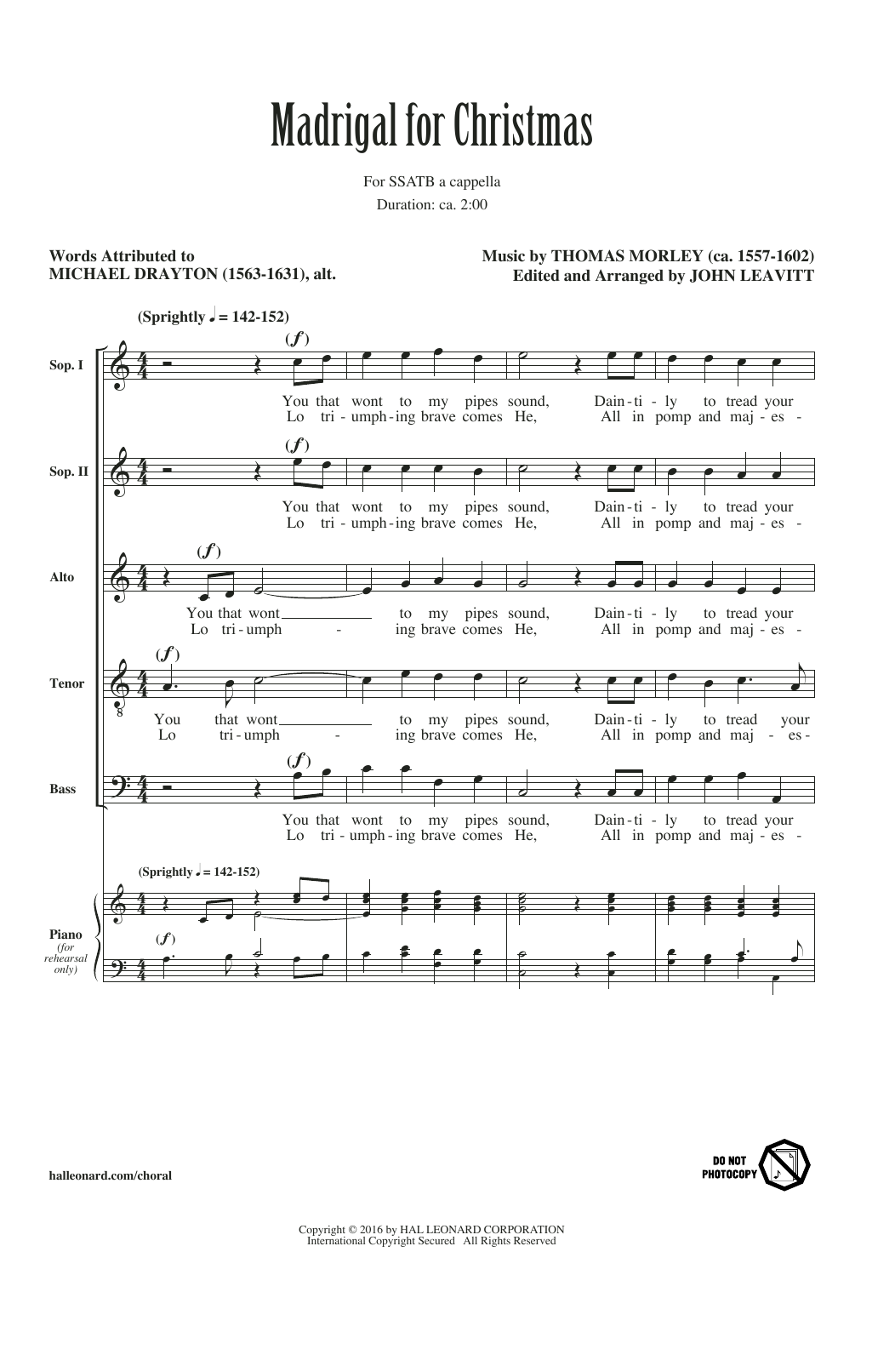
Madrigal For Christmas Sheet Music Preview

Madrigal For Christmas: SATB Choral Octavo

As performed by Thomas Morley / As performed by Michael Drayton / Arranged by John Leavitt

Item: 35-DS00393530

Digital Download
$2.50
Description

Madrigal For Christmas: SATB Choral Octavo isn't in MakeMusic Cloud just yet...but it could be. Let us know you'd like to see it, and you'll help shape what comes next. In the meantime, start a free trial and dive into thousands of interactive titles your students can play along with today.

Sample Audio
No sample audio found.
Sample Video
Additional Details
Publisher: Hal Leonard
Page Count: 6
SKU: 35-DS00393530

More about this title

About the Artist: Thomas Morley

Thomas Morley (1557-1602) was England's most celebrated composer of the late Renaissance, and his mastery of vocal writing defined the English madrigal tradition at its peak. His ability to set poetry with remarkable expressiveness and harmonic sophistication made him a model for generations of composers, and his influence extended far beyond his own era into the foundations of English choral writing.

Why we love this

John Leavitt's arrangement brings this Renaissance masterpiece into the modern choral repertoire without sacrificing the elegant counterpoint and poetic sensitivity that makes Morley's original so compelling. The holiday text transforms what is fundamentally a love song into something seasonally relevant, yet the arrangement respects the piece's inherent sophistication; this is not a dumbed-down setting. For choirs with solid musicianship, this offers the intellectual satisfaction of Renaissance polyphony paired with the accessibility of a cappella performance.

What to expect

The piece carries the grace and refinement of Renaissance vocal writing, with flowing lines that interweave like a musical conversation. There is elegance in its restraint and warmth in its harmonic movement; it feels intimate despite being designed for full ensemble.

Who it's for

This arrangement suits choirs that can handle part independence and harmonic listening. It works equally well for concert groups seeking shorter, sophisticated works and for holiday programs that want something beyond the standard seasonal fare.

How to get the most out of it

  • Shape the phrase endings with care; Morley's texts often benefit from subtle breath points that clarify the poetic meaning rather than dividing the music arbitrarily.
  • Balance the inner voices (alto and tenor) as if they are equally important soloists. The dialogue between these lines is where much of Morley's harmonic color lives.
  • Let the word-painting in the text guide your dynamic choices. Avoid a uniformly smooth approach; Renaissance madrigals were meant to respond emotionally to the words.
  • Approach the chromaticism with clarity and tuning precision. These moments should feel intentional and expressive, not accidental.

How to use it

Consider this as an alternative to more familiar holiday pieces in a concert setting, or use it as part of a thematic program exploring Renaissance music through the centuries. Its six pages make it an ideal addition to a longer choral work without overshadowing it.

Skills your students will build

  • Reading independent melodic lines in Renaissance polyphonic texture
  • Harmonic awareness and tuning in chromatic passages
  • Text expression and word-painting techniques
  • Part independence and ensemble listening in an a cappella setting
  • Interpretation of Renaissance musical style and phrasing

You May Also Like