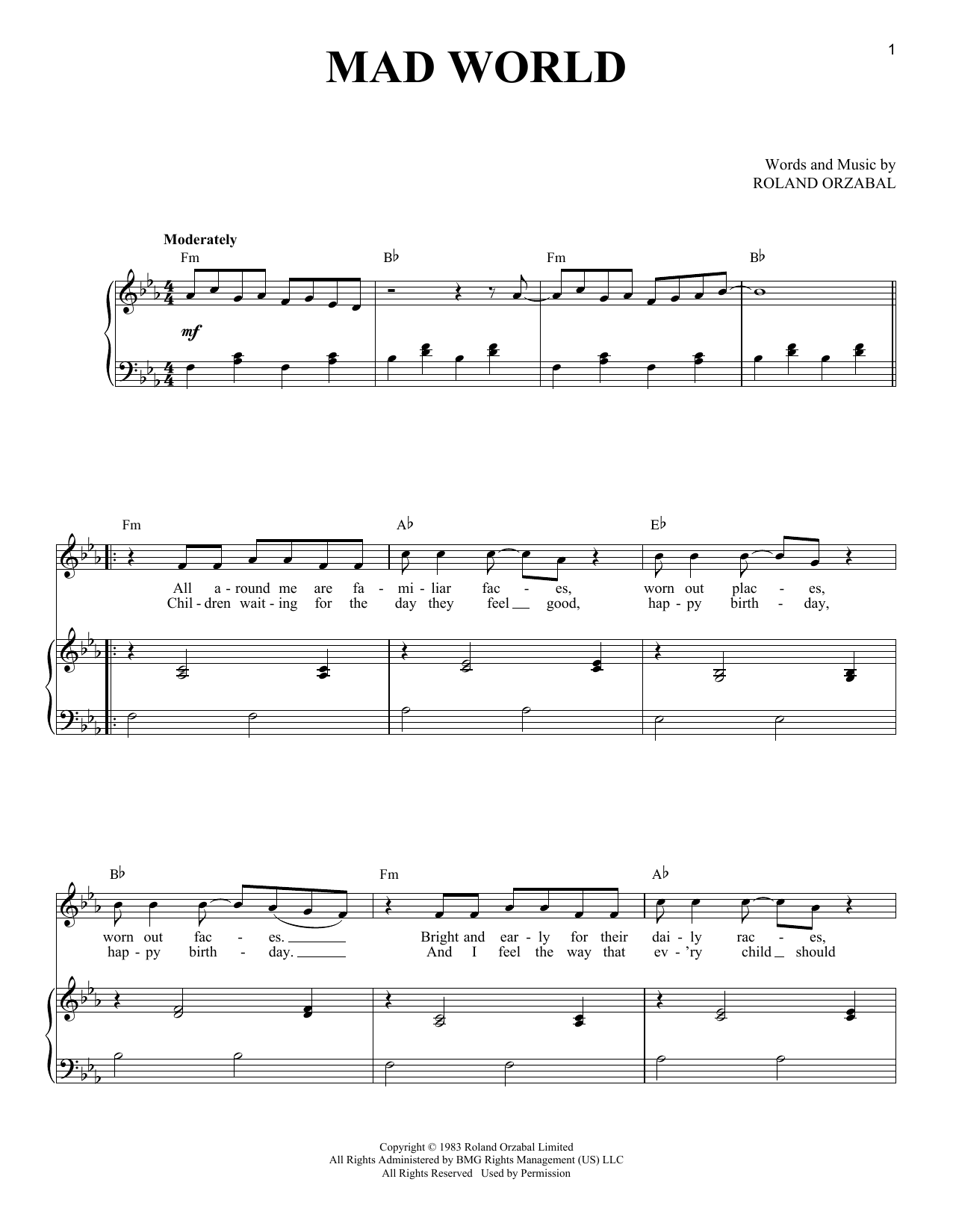
Mad World Sheet Music Preview

Mad World: Piano Vocal

As performed by Gary Jules / As performed by Tears For Fears / As performed by Adam Lambert

Item: 35-DS01444720

Digital Download
$5.99
Description

Mad World: Piano Vocal isn't in MakeMusic Cloud just yet...but it could be. Let us know you'd like to see it, and you'll help shape what comes next. In the meantime, start a free trial and dive into thousands of interactive titles your students can play along with today.

Sample Audio
No sample audio found.
Sample Video
Additional Details
Publisher: Hal Leonard
Page Count: 3
SKU: 35-DS01444720

More about this title

About the Artist: Gary Jules

Gary Jules earned widespread recognition for his haunting 2001 cover of Tears For Fears' "Mad World." His sparse, intimate arrangement transformed the original synth-pop track into something altogether more introspective, stripping away production layers to expose raw emotional vulnerability. The recording became a cultural touchstone, introduced to new generations through film and television, cementing Jules' distinctive approach to reinterpretation.

Why we love this

This arrangement opens doors for singers who respond to understated intensity over pyrotechnic vocals. The piano voicings create enough harmonic substance to hold student performers' attention while the melodic line remains singable across a wide range of ability levels. Programming it signals to your audience that you're interested in emotional authenticity, not just technical showmanship.

What to expect

The world tilts slightly sideways. Minor key simplicity meets genuine melancholy, the kind that feels both personal and universal. This is music for introspection, for quiet moments in larger concerts, for when a singer needs to make an audience lean in and listen.

Who it's for

Solo vocalists seeking material that showcases emotional depth without demanding extreme range or technical pyrotechnics. Pianists working with singers will appreciate the compact three-page format and accessible chord progressions that still feel sophisticated.

How to get the most out of it

  • Resist the urge to rush the tempo; let the minor key and sparse texture create their own gravitational pull.
  • Listen closely to the piano's movement in the verses; those subtle harmonic shifts need clarity and space to register with the listener.
  • Shape the vocal line around the lyrical phrasing rather than metric regularity, allowing the words to breathe.
  • Balance the vocal and piano so neither dominates; this is a conversation, not a spotlight moment.

How to use it

Place this in a set exploring contemporary reinterpretations of pop standards, pairing it with other stripped-down arrangements that value restraint. Alternatively, use it as a solo moment in a larger concert where contrasting moods matter; the piano-vocal texture will provide welcome relief from fuller orchestrations.

Skills your students will build

  • Interpreting minor key melodies with emotional nuance
  • Balancing vocal and piano parts dynamically
  • Managing phrasing independently of strict metric pulse
  • Reading and performing three-page piano/vocal scores

You May Also Like